
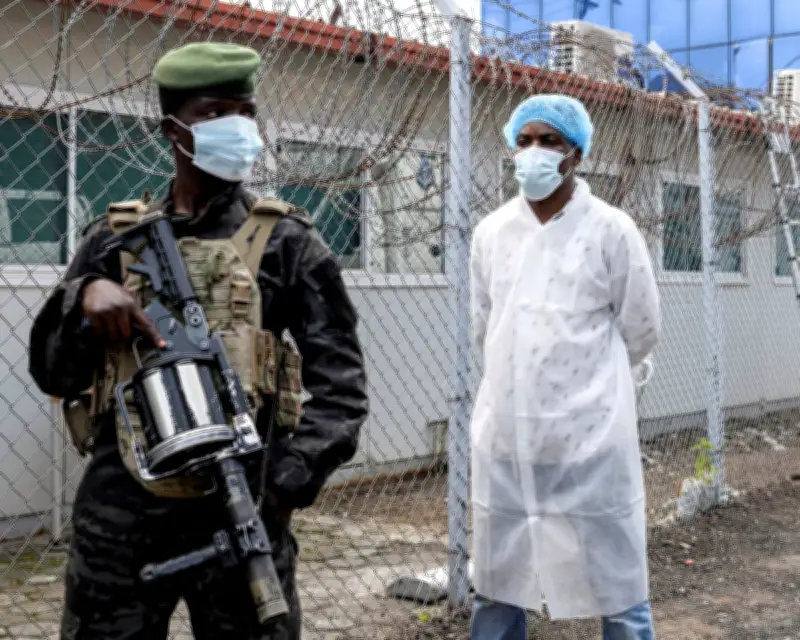
Seven American aid workers who had been in the Democratic Republic of the Congo (DRC) to combat the Ebola outbreak are now quarantining at a newly constructed isolation facility in Kenya, following the introduction of travel restrictions by the US government. Franklin Graham, president and CEO of Samaritan's Purse, the Christian aid group employing them, confirmed the development to Reuters.
First known quarantine at controversial facility
The aid workers are the first known individuals to quarantine at the facility, which has sparked significant opposition in Kenya and is the subject of a legal dispute. A Kenyan court had ordered the suspension of construction, but work continued, according to US officials and satellite imagery reviewed by Reuters.
The US government is building the 50-bed bio-isolation unit on an air force base in central Kenya for asymptomatic Americans exposed to the Ebola virus in the DRC or Uganda. Many Kenyans are angered by what they perceive as the US offloading health risks onto their country.
Background of the travel ban
Washington's new policy requires American citizens returning from the DRC, where an Ebola outbreak is ongoing, to spend three weeks in a third country before entering the United States. This measure aims to prevent potential spread of the virus.
Last month, Kenya's health minister announced an immediate halt to the facility's construction after being found in contempt of court for failing to observe an order to stop work pending a final ruling.
Details of the quarantine
“Samaritan's Purse has seven American Disaster Assistance Response Team staff members there,” Graham told Reuters. “None of them have any symptoms, but they are being quarantined by the Kenyan government for 21 days.”
A US State Department official said the asymptomatic Americans, who had served on the frontlines of the Ebola response, “voluntarily moved to the Kenya facility for precautionary monitoring and isolation.” The official added that Kenyan authorities authorized their movement under the observation of US public health service clinicians, taken “strictly out of an abundance of caution.”
Kenyan response and conditions
Kenyan health ministry officials did not immediately respond to requests for comment. A senior Kenyan foreign ministry official said they had no information on the move. Another source familiar with the matter, speaking anonymously, said the group arrived at the site in central Kenya on Monday and were sleeping in army cots in tents.
The source noted that some had treated Ebola patients at Samaritan's Purse treatment centers in Congo, while others performed construction work with no direct contact with the sick. “There is one potential high-risk exposure,” the source said, adding that their health was being monitored. Kenyan authorities are not allowing the group to leave the facility to travel elsewhere in the country.
Ebola and Samaritan's Purse role
The often fatal viral disease spreads through direct contact with bodily fluids from infected people or animals. Samaritan's Purse, an evangelical Christian group working in disaster zones worldwide, has been promised several million dollars from the Trump administration for the Ebola response. It is one of the largest foreign aid groups treating Ebola in Congo and has the most Americans there, collaborating closely with the World Health Organization to contain the outbreak. One of its US staff members who contracted Ebola earlier this month was transferred to a hospital in Germany on Monday.




