
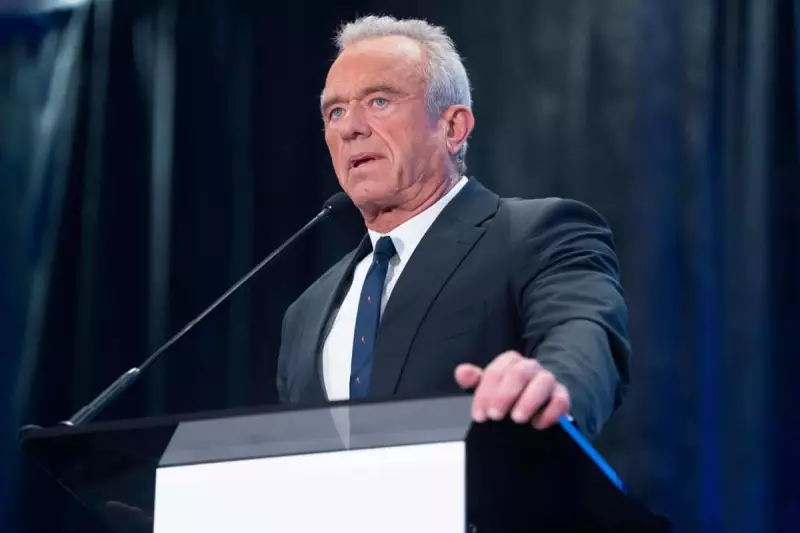
In a controversial move that has sent shockwaves through the medical community, US Health Secretary Robert F Kennedy Jr has personally instructed the nation's top public health agency to alter its long-standing position on the safety of childhood vaccines.
A Major Shift in Public Health Policy
Kennedy revealed in an interview with the New York Times that he directed the federal Centers for Disease Control and Prevention (CDC) to change its official stance regarding any potential link between vaccines and autism. The CDC's website has been updated to state: "The claim 'vaccines do not cause autism' is not an evidence-based claim because studies have not ruled out the possibility that infant vaccines cause autism."
This significant revision directly counters decades of scientific consensus and public health messaging. Kennedy acknowledged that large-scale epidemiological studies of the measles, mumps, and rubella (MMR) vaccine have found no connection to autism, and that research into the mercury-based preservative thimerosal has similarly shown no link. However, he insisted there remain gaps in vaccine safety science.
Scientific Community and Health Experts Respond
The website modification has been met with immediate and forceful criticism from public health experts, doctors, and scientists worldwide. They have decried the change as precisely the kind of misinformation the CDC has spent decades combating in its promotion of life-saving childhood immunisations.
In a powerful rebuttal, the Los Angeles county health department issued a statement asserting that "there is no new evidence to support" the CDC's updated language and that the modification is "not accurate."
The department's statement provided substantial counter-evidence, noting: "For more than 25 years, researchers around the world have rigorously examined whether vaccines cause autism. Over 40 high-quality studies involving more than 5.6 million children have found no link between any routine childhood vaccine and autism." This conclusion is supported by leading global health authorities including the American Academy of Pediatrics, the World Health Organization, and numerous research institutions.
The Broader Implications and Fallout
The Los Angeles health department further clarified that the documented increase in autism diagnoses reflects "improved screening, broader diagnostic criteria, and greater awareness – not a link to vaccines." The statement concluded with a warning about the real-world harm caused by such misinformation, noting that "the spread of this harmful myth stigmatizes members of the autism community and their families."
This development marks a dramatic departure from established public health policy and places the US health secretary at odds with the overwhelming majority of the international medical and scientific community. The controversy raises significant questions about the future of vaccine policy and public trust in health institutions.




