
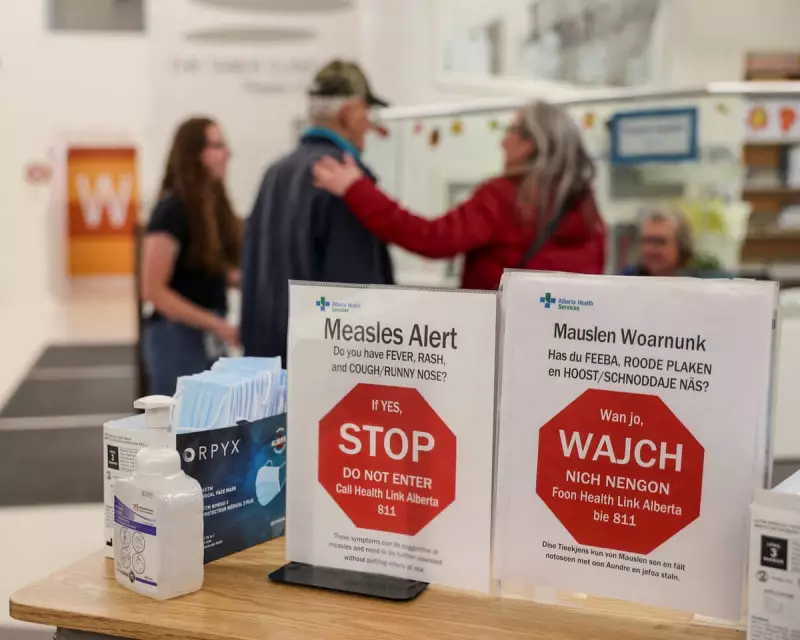
Canada's Measles Elimination Status Revoked After Year-Long Outbreaks
Canada has officially lost its measles-free status, international health authorities confirmed on Monday, marking a significant setback in the country's public health achievements. The decision comes after the highly contagious virus circulated continuously for more than twelve months, overwhelming healthcare systems and exposing gaps in childhood immunisation coverage.
The Alarming Statistics Behind the Status Loss
Canada has recorded 5,138 measles cases this year alone, with tragically two confirmed fatalities. Both deaths occurred in premature babies who had been exposed to the measles virus while still in the womb, highlighting the particular vulnerability of certain population groups.
The Pan American Health Organization, an independent health agency, made the determination after thoroughly analysing outbreak data that demonstrated uninterrupted transmission of the virus throughout Canadian communities for an entire year.
What Measles Elimination Really Means
Measles elimination represents a symbolic but hard-earned designation that countries achieve when they can demonstrate they've stopped the continuous spread of the virus within local communities. The status doesn't mean complete absence of cases, as occasional infections can still occur through international travel, but it confirms that local transmission chains have been broken.
Canada originally achieved measles elimination in 1998, with the United States following two years later. Through extensive vaccination campaigns, the entire Americas region became the first in the world to be declared measles-free in 2016. Health officials estimate that measles vaccination prevented approximately 6.2 million deaths across the Americas between 2000 and 2023.
Why Vaccination Rates Matter So Much
The critical threshold for measles vaccination coverage stands at 95% - a level necessary to establish herd immunity and prevent outbreaks from taking hold. Canada's immunisation rates have unfortunately slipped below this crucial percentage, leaving vulnerable populations exposed to the highly infectious disease.
Measles typically begins with high fever followed by a distinctive rash that starts on the face and neck. While most people recover, it remains one of the leading causes of death among young children globally according to the World Health Organization. Serious complications including blindness and brain swelling are more common in young children and adults over thirty.
Expert Reactions and Regional Context
Jennifer Nuzzo, an infectious disease expert at Brown University, described the development as "deeply disheartening, deeply worrisome, and frankly embarrassing." She emphasised that "no country with the amount of resources of Canada – or other countries in North America even – should lose their measles elimination status."
This isn't the first time the Americas region has faced this setback. Large outbreaks in Venezuela and Brazil during 2018 and 2019 previously cost the region its elimination status. The designation was reclaimed in 2024, but now ends again with Canada's loss.
Looking Forward: The Path to Reclaiming Elimination Status
Dr. Jarbas Barbosa, director of the Pan American Health Organization, reminded health officials that "as a region, we have eliminated measles twice. We can do it a third time." He acknowledged that stopping measles circulation in local communities has never been straightforward.
Canadian health officials have released a statement confirming they're working with government and community partners to improve vaccination coverage, enhance data sharing, and provide evidence-based guidance to healthcare providers and the public.
The situation serves as a stark reminder that public health achievements require constant vigilance and maintained investment in vaccination programmes to protect vulnerable populations from preventable diseases.




