
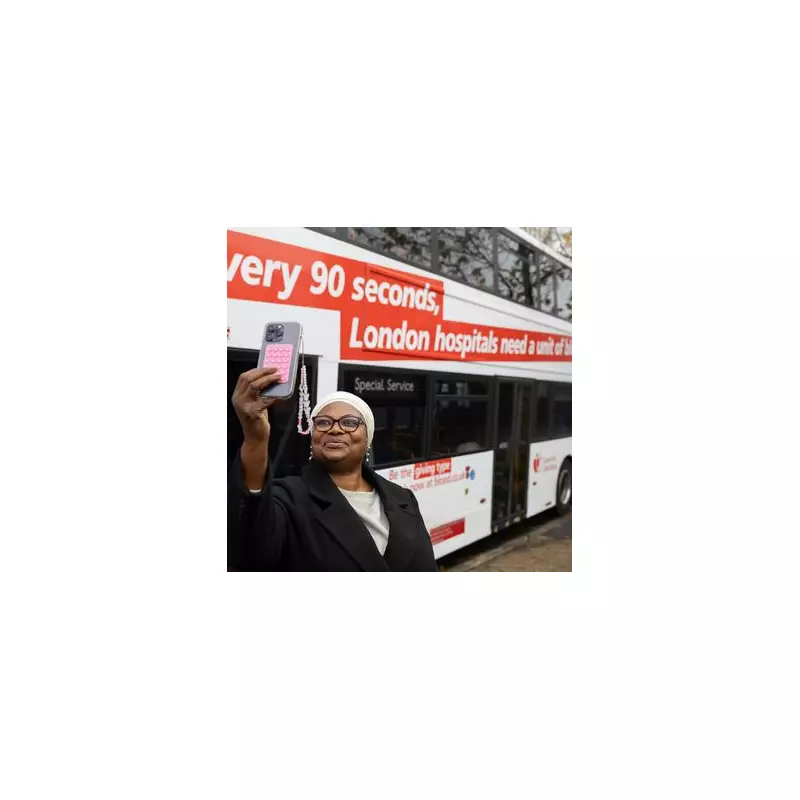
Viral TikTok sensation 'Bus Aunty' has launched an urgent appeal for 3,000 Londoners with a specific blood type to come forward and save lives this Christmas.
The social media star, real name Bemi Orojuogun, has partnered with City Hall and the NHS to address a critical shortage of blood donors from Black and ethnic minority communities in the capital.
Critical Shortage During Festive Season
There are currently 23,000 unfilled blood donation appointments in London over the next six weeks, representing a staggering 42 per cent of the national total.
NHS Blood and Transplant (NHSBT) specifically needs donors with the Ro blood subtype, which is essential for treating sickle cell patients. This inherited blood disorder disproportionately affects people of Black African and Black Caribbean heritage.
Alarmingly, there are 3,000 eligible Ro donors across London who haven't made a donation appointment in the past year.
Overcoming Community Hesitancy
Deputy Mayor for Communities and Social Justice, Dr Debbie Weekes-Bernard, joined the campaign aboard a specially wrapped double-decker bus travelling from Lambeth Road to Brixton Blood Donor Centre.
Dr Weekes-Bernard revealed she only became a donor two years ago and acknowledged significant hesitancy within BAME communities. "There's a lot of hesitancy within some communities because people are worried about how long it might take to give blood, perhaps about it being potentially quite painful," she told reporters.
She emphasised that ethnically matched blood can "transform and save lives", particularly for sickle cell, which she described as "one of the fastest growing genetic blood disorders" disproportionately impacting Black communities.
Social Media Stars Champion the Cause
'Bus Aunty', a former mental health nurse famous for her TikTok videos celebrating London's buses, made a direct appeal to minority communities. "Please don't be reluctant to give blood. You never know, your family, your relatives may even need blood one day," she urged.
Ms Orojuogun added: "Even if your blood doesn't match, somebody else may need your blood. Like for me, I have a very rare blood type, and for that, I'm happy to give today because somebody will need that blood."
Fellow campaigner and NHSBT ambassador Simply Sayo shared her personal tragedy, having lost two sisters to sickle cell. One sister died just months before her tenth birthday. "I've channelled that grief and turned it into advocacy," she explained.
The campaign aims to recruit 16,000 additional Black heritage blood donors over the next year to support the growing number of people living with sickle cell.
Political Support and NHS Urgency
Labour MPs have thrown their weight behind the initiative. Florence Eshalomi, MP for Vauxhall and Camberwell Green, revealed her late mother suffered from sickle cell anaemia and that she carries the sickle trait herself.
"It's so vital we get more Black Londoners coming forward to give blood. We really can make such a difference and you will save someone's life," she said, acknowledging that many people share her fear of injections but assuring that the process is quick and easy.
Bell Riberio-Addy, MP for Clapham and Brixton Hill, delivered a stark warning: "If our communities are not giving blood, more people will die."
She highlighted that sickle cell is now the fastest growing genetic disease in the UK, with the crucial Ro blood type found most predominantly in the Afro-Caribbean community.
Renata Gomes, Chief Scientific Officer at NHS Blood and Transplant, explained the particular challenge of the winter season: "It tends to be a lot with the cold that people stop going out, it's also the festive season so people start getting very busy with their celebrations."
She encouraged Londoners to "buy someone the gift of time" by visiting a donation centre during the Black Friday period, emphasising that London's diversity makes it particularly important for matched blood donations.
NHSBT data reveals the scale of London's need: one in every four blood donations used by the NHS in England last year went to London hospitals, equivalent to 921 lifesaving units every day, or one every 90 seconds.




