
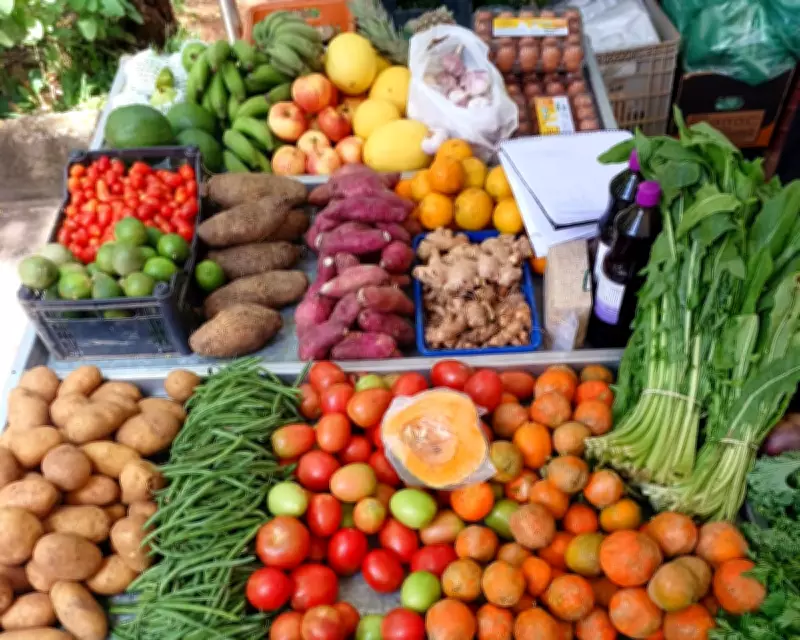
A fresh vegetable stall at one of the monthly food fairs attended by staff from the city’s hospitals, where they meet producers and arrange supply deals. Photograph: ECCCoUSP
Just what the doctor ordered: Brazil’s drive to ditch UPFs from hospital menus. Following the successful reduction of ultra-processed foods in schools, scientists and politicians hope to improve patient health with locally grown and freshly prepared meals.
Every month, a few dozen staff from some of São Paulo’s leading hospitals take time out of their busy schedules to visit food fairs where stallholders from more than 50 local farms display their produce. The aim is to strike deals that will supply the hospitals with organic vegetables, homemade bread and other locally made foods.
Started in October 2023, the fairs are part of a revolutionary scheme in São Paulo state to phase out ultra-processed foods (UPFs) from hospital menus in favour of healthier alternatives. “It’s not only cooks, nutritionists, meal planners and hospital management who attend the fairs but also nurses and doctors,” says Weruska Davi Barrios, a specialist in hospital nutrition at the University of São Paulo, the institution that has initiated the project.
These events represent an opportunity for hospitals to fill their order books for vegetables, fruits, herbs and spices, and also to sample artisanal delicacies made from lesser-known plant species unique to Brazil’s remarkably diverse ecosystem. Many of them have been threatened by the degradation of rainforests and saved by the farmers.
While Brazil’s hospitals have always attempted to use fresh vegetables and natural foods where possible, UPFs have increasingly worked their way into hospital menus in recent decades, despite accumulating evidence that they actively worsen health. One 2019 study estimated that 57,000 premature deaths in Brazil every year were being caused by UPFs.
As well as selling fruit, vegetables and spices, the food fairs give hospital staff a chance to sample foods made from plant species unique to Brazil. Photograph: Núcleo ECCCo USP
In the eyes of Ana Duran, an epidemiologist and associate professor at the University of Campinas, the availability of UPFs in hospitals is troubling. “We’re using our money from the national health system to buy ultra-processed foods,” she says. “It shouldn’t be something that we accept.”
Yet it’s also a complex problem to address. Transitioning to freshly grown foods requires building hospital kitchens, investing in cold storage, creating transportation networks to deliver the food from farms, and running educational programmes to explain the benefits to overworked staff and bemused patients. Some of this has already begun, but it remains a work in progress. “Change is gradual, and as more local foods become part of the purchasing plan, fewer ultra-processed foods will be needed to compose patients’ diets,” says Barrios.
The idea has now gained political backing in other states. Speaking at the recent Partnership for Healthy Cities conference held in Rio de Janeiro, Daniel Soranz, the secretary of health for Rio de Janeiro, said that the city is aiming to completely eliminate processed foods in all of its hospitals over the next eight years.
“From now on, we will hire people [to prepare on site], we will buy food – and as the contracts expire between hospitals and [outside contract] companies, we will replace with this new logic. In two years, 30% of our hospitals will no longer use ultra-processed food,” Soranz says.
Moujaddara, a dish of lentils and rice, served with hummus and beetroot at Hayek hospital in Sin El Fil, Lebanon. Photograph: Hayek Hospital
Such measures could soon be enshrined in federal law. A new bill prohibiting the offering of UPFs in hospital meals is working its way through the senate.
While hospitals in other countries, such as Hayek Hospital in Beirut, Lebanon, have replaced UPFs with a plant-based diet, this would represent one of the first examples of such a policy being implemented on a national scale. Doing so would require overcoming immense logistical challenges, quelling opposition from the food industry and winning over the public.
But there are reasons to be optimistic. Over the last few years, Brazil has already implemented one world-leading food policy, which is drastically reshaping the nutritional intake of the nation’s children.
Beginning in 2020, both federal and local governments progressively enforced increasingly stringent restrictions on the availability of UPFs in schools – a new law introduced last year requires 45% of school funding to be used for purchasing food from local farmers. As of 2026, UPFs must comprise no more than 10% of any school menu, while in Rio de Janeiro and the state of Ceará, their use has been completely banned.
A few years ago, the standard meals at EDI Gabriela Mistral primary school featured packaged cookies and bread, along with ready-made chocolate milk. Now, according to Marluce Fortunato, who coordinates the Brazilian National School Feeding Program (PNAE) in Rio, pupils are fed a mixture of rice and beans, fruit, oatmeal and homemade bread. “We have a vendor who comes and cooks the bread on site, and it’s served to the whole network of schools [in Rio],” says Fortunato.
As with hospitals, the move was not universally popular. Renata Couto, executive director of the Desiderata Institute, a non-profit dedicated to tackling child obesity in Brazil, describes conversations with school principals concerned about the costs and practicalities of storing fresh food for several days.
Laura Ribeiro, an educator at the EDI Gabriela Mistral School teaches students about the importance of nature, food and ecology. Photograph: EDI Gabriela Mistral
According to Duran, school cooks argued that children would refuse to eat anything that didn’t have the palatability and intense flavours they were accustomed to – an outcome the UK is currently grappling with as it tries to transition to healthier school meals. Surprisingly, the most intense opposition came from parents themselves, who were concerned that healthier school meals would create expectations of healthy food at home.
Duran’s explanation is that the marketing, easy availability and low cost of UPFs have seen them become entrenched in the minds of parents as an everyday solution. “We’ve heard a lot of mothers saying: ‘I don’t have time to cook and create meals,’” she says.
Couto believes that perceptions in Brazil that being overweight is a positive thing for child health are also playing a part. “Brazil has a recent history of hunger and malnutrition,” she says. “So while obesity is a major public health issue, people can’t see the urgency.”
But despite the pushback, there are already positive signs. Duran’s research suggests that children who attend schools that comply with the regulations are more likely to consume fewer UPFs overall, even at home. While it’s still too soon to know whether this is beginning to improve child health, Soranz says that officials in Rio will commence an initial assessment later this year.
Paula Johns of ACT Health Promotion. Photograph: ACT
According to Carlos Monteiro, the nutrition professor at the University of São Paulo who coined the term ultra-processed foods in the early 2000s, it has arisen out of necessity. Brazil was grappling with a rising tide of diet-related chronic diseases, with a study revealing that the numbers of overweight five- to nine-year-olds had risen from 13.4% in 1989 to 33.4% in 2008.
“My colleagues and I were observing this transformation in real time and trying to make sense of what traditional nutrient-based approaches could not fully explain,” says Monteiro.
Paula Johns, co-founder and director of the Rio-based non-profit ACT Health Promotion, believes that more can be done to reduce the consumption of UPFs among the Brazilian population. In particular she would like to restrict their marketing, but implementing this would be highly politically challenging as it would have an impact on the profits of many industries – television networks, advertising agencies and newspapers all receive a considerable portion of their income from food adverts.
“It’s a huge market,” Johns says. “No one’s advertising broccoli. Our ambition would be for any ultra-processed food to have marketing restrictions – that would be our gold standard. But it would require a very strong parliamentarian [to get such a bill passed] – a powerful one that has a lot of influence in congress. So far we haven’t really found a champion that could take it.”
Instead Johns and others are hoping to further limit the exposure of children to UPFs through other means. Couto’s organisation is attempting to force through a law in Niterói, a municipality adjacent to Rio, which would prohibit any UPFs from being exhibited on supermarket shelves below a height of 1.5 metres.
It’s time to stop the great food heist powered by big business. That means taxation, regulation and healthy school meals | Stuart Gillespie
“They are always at children’s eye level, and there’s a reason for that,” she says. “To create a healthy food environment, we have to push back against all of this manipulation. Why don’t they expose fresh fruit in these shelves?”
As with Brazil’s schools and now hospitals, she is not anticipating that it will be easy, but she believes it’s another step which can make a big difference to public health.
“We’re starting in Niterói because it’s a small city,” she says. “And then if we can get it approved, we can move to Rio, and say: ‘How come the capital of the state hasn’t approved this yet?’ Politicians and governors have pride – they want to keep up with the latest policies. Vanity is something that we have to use.”




