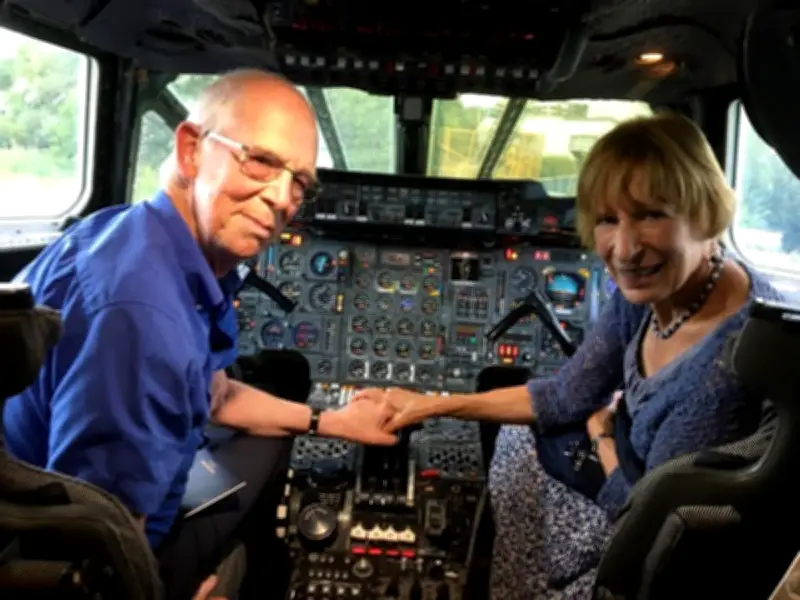
Four months ago, Richard Cyster's life changed forever when his wife Margaret collapsed without warning from a brain haemorrhage. She died six days later, aged 76.
Collapse without warning
Richard and Margaret met at a local book club in 2007 and married in 2010. In February 2026, Richard got up to make tea. As he returned to bed, he heard a loud bang. He rushed downstairs to find Margaret collapsed on the floor.
Margaret was rushed to hospital, where doctors discovered a catastrophic subarachnoid haemorrhage — a major bleed on the brain. She spent six days in hospital surrounded by family but never fully recovered. She passed away on February 13.
No prior signs
"There were no warning signs," Richard told MyLondon. "Earlier in the week, she had even gone to a ballet class, attended two bridge clubs, and was making plans as normal. We were enjoying our retirement, spending time together and looking forward to the future. When something like that happens completely out of the blue, your entire world changes in a matter of moments."
Richard, originally from Putney, lived with Margaret in Harrogate. He described her as a "strong character" who would always stand up to him. "[Her death] came out of nowhere," he added. "That's what made it difficult to come to terms with. I still talk to her, accusing her of hiding things when I can't find them."
Preparation eased the process
Years before her death, Margaret and Richard had discussed end-of-life wishes. They prepared detailed advance decisions about treatments and funeral arrangements. Richard was able to honour her wishes, including what treatments she wanted or didn't want.
Before she passed, Richard suggested a "pre-death wake" to celebrate Margaret while she was still alive. "When I first suggested it, people were appalled, but even the palliative care team made the same suggestion," he said. "We played her favourite music, brought a bottle of wine, and we had our own party. When people are nearing the end of their palliative care, they're usually given a sponge to moisten their lips with water. This time, I decided to dip it into her white wine because I thought she should take part as well."
Counselling experience didn't prepare him
Richard worked as a grief counsellor and volunteered at a local hospice for 10 years, supporting bereaved people. He also established a course called Going Gently to help people prepare for death, wills, power of attorney, funerals and end-of-life decisions. Despite his experience, the sudden death of his wife was something he was not prepared for.
"I know the theory but the practice is so much different. You can't counsel yourself," he said. "Now, I've returned to the people I used to volunteer with for my own counselling needs. You can't talk yourself in or out of something; you have to get help."
"Death is the one thing that unites us all, and I don't think we should skirt around it. [Her dying was hard,] but it was made easier because I knew what she wanted. She needed to be kept comfortable till nature took its course. Working as a counsellor, one of the things that made grief worse for my clients was the fact that there'd be no preparation, and no one had talked about it before it happened."
Life after loss
Richard now has someone move in who brought a dog, making the four-bedroom house he shared with Margaret less lonely and "more comforting". He is part of The Widowed Collective, a community interest company for anyone who has lost a life partner. For International Widows Day (June 23), Richard and The Widowed Collective launched the #WidowedAndForgotten campaign to highlight the isolation and loneliness many widows and widowers experience.