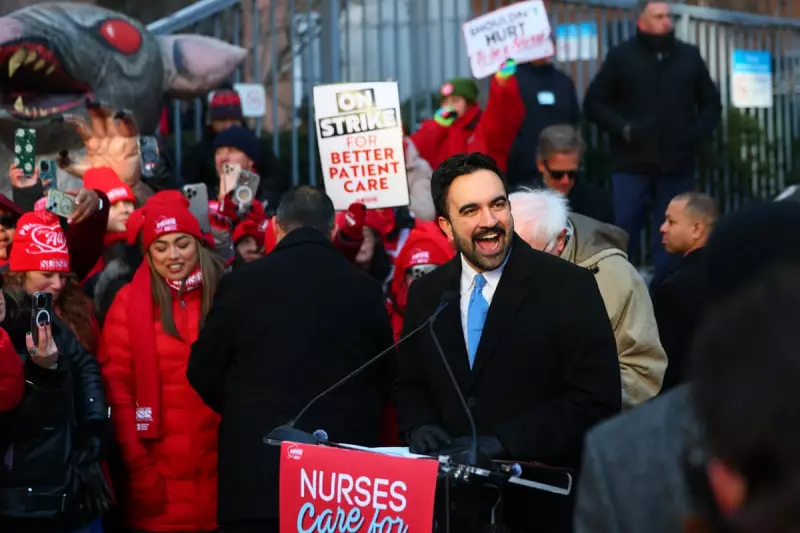
In the biting cold of a New York City winter, with temperatures plunging towards 19°F (-7°C), thousands of nurses have braved the elements to maintain picket lines in what has become the largest nurses strike in the city's history. The industrial action, which began on 12 January 2026, involves nearly 15,000 nurses from three major hospital systems: Mount Sinai, Montefiore, and NewYork-Presbyterian. Their demands centre on increased staffing levels, enhanced safety measures within hospitals, and improved healthcare benefits, highlighting a stark contrast with the multi-million dollar salaries of hospital CEOs.
Political Figures Rally Behind Striking Nurses
The strike has garnered significant political backing, most notably from New York City Mayor Zohran Mamdani and Vermont Senator Bernie Sanders, both of whom joined the picket line outside Mount Sinai West on Tuesday 20 January. In a powerful show of solidarity, Mamdani emphasised that strikes are a last resort for workers, stating, "This is about safe working conditions. This is about a fair contract. This is about dignity." He added, "What this is in fact about is recognizing the worth of each and every nurse in this city."
Senator Bernie Sanders echoed these sentiments, criticising the healthcare industry's greed. "The people of this country are sick and tired of the greed of the healthcare industry," Sanders declared. "Don’t tell me you can’t provide a good nurse-staff ratio when you’re paying your CEO at NewYork-Presbyterian $26m a year, the CEO at Montefiore $16m a year, Mount Sinai $5m a year."
Nurses' Perspectives on the Strike
Cecilia Barreto, a nurse at Mount Sinai with two years of experience, described the rally as "a pretty awe inspiring moment." She reflected, "Bernie Sanders is a big union champion. So to have learned about his life’s work in school, and then to see him standing 15ft away from me, was an amazing experience. And to also see somebody like Mayor Mamdani come and support us since day one of the strike has been really, really inspiring."
Aretha Morgan, a nurse at NewYork-Presbyterian with 34 years of practice, highlighted the critical safety issues driving the strike. "I’m one of countless nurses who are struggling, exhausted and increasingly afraid to come to work – the main reason is the safety in our hospitals," Morgan explained. "We’re on strike because of the lack of safety. We have staffing shortages, and we have increased unprecedented levels of workplace violence."
Hospital Responses and Negotiations
The hospitals have responded by hiring thousands of temporary nurses at a cost of millions of dollars, a move Barreto called "very disappointing." She noted, "It’s incredibly disheartening to have the hospitals be stalling on this because at the end of the day, striking is a last resort, and we want to be at the bedside. We want to be taking care of the patients."
Mount Sinai has accused the union of making "extreme economic demands," while Montefiore labelled them "reckless demands." The hospitals claim that union-registered nurses earn average salaries of $165,000 at Montefiore, $162,000 at Mount Sinai, and $163,000 at NewYork-Presbyterian’s Columbia University Irving medical center. They argue that the union's proposals would raise these averages to $220,000 and $275,000 over three years, respectively.
Safety Concerns and Incidents
Nurses are also advocating for better security measures, citing recent violent incidents. The New York State Nurses Association (NYSNA) pointed to a November event where a man allegedly threatened to "shoot up" a Mount Sinai hospital before being killed by police. In early January, another man allegedly threatened staff with a sharp object in a Brooklyn hospital before barricading himself and being shot by police.
Morgan emphasised the urgency of these issues, stating, "The hospitals are attempting to tarnish our reputation as a respected profession, they are trying to portray us as being unreasonable and demanding, when in reality, we are just fighting for safe staffing, safe environments and the basic resources required to protect our patients." She urged, "They need to come to the table in good faith, and let’s talk about it, and let us get this done."
Negotiations between the NYSNA and hospital representatives were scheduled to resume on Thursday, following urging from Mayor Mamdani and New York Governor Kathy Hochul. As the strike enters its second week amidst frigid conditions, the resolve of the nurses remains strong, backed by high-profile political support and a clear focus on fundamental workplace improvements.