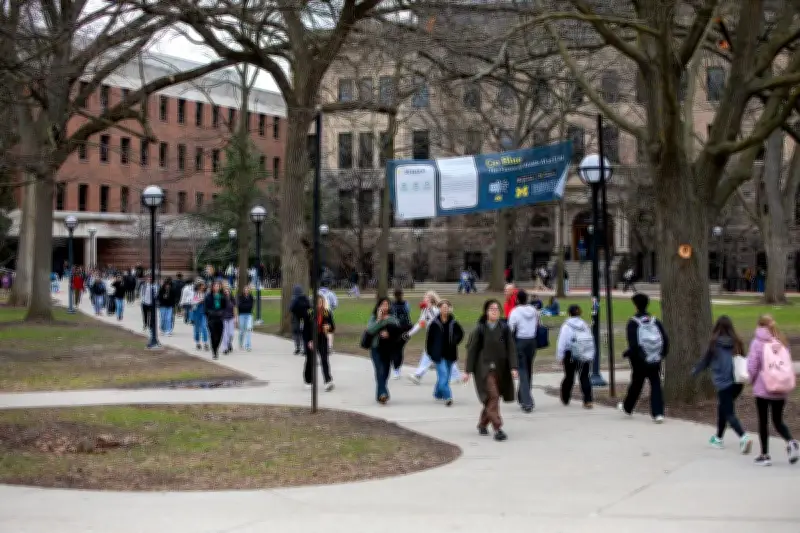
The University of Michigan will replace letter grades with a pass-or-fail system for first-semester students in its College of Literature, Science and the Arts (LSA), a move aimed at addressing rising mental health issues among college students. The pilot program, announced on Tuesday, is designed to help new students transition to college life and reduce academic competition.
Pass/Fail Pilot Program Details
Under the new scheme, transcripts for first-semester LSA students will show either “pass” or “no credit” instead of traditional letter grades. The university stated that the goal is to “help first-year students acclimate to the demands of college and allow intrinsic motivations to guide personally meaningful academic journeys” while fostering “a culture of connection and collaboration – rather than competition.”
The decision follows a national mental health study published last year that surveyed students across 135 US colleges and universities. The 2024-2025 Healthy Minds Study found that symptoms of severe depression had dropped to 18% from 23% in 2022, and suicidal ideation had fallen to 11% from 15% over the same period, suggesting that reducing academic pressure may have positive effects.
University Leaders and Faculty Support
Rosario Ceballo, dean of the University of Michigan, told the University Record that the move “has the potential to not only address the alarming rates of stress, depression and anxiety among our students, but to deliver on our core promise as a liberal arts and sciences college.” Timothy McKay, LSA associate dean for undergraduate education, added that the program “would provide LSA students with a smooth on-ramp as they accelerate from high school into a rigorous college education; a chance to refine their academic skills and build early momentum.”
The university is not alone in this approach. According to the Wall Street Journal, other institutions including the California Institute of Technology, Swarthmore College, Wellesley College, and the Massachusetts Institute of Technology are also offering similar grade-covering initiatives.
Broader Context of Academic Standards
The changes at Michigan come amid wider debates about grading and academic preparedness. In May, Harvard faculty voted to cap A grades at roughly 20% to combat grade inflation, which they said degrades the value of top-tier academic achievement. Meanwhile, in June, math and science professors at the University of California called on regents to reinstate college-entrance exams, citing “severe preparation deficits” among students taking first-semester calculus at UC Berkeley.
“Basic mathematical fluency is analogous to literacy; without it, success in university-level Stem becomes structurally unattainable for students,” they wrote in an open letter. The University of California San Diego found that the percentage of students needing remedial math before precalculus increased to 8.5% in 2025 from 0.5% in 2020. The professors added: “We now observe preparation gaps so severe that instructors must reteach middle-school mathematics while simultaneously teaching the material students need for sciences, engineering, economics and other quantitatively demanding fields.”
Kenneth Lowande, a former University of Michigan political science professor, expressed skepticism about the policy, telling the Journal, “Grades have lost their value as an indication of quality or excellence.” The pilot program at Michigan will be closely watched to see if it achieves its intended mental health benefits without compromising academic standards.