
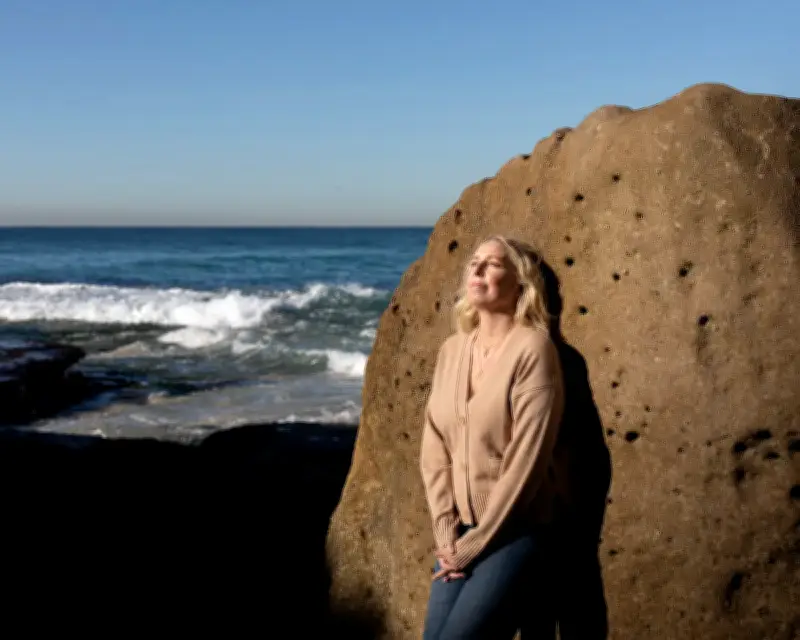
Ten years after her husband Matt died in a surfing accident at Tamarama beach in Sydney, author Hannah Richell has shared her deeply personal journey through grief, detailing the immediate aftermath, the long process of acceptance, and the enduring nature of loss. In an edited extract from her new book, An Ocean and a Day, Richell recounts the day police arrived at her door, the agonizing hours at the morgue, and the slow, painful path toward finding a new way to live.
The Day That Changed Everything
It was an ordinary Wednesday afternoon in July 2014 when two plainclothes police officers knocked on Richell's front door. She was not home, but received a call from her husband's PA, who had been contacted by a Bondi detective. Richell rushed home, where the officers delivered the news: Matt had been in a surfing accident and had died.
At the morgue, Richell spent what she describes as “the longest, shortest, most loving, most painful hour of my life” with her husband's body. She noticed the cuts on his face and the stitches from the autopsy, and held his hand, feeling grains of Tamarama sand fall from his palm into hers. “They feel like a last gift: a piece of the country he loved so deeply,” she wrote.
Finding Solace in Grief Counseling
In the days that followed, Richell met with Adam, the friend who had been surfing with Matt. Adam recounted the accident: shifting tide conditions, Matt's board coming loose, and a rip pulling him dangerously close to the rocky headland. Richell also sought counseling from Wendy, a forensic counsellor, who provided a safe space to explore her grief. “There is never any judgment, only compassion and a kind ear,” Richell wrote.
Richell describes grief as “a sinkhole, opening up where real life once stood.” She struggled with the fear and exhaustion of single parenting, and found it difficult to return to her novel. A friend suggested creating “memory jars” with her children to help them access happy memories of their father. Her daughter remembered “swooping and giggling with her dad on the round saucer swing in the park,” while her son recalled “curling into the crook of Matt's arm when he read him a bedtime story.”
The Inquest and the Search for Acceptance
Nearly two years later, Wendy informed Richell that an inquest would be held into Matt's death, as it was deemed to be “in the public interest” due to its high-profile nature and location. Richell attended the two-day proceedings, where the chain of events leading to Matt's death was relayed. She later reflected that acceptance is not about rightness, but about “allowing it to be, whatever it is. A letting go of the need for things to be different.”
Richell eventually sold the family home and moved on, but she emphasizes that grief never truly leaves. “I know now that grief will never leave me. It will always be a part of me, just like the love it stems from,” she writes. The shift, she says, comes in wanting to embrace it, and in that embrace, grief has shifted “from something ugly and unthinkable to something softer, more akin to love than pain.”
Richell's book, An Ocean and a Day, is published by Bedford Square at £16.99. Her message to others who have experienced loss is one of hope: “You will survive your greatest loss. You will be altered, but you will survive.”




