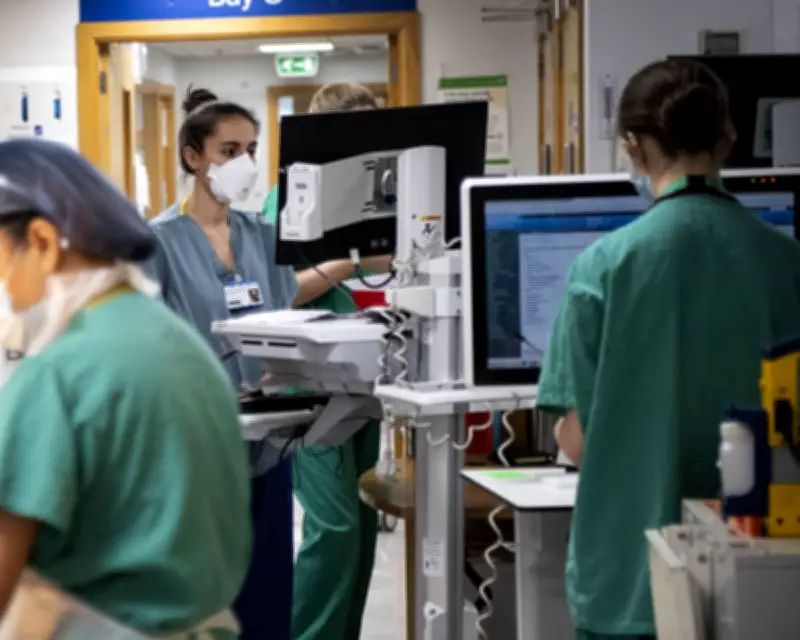
The compassion and empathy of the nurses saved me. Photograph: Victoria Jones/PA
Letters: Emergency medicine is in crisis – why is this allowed to continue? Dr Carole Gavin says if the government fails to act it will bear the responsibility for yet more avoidable deaths, while Sarah Brown describes her mother’s experience.
A&E crisis: a consultant's perspective
The experience of working in A&E described by Sophie (Patients are dying in A&E corridors – but I’ve seen how things could be different, 11 June) will be familiar to every member of staff working in a UK emergency department. Not only are patients dying on our corridors with no privacy or dignity due to lack of space and hospital beds, but we know that many more will die later as a consequence of their prolonged emergency department stay (More than 1,300 deaths a month in England due to long A&E waits, figures suggest, 8 June).
I have been an emergency physician for more than 30 years during which time the advances in emergency medicine have been life changing, with acute interventions for once untreatable conditions such as stroke and heart attacks now routinely available. Unfortunately despite all of the advances in medical science, in England in 2026, we are now unable to provide even the most basic, humane emergency care. The government appears to be prepared to accept these deaths and when we repeatedly try to raise the alarm we are told NHS performance is improving as there are fewer patients waiting in A&E for more than four hours. However those are the well patients who will go home, while the seriously ill patients wait for up to 48 hours for admission to a bed – something that would have been unimaginable a few years ago. I am amazed on a daily basis by the resilience of the patients and staff in the face of this disaster, but fail to comprehend why this national crisis is allowed to continue.
Of course the solutions will not be easy and will require significant investment; however if the government fails to act it will bear the responsibility and shame for yet more avoidable deaths that I and my colleagues will continue to witness on a daily basis while our protests fall on deaf ears.
Dr Carole Gavin
Consultant emergency physician, Manchester
A family's ordeal
Thank you, Sophie, for raising this issue. A year ago this week, my mum, who was dying, spent seven hours in A&E, in two “side rooms”. The first was the size of a store cupboard with a harsh fluorescent light shining down on her, a thin curtain separated her from the building works happening down the corridor. The sound of drills and hammers and builders shouts, haunts me to this day. The second side room was no better. This had a door but it couldn’t be closed because of the stench of urine and vomit from the previous occupant. However, the compassion and empathy of the nurses saved me. When I begged for mum to be moved – she was waiting for a bed in palliative care – one nurse, visibly distressed by being unable to solve the issue, went down on her knees (amid the remains of vomit) and apologised to me. I found this hugely moving and in the midst of this hellscape, my heart went out to this person, battling to improve a nightmare.
Sarah Brown
York
Explore more on these topics: A&E, NHS, Health, Hospitals, letters