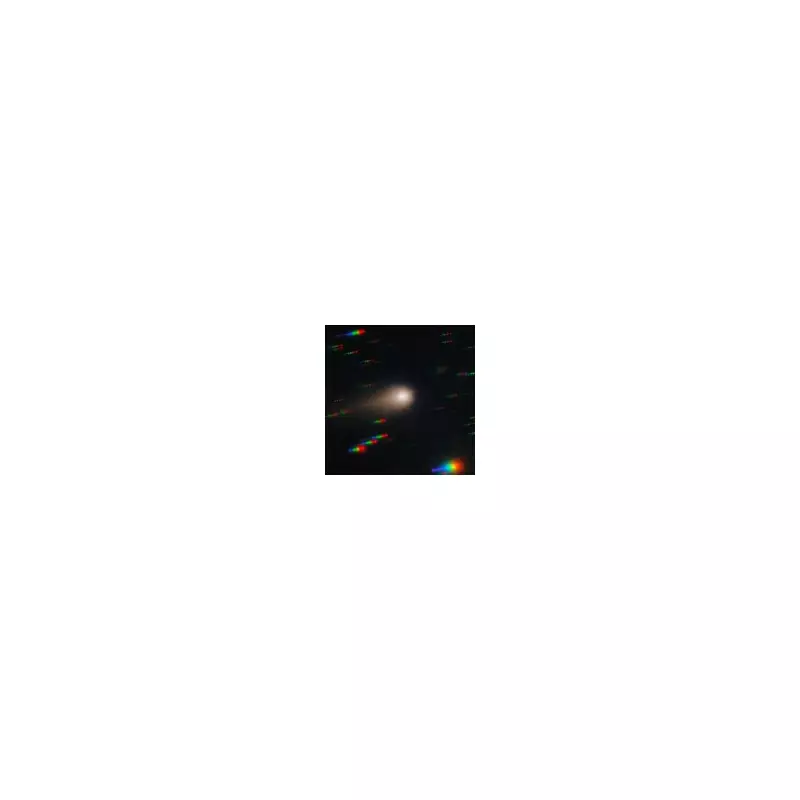
NASA has broken its three-month silence with spectacular new close-up images of the interstellar comet 3I/ATLAS, directly addressing widespread speculation that the mysterious object might be an alien spacecraft.
The space agency's officials presented the images during a briefing at the Goddard Space Flight Center in Greenbelt, Maryland, at 3pm local time on November 19, 2025. They explained that the delay in releasing new photographs was caused by a months-long US government shutdown that paralysed federal agencies including NASA.
What Makes 3I/ATLAS Special?
3I/ATLAS represents only the third interstellar object ever detected from Earth, having first been spotted in July by the NASA-funded Asteroid Terrestrial-impact Last Alert System. This project typically monitors space rocks that could potentially collide with our planet.
Unlike most comets that originate from our solar system's formation, this cosmic traveller comes from another star system entirely. Scientists estimate the interstellar visitor measures approximately seven miles wide and is travelling at a staggering 130,000 miles per hour relative to the sun.
"This comet has possibly been travelling through the cosmos for billions of years," NASA revealed, noting that even if it came from our closest stellar neighbour, Proxima Centauri, it would have journeyed nearly six million miles to reach us.
The Alien Spacecraft Controversy
The comet's unusual characteristics have fuelled intense speculation among conspiracy theorists and scientists alike. Previous observations showed the object behaving strangely, including periods when it appeared to lack a tail and displayed unusual colour variations.
Recent images have captured jets—eruptions of gas from beneath the comet's surface as it warms approaching the sun. This phenomenon prompted Harvard astrophysicist Avi Loeb to question whether these were natural occurrences or something more extraordinary.
"Is the network of jets associated with pockets of ice on the surface of a natural cometary nucleus, or are they coming from a set of jet thrusters used for navigation of a spacecraft?" Dr Loeb previously told Metro. "We do not know. For now, let us enjoy the view. After all, a picture is worth a thousand words."
However, Dr Matthew Genge from Imperial College London's Department of Earth Science and Engineering offered a more conventional explanation. "Apart from it being an interstellar object, there is nothing particularly unusual about 3I/Atlas," he stated. "Recent observations of jets have been suggested to be 'thrusters', however, many comets generate jets naturally through rapid degassing of deposits of particularly volatile ices on their surface."
How to Spot the Interstellar Visitor
For those wanting to see the comet with their own eyes, towards the end of November, 3I/ATLAS will become visible again around 6am, just before sunrise, through amateur telescopes. Current positioning places it roughly to the southeast of Venus.
The comet is currently about 190 million miles away and will make its closest approach to Earth on December 19, though it will remain at nearly twice the distance of the sun from our planet. Its final major solar system encounter will be a drive-by visit of Jupiter on March 16, 2026, after which it will likely disappear forever into the depths of space.
As time progresses, the comet's separation from the sun will widen, making it visible earlier in the night for astronomy enthusiasts hoping to catch a glimpse of this rare interstellar visitor before it's gone forever.