Cosmic Breakthrough in Dark Matter Hunt
Astrophysicists may have achieved a landmark discovery in the century-long search for dark matter, with new research claiming to provide the first direct evidence of the elusive substance that makes up more than a quarter of our universe. Professor Tomonori Totani from the University of Tokyo has identified a pattern of gamma rays emanating from the heart of our galaxy that appears to match the predicted signature of dark matter annihilation.
The Galactic Signal That Could Change Everything
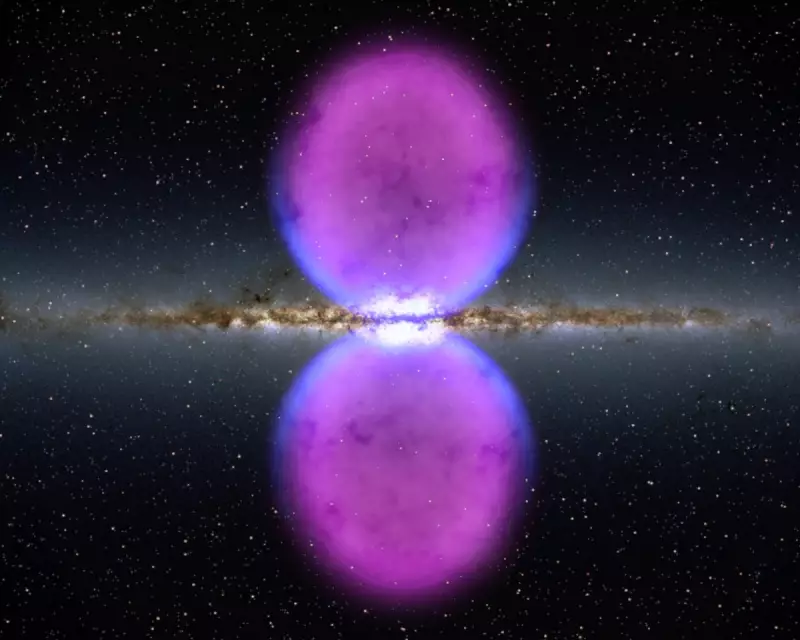
Using data from NASA's Fermi Gamma-ray Space Telescope, Professor Totani detected high-energy photons that closely correspond to the spherical shape of the theoretical dark matter halo surrounding the Milky Way's centre. "This could be a crucial breakthrough in unravelling the nature of dark matter," Totani stated, noting that the radiation pattern matches predictions for what should be emitted when dark matter particles collide and annihilate each other.
The research, published in the Journal of Cosmology and Astroparticle Physics, suggests that if the signal indeed comes from dark matter, it would be composed of elementary particles approximately 500 times more massive than protons. This finding builds upon work dating back to the 1930s, when Swiss astronomer Fritz Zwicky first proposed the existence of invisible matter to explain why distant galaxies rotated faster than their visible mass should allow.
Scientific Caution and Next Steps
While the potential discovery represents what could be a turning point in astrophysics, the scientific community is urging caution. Professor Justin Read from the University of Surrey pointed out that the absence of similar signals from dwarf galaxies raises questions about the dark matter interpretation. Similarly, Professor Kinwah Wu at UCL emphasised that "extraordinary evidence" is required for such an extraordinary claim.
Professor Totani acknowledges that more work is needed to rule out other astrophysical processes and background emissions. The decisive factor, he suggests, will be whether the same gamma-ray spectrum can be detected from other regions of space, particularly dwarf galaxies known to contain high concentrations of dark matter.
The decades-long search for dark matter has involved ground-based detectors, space telescopes, and massive experiments like the Large Hadron Collider near Geneva, all of which have so far failed to provide conclusive evidence. This new approach analysing gamma-ray patterns offers a fresh pathway toward solving one of cosmology's most enduring mysteries.