
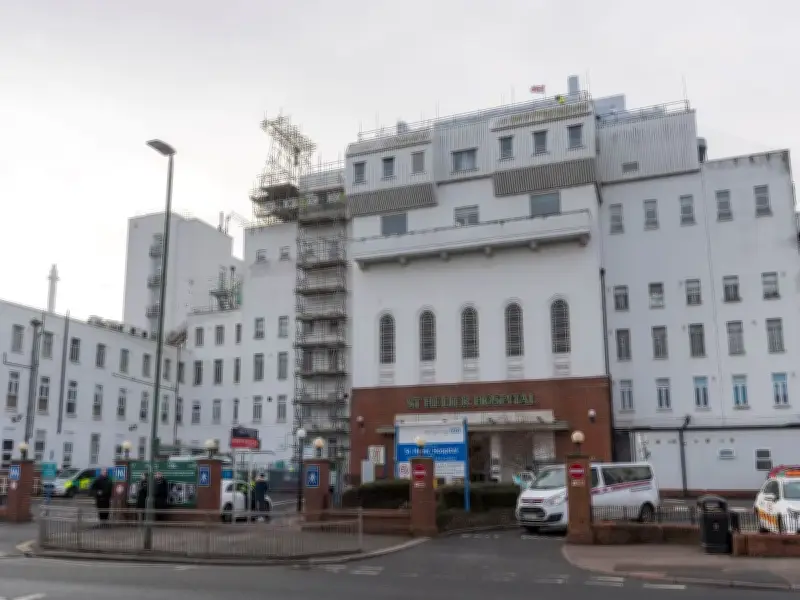
St Helier Hospital in South London is facing a growing maintenance crisis, with spending on repairs rising every year and a backlog now estimated at £142.1 million, according to figures obtained by the Local Democracy Reporting Service (LDRS) through a Freedom of Information request. The hospital, which first opened in 1941 and is nearly 90 years old, spent £505,537 on patch-up jobs in the first three months of 2026 alone, as local councils warn parts of the ageing site are “literally falling to pieces.”
Maintenance spending surges by 73% since 2023
Annual repair costs at St Helier have climbed sharply in recent years. Maintenance spending soared by 73 per cent to £1.75 million in 2023, and the higher level of spending has continued, reaching £1.79 million in 2024 and £1.88 million in 2025. The hospital has spent more than £7.9 million on day-to-day property maintenance since 2021.
Analysis of the figures shows the biggest driver of the increase was spending on building and engineering equipment repairs, which more than doubled from £275,783 in 2022 to £729,576 in 2023. Spending on building materials also rose by more than 50 per cent to £362,338 in 2023.
Trust cites ageing estate, delays in national funding
Epsom and St Helier NHS Trust officials said they could not identify any single incident or factor behind the sharp rise in spending, instead attributing it to the growing cost of maintaining the ageing estate. A Trust spokesperson told the LDRS: “St Helier is older than the NHS itself and our crumbling estate is deteriorating faster than we can repair it, despite spending £60 million in the past five years.”
The spokesperson also criticised delays to long-term national funding, saying they had left local healthcare services in limbo. “We were hugely disappointed when the new hospital was pushed back another 12 years or more – we warned that we would be unlikely to continue providing safe services and it’s becoming increasingly clear that we, or our patients, cannot wait until 2037,” they added.
Women’s health block relocation and A&E investment
The impact of these ongoing maintenance issues was highlighted earlier this summer when the hospital announced plans to temporarily relocate its entire women’s health block from next spring. The two-year move will allow pre-war pipework to be replaced following infrastructure concerns and the detection of low levels of Legionella and Pseudomonas. The planned relocation has prompted local leaders to seek assurances that the move will be strictly temporary, with services returning to the site once the work is complete.
In June, the Trust secured £57 million for a major A&E expansion after inspectors found the department was routinely operating at more than ten times its intended capacity. Hospital leaders hope the new facilities will reduce waiting times and improve patient care, with construction expected to begin in spring 2027.
Local leaders call for end to 'patch-and-mend' approach
Liberal Democrat MP Bobby Dean welcomed the investment but warned that other parts of the site remain in “real trouble.” He told the LDRS: “Rather than continuing to carry out expensive patch-up jobs, the Government must urgently bring forward the plan for a new hospital building. We are seeing the consequences of decades of delay: patients being treated in corridors, wards being forced to close, and the cost of a new hospital building soaring from £250 million in 2010 to now approaching £2 billion.”
A spokesperson for Sutton Council echoed Mr Dean's concerns, saying they are "extremely concerned about the poor physical state of St Helier Hospital and its ability to provide high-quality services for our residents." They added: “The recent promise of £57 million investment for the A&E and urgent care services is great news, however, this cannot be the end of the story. We have all seen and heard how other parts of the hospital are literally falling to pieces and this ‘patch-and-mend’ approach to St Helier needs to end.”
Meanwhile, neighbouring Merton Council says it has also campaigned for a sustainable, fully funded plan to secure the future of the estate. Its Cabinet Member for Health and Social Care, Councillor Peter McCabe, welcomed the recent investment but said: “We believe a clear, funded plan is needed to fix the appalling state of disrepair and make sure residents can continue to access the safe, effective health services they deserve.”
New Hospital Programme delays leave St Helier in 'Wave Two'
In 2019, the Boris Johnson-led government promised £500 million for Sutton as part of the nationwide New Hospital Programme (NHP). The estimated cost now, though, is between £1.5 billion and £2 billion. The NHP promised to build 40 new hospitals by 2030. However, Wes Streeting said in January last year the original NHP plan was unaffordable in the short term and that funding would see further delays. He said: "Not a single new hospital was built in the past five years, and there was no credible funding plan to build 40 in the next five years."
While all the promised hospital upgrades are still planned, many have been pushed back with the programme done in waves to ensure the funding is available. As part of the review, Mr Streeting confirmed that construction of a new Specialist Emergency Care Unit next to St Helier won't begin until at least 2033 with construction not expected to be finished until 2037 at the earliest, placing the hospital in 'Wave Two' of the New Hospital Programme.




