
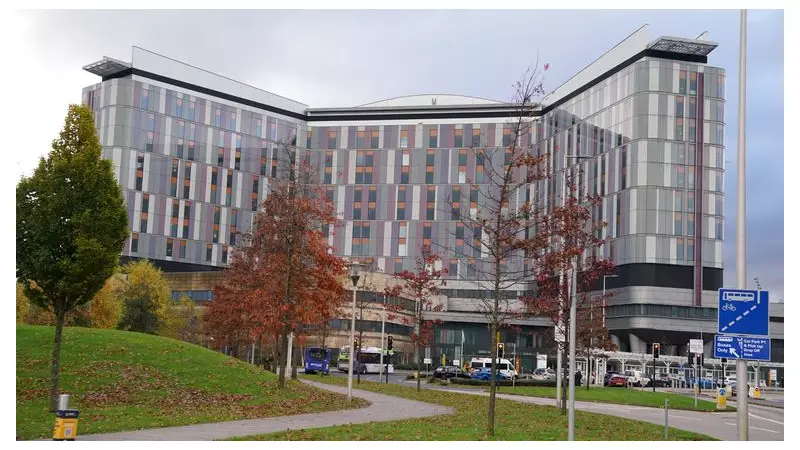
Scottish Health Secretary Declares Queen Elizabeth University Hospital 'Safe' in Holyrood Debate
Scotland's health secretary, Neil Gray, has firmly assured Members of the Scottish Parliament (MSPs) that he has "no doubt" the Queen Elizabeth University Hospital (QEUH) in Glasgow is "safe" for patients. This declaration came during a heated debate at Holyrood on Wednesday, as the super hospital remains under intense scrutiny due to long-running infection concerns.
Labour-Led Motion Calls for Expanded Inquiry into Political Decision-Making
Scottish Labour leader Anas Sarwar tabled a motion aiming to have the Scottish Hospitals Inquiry, chaired by Lord Brodie, examine the political decisions made by the SNP government during the hospital's commissioning, construction, and opening. The motion, which is expected to pass, also demands the immediate full disclosure of key records held by the Scottish government related to:
- Contaminated water systems at the hospital.
- Issues with the ventilation system.
- The "premature opening" of the facility in 2015.
- Subsequent communications regarding infection handling.
In his opening remarks, Mr Sarwar paid tribute to three whistleblowers—Dr Teresa Inkster, Dr Penelope Redding, and Dr Christine Peters—and praised the courage of affected families, including Kimberly Darroch, whose daughter Milly Main died after contracting an infection at the hospital. He stated, "This is, without question, the biggest scandal in the history of this Scottish parliament."
Background: The Scottish Hospitals Inquiry and Recent Admissions
The Scottish Hospitals Inquiry has been investigating the design and construction of the QEUH campus, as well as the Royal Hospital for Children and Young People in Edinburgh. Launched in response to safety concerns following high infection rates and deaths, the inquiry has highlighted significant issues. In closing submissions earlier in January, NHS Greater Glasgow and Clyde (NHSGGC) admitted that, on the balance of probabilities, there was a causal connection between some patient infections and the hospital environment, particularly the water system.
NHSGGC also acknowledged that pressure was applied to open the hospital on time and on budget in 2015, leading to it opening "too early" and "not ready." The health board has since issued a sincere apology for these historical failings, noting that comprehensive steps have been taken to address physical defects and ensure ongoing safety.
Political Fallout and Calls for Accountability
Scottish Labour has called for Lord Brodie to reopen the inquiry to question former SNP ministers Nicola Sturgeon, John Swinney, and Shona Robison, who were in office during the hospital's opening. Mr Sarwar argued that without their testimony, the full picture of what happened cannot be understood, and there is a risk that ministers might use the inquiry's final report to shift blame solely onto the health board.
In response, Health Secretary Neil Gray stated that instructing the inquiry to investigate political decisions would breach the legal framework of the Inquiries Act, which protects the independence and integrity of such investigations. He emphasised that inquiry chairs have the power to compel witnesses and determine relevant evidence, not ministers.
The debate underscores ongoing tensions between political accountability and legal boundaries in addressing one of Scotland's most significant healthcare scandals.




