
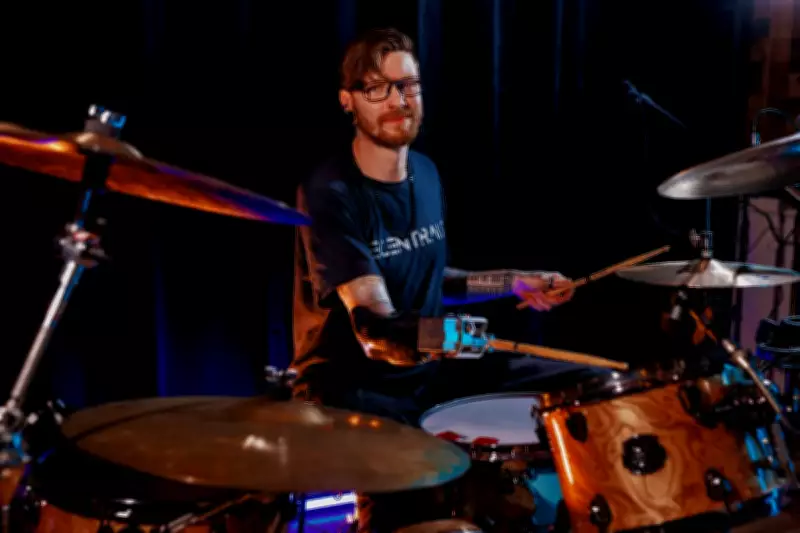
From Electrocution to World Record: A Drummer's Unbelievable Journey
One ordinary afternoon transformed Jason Barnes' life forever while he was cleaning exhaust vents on an Atlanta restaurant roof. A transformer exploded mere feet away, sending him to the ground with his body seizing and severely burned. Before this catastrophic event, music had been the absolute center of his existence, with a father who was a well-known Australian guitarist and a personal passion for drumming since receiving his first kit at age fourteen.
The Devastating Choice and Early Recovery
Waking in the hospital with fourth-degree burns reaching to the bone marrow in his right arm, Barnes faced an impossible decision after four weeks in the burns unit. Doctors presented two options: years of attempts to save the damaged limb or immediate amputation with discharge within a week. He chose amputation, which proved medically correct but emotionally devastating.
"I had lost my job and moved back with my mother," Barnes recalls. "I spent endless days watching television or playing video games one-handed, contemplating everything I might never do again—playing guitar, piano, or especially drums. Even with a standard prosthetic, holding a drumstick again seemed completely impossible."
The Turning Point on the Porch
After approximately one month of this stagnant routine, Barnes realized he couldn't continue living in such a limited way. He retrieved his packed-away drum kit from his mother's attic, set it up on the porch, and taped a drumstick directly to his amputated arm. Though incredibly painful, he discovered he could still maintain a groove. This marked the first significant shift since his accident, sparking what would become an extraordinary innovation journey.
He began developing his own drumming prosthetics, starting with crude designs using moldable plastic shaped to hold a drumstick, attached with rubber bands to a standard prosthetic. Later versions incorporated springs and bearings, eventually enabling him to resume playing with his reggae band.
Academic Collaboration and Technological Breakthrough
About a year post-accident, Barnes re-enrolled at the Atlanta Institute of Music where teacher Eric Sanders connected him with a Georgia Tech music technology professor. This collaboration led to experimentation with students building artificially intelligent musical robots. Barnes proposed enhancing his prosthetic concept with robotics, leading to multiple prototypes including one with two drumsticks—one controlled by AI and another he currently performs with.
"For my current prosthetic," Barnes explains, "engineers filmed my intact arm in slow motion to study my striking technique, then replicated it through sensors and motors. The device features six electrodes reading electrical activity in my remaining muscles. When I think about moving my hand, those muscles contract and the prosthetic responds with near-perfect accuracy."
Record-Breaking Achievements and Global Impact
Fourteen years after his accident, this advanced prosthetic has opened unimaginable doors. Barnes can now play timbres and speeds inaccessible to other drummers—achieving up to twenty hits per second. In 2019, he earned the Guinness World Record for most drum beats per minute using a prosthetic, technically the fastest ever recorded though he modestly acknowledges his technological advantage.
The record was never the ultimate goal. What truly motivates Barnes today is making these tools more affordable and accessible through his nonprofit Limitless Sound, which develops prosthetics for other disabled musicians. He remembers his first major performance with the new prosthetic in Moscow before thousands of people, where numerous audience members with disabilities approached him afterward, describing the performance as profoundly inspiring.
"In that moment," Barnes reflects, "I realized this was much bigger than just me getting my life back. This was about demonstrating to others that they too could pursue their passions regardless of physical limitations."




