
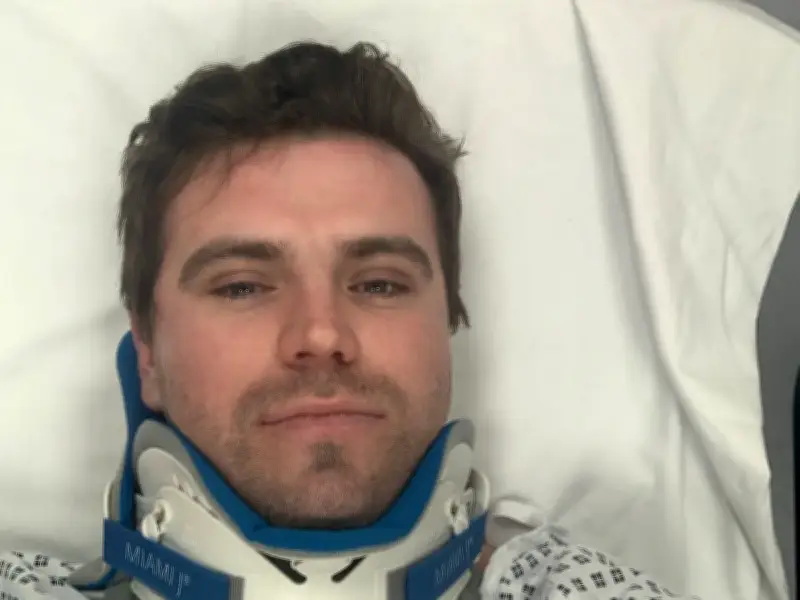
Jack McCooke, a 30-year-old technology worker from London, suffered a fractured neck during a skiing holiday in Val d'Isere, France, on April 11, 2024, but did not realize the severity until he sneezed at his desk two days later, passed out, and was rushed to accident and emergency at Guy's and St Thomas' Hospital in London. Within 45 minutes, doctors confirmed a fracture in his C2 vertebrae, which he said was "digging" on his nervous system, leading to months of physiotherapy and a long recovery journey that also included an ACL rupture.
The Accident and Delayed Diagnosis
McCooke, who describes himself as fit and "very active," was skiing with friends when he went over a lip in the snow and was sent "flying," landing "badly" on his neck. He immediately passed out and woke up surrounded by people, but managed to walk away, which he later admitted he "probably shouldn't have been able to."
For two days, he experienced "all sorts of pain" in his neck and back, but assumed it was "really severe whiplash" and did not seek medical attention. On April 13, while sitting at his desk at work, he sneezed and felt "shooting pain" up his neck before passing out again. He was taken to A&E, where a CT scan and X-ray revealed the C2 vertebrae fracture. McCooke recalled, "Doctors were shocked that I was still standing. When she said I'd fractured my neck, I laughed at first because I thought she was joking."
Recovery Challenges and a Second Injury
McCooke spent six weeks in hospital, experiencing "pure frustration" as he went from being a "very active person" to being told to "sit still" to recover. He noted that even going down stairs "too quickly" could send a jolt of pain down his spine. After discharge, he wore a neck brace for three months and relied on "fairly strong painkillers" while undergoing extensive physiotherapy to improve mobility and pain management.
However, on September 19, five months after the skiing accident, McCooke fell down a flight of stairs while trying to walk carefully, which he attributes to being "so inactive" during rehabilitation. An MRI revealed a third degree meniscus tear and an anterior cruciate ligament (ACL) rupture, classified as the most debilitating knee ligament injury, according to Complete Physio. He required full reconstructive surgery, but due to NHS waiting times, the procedure was not performed until February 2025.
Road to the Shoreditch Half Marathon
After five months on crutches, surgery, and six weeks in a "leg immobiliser," McCooke had to "learn to walk again" and took a full year to return to proper sport. He only began running again in February 2026. To stay motivated, he signed up for the Saucony Run Shoreditch Half Marathon on September 20, preparing with regular strength training to rebuild his "core functions" and running "most weeks," including longer weekend sessions.
Despite progress, McCooke says his neck injury pain level when running sits at "around four or five out of 10" and "creeps up" during longer distances. He describes it as a "lifelong management case," requiring continuous physio and strength exercises, and avoiding "heavily jolting or aggressive" activities, including bumpy car rides.
Two years on, McCooke says he is "thankful" for how far he has come and offers advice to others: "I think a lot of active people who run into an injury in their 20s – whether it's an ACL or a fracture – can find it a real challenge. But there is light. Don't give up hope."




