
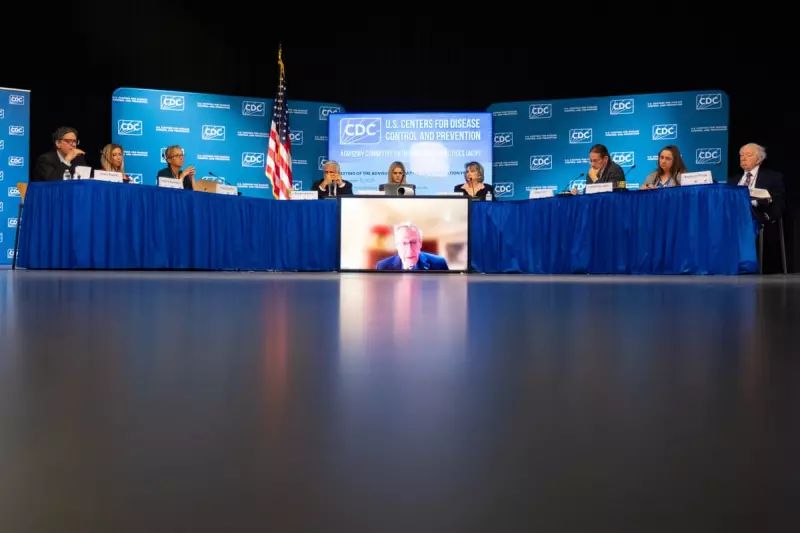
A pivotal advisory panel to the US Centers for Disease Control and Prevention (CDC) has voted to significantly alter longstanding recommendations for vaccinating newborns against hepatitis B, a move that has ignited fierce debate among public health experts.
A Controversial Vote and Its Implications
The CDC's Advisory Committee on Immunization Practices (ACIP) convened in Atlanta on Friday for a heated meeting. The committee ultimately voted 8-11 to remove the universal recommendation that all infants receive the hepatitis B vaccine at birth.
Instead, for babies born to mothers who test negative for the virus, the decision on when—or if—to start the vaccine series will be left to parents after consulting a healthcare professional. This approach, termed "shared clinical decision-making," is typically reserved for non-routine immunisations and is poorly defined, critics argue.
The vote signals a major shift in approach to a vaccine that has been administered safely and effectively for decades, with experts warning it mirrors a regressive stance from the Trump administration and advisers to Robert F Kennedy Jr.
Experts Warn of Dangerous Consequences
Medical professionals and advocacy groups have reacted with alarm. Michaela Jackson, program director of prevention policy at the Hepatitis B Foundation, stated the move "is going to lead to an increase in preventable infections among children." She argued it removes choice by creating barriers to access and will sow confusion among parents.
The committee's own modelling suggests dire outcomes: delaying the first dose from birth to two months could result in at least 1,400 additional infections, 300 cases of liver cancer, and 480 deaths annually in the United States. Liver cancer has a stark five-year survival rate of just 18%.
Professor Cody Meissner of Dartmouth College, a respected paediatrician and committee member, strongly opposed the change. "We have heard 'do no harm' is a moral imperative. We are doing harm by changing this wording," he said, emphasising the vaccine's proven safety and efficacy in protecting infants from a potentially fatal disease.
Creating Confusion and Barriers to Care
The new guidance is expected to complicate routine immunisation schedules and disproportionately affect lower-income families. Although the committee's recommendations are non-binding, they heavily influence official policy and insurance coverage.
Natasha Bagdasarian, representing the Association of State and Territorial Health Officials, warned that the "shared decision-making" language "creates barriers to care." She explained many healthcare providers may interpret it as a sign the vaccine is controversial, requiring extra steps or exposing them to liability.
In a further controversial step, the advisers also recommended giving blood tests to infants after their first shot to determine if additional doses are needed—an untested strategy with unclear efficacy compared to the standard three-shot course.
The recommendations now proceed to Jim O'Neill, the acting CDC director, who will decide whether to adopt them as official US policy. This decision puts the CDC at odds with other leading medical bodies, such as the American Academy of Pediatrics, which strongly advises all infants receive the vaccine within 24 hours of birth.




