
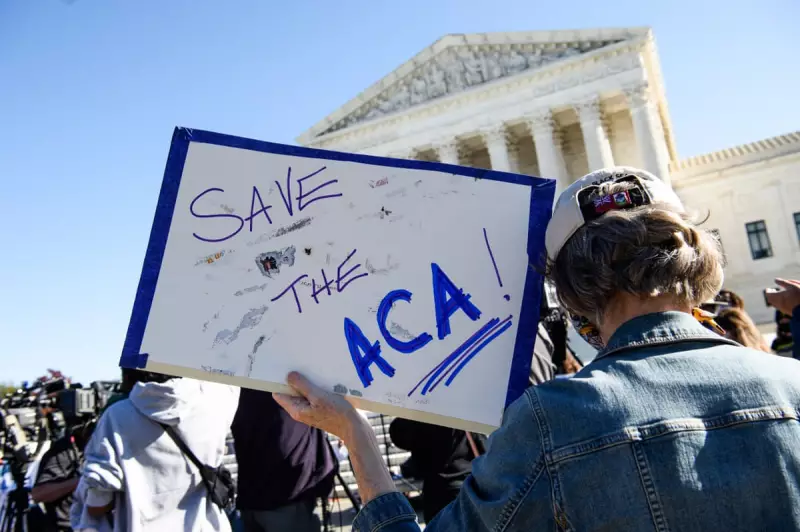
A profound and growing chasm in American health outcomes is being exacerbated by political decisions, with cuts to vital insurance programmes threatening to shorten lives further while the ultra-wealthy fund research to extend theirs indefinitely.
The Political Assault on Healthcare Access
In a stark policy shift, the US Congress, led by Republicans, agreed earlier this year to cut more than $850 billion from the decade-long budgets of Medicaid and the Children's Health Insurance Program (CHIP). This drastic reduction was primarily to help finance sweeping tax cuts. Due to complex US budgetary rules, this move also places an additional $500 billion in funding for Medicare at serious risk.
This comes on the heels of another destabilising action from the previous administration. In January, millions of Americans faced the prospect of dropping their health coverage as premiums were set to skyrocket. This crisis was triggered by the Trump administration's decision to terminate federal subsidies that had enabled roughly 20 million people to afford insurance on the Obamacare marketplaces.
A Nation Falling Behind: The Shocking Data on American Health
The consequences of these policy choices are reflected in grim national statistics. By 2023, the average life expectancy in the United States was shorter than it had been in 2010. The US now lags not only behind affluent peers like Japan, Canada, and EU nations but also trails countries including Albania, Czechia, Chile, and Panama. Astonishingly, average life expectancy at birth in the US is a full four years shorter than in Puerto Rico.
This decline persists despite America's unparalleled spending on healthcare, a system inflated by a massive, profit-driven private industry known for exorbitant costs. The problem, experts argue, is not a lack of resources or medical innovation but a failure of priority. The US excels at inventing advanced therapies but fails to ensure all its citizens have access to basic health insurance, decent jobs, and fundamental amenities like clean water.
The Billionaire Pursuit of Eternal Youth
In a stark contrast that highlights the nation's extreme inequality, the wealthiest Americans are investing vast sums into biotechnology aimed at radically extending human lifespan. Over the past 25 years, an estimated $12.5 billion has flowed into startups researching life extension, according to the Wall Street Journal.
High-profile tech figures are at the forefront. OpenAI's Sam Altman has invested $180 million in Retro Biosciences to reprogram ageing cells. Other billionaires like Eric Schmidt and Vinod Khosla have funded NewLimit, which seeks to reverse cellular ageing. Meanwhile, Meta's Mark Zuckerberg recently refocused his philanthropic foundation on merging biology and artificial intelligence to cure all diseases.
This futuristic investment stands in jarring opposition to the reality for poorer Americans. Research indicates the richest 1% of American men live 14.6 years longer than the poorest 1%. For women, the gap is 10.1 years. Furthermore, this longevity divide between the top and bottom 5% of earners widened by more than two years between 2001 and 2014.
The roots of America's mortality crisis are deeply social. From 'deaths of despair' like fentanyl overdoses and suicides to high infant mortality rates, poverty is a critical determinant. Research shows that while babies born to affluent American mothers die at similar rates to those of wealthy Europeans, the US's disproportionately high infant mortality is almost entirely accounted for by the children of the poor.
The fundamental issue, as outlined in a major 2013 National Institutes of Health report, is not a mystery. The report provided clear recommendations, yet Washington's response has included repeated attempts to repeal the Affordable Care Act, cuts to Medicaid, and a stunted vaccine schedule. The evidence suggests that until the social contract is mended, the tragic disparity in American life expectancy will only continue to grow.




