
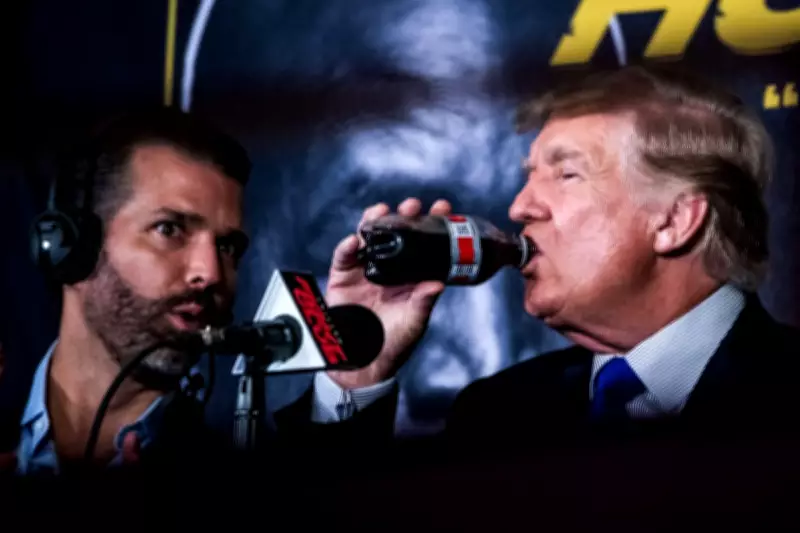
Trump's Unusual Health Belief: Diet Soda as Cancer Fighter
In a surprising revelation, former U.S. President Donald Trump has reportedly claimed that diet soda possesses cancer-fighting properties. This assertion came to light during a recent podcast episode featuring Dr. Mehmet Oz, who now leads the Centers for Medicare and Medicaid Services, in conversation with Donald Trump Jr.
The Podcast Revelation and Presidential Anecdote
During the "Triggered with Don Jr" podcast, Oz recounted a telling incident aboard Air Force One. "Your dad argues that diet soda is good for him because it kills grass – if poured on grass – so, therefore, it must kill cancer cells inside the body," Oz stated, summarizing Trump's unconventional reasoning.
Oz elaborated on finding Trump with an orange Fanta soft drink during a meeting. When questioned about the beverage choice, Trump reportedly responded with a sheepish grin, insisting, "You know, this stuff's good for me – it kills cancer cells." The former president further defended his preference by joking that Fanta couldn't be unhealthy since it contains "fresh squeezed" orange juice concentrate.
Medical Community's Swift Response
Physicians immediately countered Trump's claims, issuing public reminders about the actual scientific evidence regarding diet soda and cancer. Dr. Zachary Rubin, a Chicago-based pediatric immunologist, offered a pointed analogy: "If Fanta is able to kill grass, then it could kill cancer cells, which means it must not be bad for you. Therefore, by the same logic, that would mean that bleach is a superfood, which we all know doesn't make any sense."
Dr. Owais Durrani, an emergency physician who previously worked in the Obama administration, posted a straightforward clarification: "Friendly reminder from a doctor, diet soda or soda does not kill cancer cells."
The Science Behind Artificial Sweeteners
Most diet sodas contain aspartame, an artificial sweetener approximately 200 times sweeter than sugar. The International Agency for Research on Cancer has classified aspartame as "possibly carcinogenic to humans" based on limited evidence suggesting potential links to liver cancer.
However, this classification reflects the strength of evidence about cancer potential rather than definitive proof of causation. Group 2B, where aspartame falls, typically indicates either limited evidence in humans or sufficient evidence in animals, but not both.
Recent research has raised concerns about artificial sweeteners' effects on gut health. A 2022 French study involving over 100,000 participants found aspartame associated with a 15% higher cancer risk, though researchers noted this didn't establish direct causation. Other studies have shown artificial sweeteners may alter gut microbiome diversity and intestinal wall integrity.
Trump's Longstanding Dietary Philosophy
This isn't the first time Trump has defended unconventional health practices. During the COVID-19 pandemic, he famously suggested alternative treatments including injecting disinfectants. Oz explained Trump's dietary approach on the podcast: "He doesn't want to get sick, so he eats junk food, but it's food made in large, reputable chains because they have quality control."
Donald Trump Jr. offered a different perspective on his father's habits: "But then maybe he's on to something. Because I will say this: I know a lot of guys pushing 80, not a lot have his level of energy, recall, stamina."
Broader Health Policy Context
These revelations emerge as the U.S. health department works on updating national nutrition guidelines, including revisions to the traditional food pyramid that emphasize "real food" consumption. The discussion highlights ongoing tensions between popular beliefs about nutrition and evidence-based medical recommendations.
While research continues to examine potential links between artificial sweeteners and health risks, medical experts unanimously agree: no scientific evidence supports diet soda as a cancer prevention or treatment method. The medical community maintains that balanced nutrition, regular exercise, and evidence-based screenings remain the most reliable approaches to cancer prevention and overall health maintenance.




