
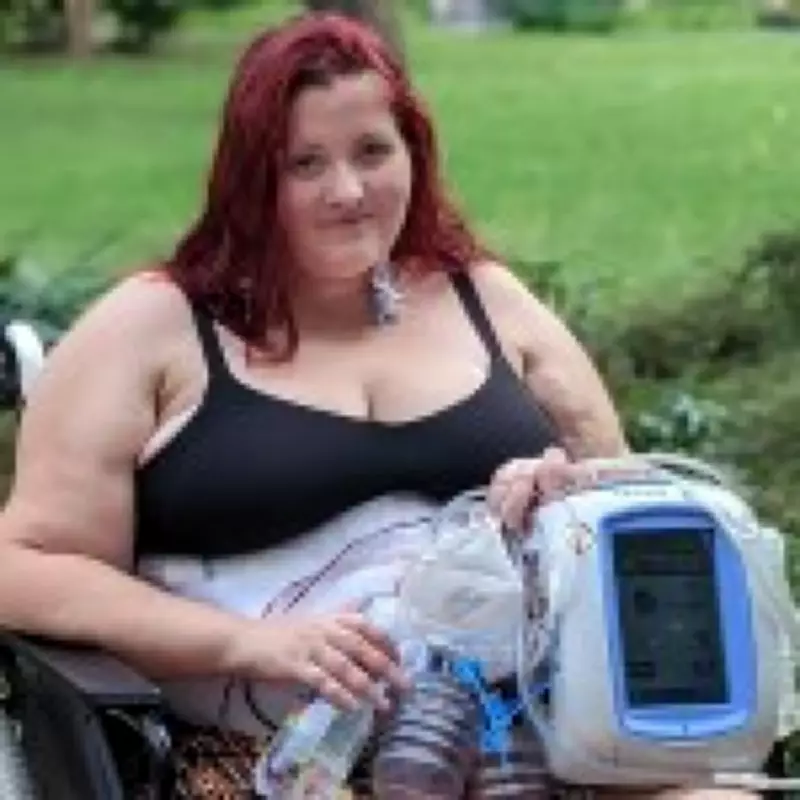
Woman's 'Unfixable' Giant Hernia Revealed After Multiple Surgeries
A shocking medical case has emerged as a 35-year-old woman from Chesterfield lives with what doctors describe as an 'unfixable' giant hernia in her abdomen. Amy Bamford's condition developed gradually following emergency surgery in August 2022, creating a 25-centimeter gap in her abdominal wall that now protrudes significantly.
Medical History and Complications
Bamford underwent five surgeries for lipoedema, a painful condition involving abnormal fat accumulation in legs and sometimes arms. After her fifth procedure, she developed sepsis in her abdomen, requiring eight additional surgeries within a single month to remove infected tissue and 80 centimeters of her small intestines.
'The extensive cutting from the top to bottom of my abdomen weakened the abdominal muscle significantly,' Bamford explains. 'Once you have this kind of damage to your abdominal wall, it's extremely difficult to recover from.'
This muscle weakness led to what medical professionals now classify as a 'giant' incisional hernia. Despite multiple NHS and private consultations, doctors have unanimously advised against surgical repair due to the hernia's size and Bamford's complex medical history.
Missed Opportunities and Medical Oversight
Bamford reports that during years of follow-up appointments, she repeatedly expressed concerns about her growing abdomen and persistent pain to various medical professionals. 'I was constantly explaining my surgical history and abdominal changes,' she says, 'but no one recognized it as urgent or warned me there would be a point where it couldn't be fixed.'
Her referrals were never expedited, and the seriousness of her developing condition went unrecognized until it reached its current state.
Why Surgery Isn't an Option
'Repairing this would require major surgery with significant risks,' Bamford explains. 'Given my complex medical history—including having had a stroke and extensive abdominal damage—I'm at much higher risk for complications.'
Medical professionals have determined that while her hernia is large and uncomfortable, it remains stable and not at immediate risk of strangulation. 'Even if there was a surgical option,' Bamford notes, 'it might not provide a permanent solution, and safety concerns outweigh potential benefits.'
Understanding Hernias
A hernia occurs when internal tissue pushes through a weakness in muscle or surrounding tissue walls, typically developing between chest and hips. While many hernias cause minimal symptoms, they may present as noticeable swellings or lumps in the abdomen or groin area.
Medical guidance recommends visiting a GP if you suspect a hernia. Emergency attention is required if severe pain, vomiting, bowel obstruction symptoms, or an irreducible firm hernia develops, as these may indicate strangulation or obstruction—both medical emergencies requiring immediate treatment.
Emotional and Physical Impact
Bamford describes her journey as emotionally and physically challenging. 'I fluctuate between hating my body and being grateful for what it has endured and recovered from,' she shares. 'My relationship with my body is complicated, but I work daily to make it less so.'
Despite the difficulties, she credits her husband's unwavering support throughout her medical ordeal. 'This experience has actually brought us closer together,' she says. 'He's been with me through everything.'
Raising Awareness Through Social Media
Bamford now manages an Instagram account (@hernia_troll_uk) where she shares her experience and raises awareness about her condition, though she receives considerable online negativity. 'I used to be bothered by hate comments,' she admits, 'but I've done significant personal work and no longer need validation from strangers online.'
She employs content filtering to protect her community from harmful language and varies her response to negativity between humor, engagement, and ignoring it altogether. 'It simply doesn't affect me anymore,' she states firmly.
While Bamford has accepted medical advice against surgery, she continues to navigate the physical and emotional challenges of living with what doctors have determined is an unfixable condition, advocating for greater awareness of surgical complications and post-operative care.




