
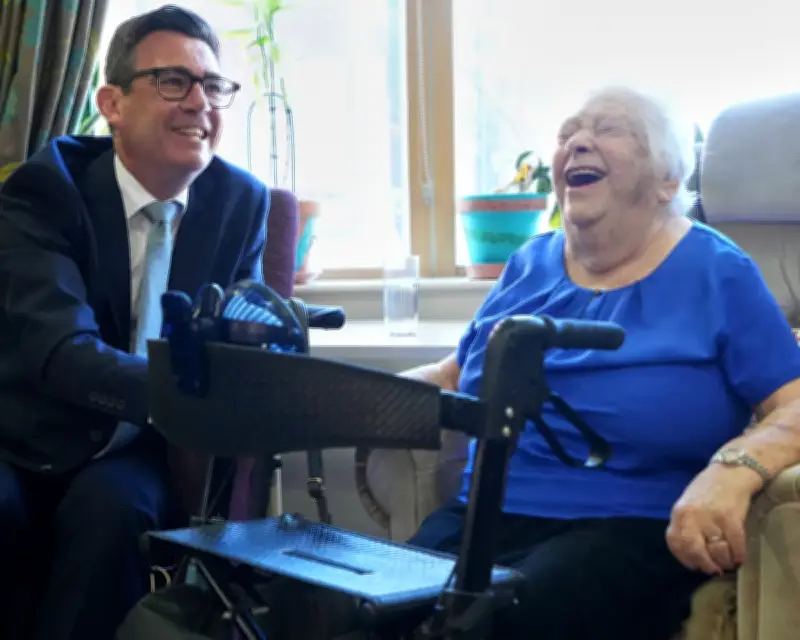
Andy Burnham has made social care reform the centrepiece of his first major set-piece address as prime minister, declaring the issue personal to him and vowing to break a three-decade cycle of political avoidance. Speaking at Jewish Care in north London, Burnham outlined plans for cross-party talks, a merged health and social care workforce, and an accelerated review to be completed next year.
A personal connection to the crisis
Burnham revealed that his father has dementia and requires daily care, framing the crisis as one that touches millions of families. “This is personal to me,” he told a small audience of care workers and journalists. The prime minister acknowledged that previous governments had commissioned 22 reviews and a royal commission without meaningful change, but insisted his administration would be different.
The speech resonated deeply with many, including Guardian columnist John Crace, who noted his own mother’s seven-year battle with Alzheimer’s. Crace wrote that his family sold her home to pay for care, a common fate that Burnham described as a “lottery” that unfairly penalises those who cannot choose how they die.
Three key reforms announced
Burnham outlined three immediate changes: bringing forward the social care review to next year, integrating the social care and NHS workforces, and initiating cross-party talks. He confirmed that Conservative leader Kemi Badenoch and Liberal Democrat leader Ed Davey had already written to him, and he has invited them to participate. Reform UK leader Nigel Farage had not responded, Burnham noted, adding that even Reform supporters may eventually need care.
“Hard choices need to be made,” Burnham said. “No one wants to pay extra for social care, but how can it be fair that some families are left with next to nothing?” He accepted that some costs could be met through efficiency savings, but warned that tax increases may be unavoidable.
A new tone in politics
Burnham’s unscripted, emotionally intelligent delivery marked a stark contrast with recent predecessors, according to observers. Crace described it as “the return of hope over grievance,” with a prime minister who speaks to voters as fellow adults. Burnham answered questions directly, without evasion, and acknowledged the difficulty of the task.
“If Andy were to do nothing in his time in office but fix social care, he would have achieved more than most other prime ministers,” Crace wrote. The speech has been widely seen as a test of Burnham’s political capital, with the public cautiously optimistic but wary after decades of broken promises.
Broader context and challenges
The social care system in England has been described as unsustainable, with 15-minute care packages, emergency call failures, bedblocking in hospitals, and care homes profiting from misfortune. Burnham called the current system “ultimately unsustainable” and compared it to the unfairness of the US health system, where the vulnerable bear the heaviest burden.
Assisted dying legislation, Burnham argued, should only be considered after end-of-life care reform is complete. The prime minister’s approach has drawn praise for its honesty, but sceptics note that previous leaders have also promised reform without delivery. The cross-party talks will be crucial to achieving consensus.




