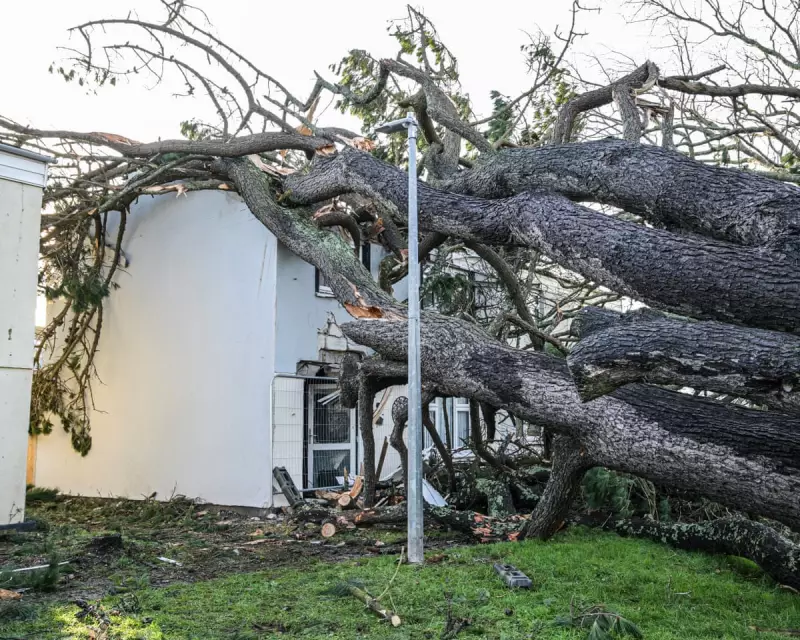
The clean-up continues across Cornwall as communities grapple with the severe aftermath of Storm Goretti, which struck with violent winds approaching 100 miles per hour last week. Four days on, the disruption remains critical, with thousands of homes still lacking basic power and water supplies, prompting a local MP to demand the situation be declared a national emergency.
Widespread Disruption and Infrastructure Damage
By Monday afternoon, utility companies and local authorities reported a stark picture of ongoing hardship. National Grid confirmed approximately 1,250 properties were still without electricity, with the Helston area being the worst affected. The situation with water is even more dire, as South West Water (SWW) stated around 3,000 homes had no running water.
The water company described the storm's impact on its network as "devastating." In the Helston region alone, six major water mains suffered severe damage, primarily from numerous large trees uprooted by the ferocious gusts. Sam Bottomley, SWW's Water Services Director for Devon and Cornwall, explained that 30 to 40 fallen trees had landed directly on mains pipes emanating from the Wendron treatment works. While repair crews are working tirelessly and have restored supplies to over half of those initially affected, the scale of the damage means many remain cut off.

The storm's legacy has also forced 31 schools across Cornwall to either close entirely or open late due to the ongoing infrastructure problems and safety concerns.
Political Calls for a National Emergency Response
The prolonged crisis has ignited significant political frustration. Andrew George, the Liberal Democrat MP for St Ives, has vociferously argued that the scale of the disaster warrants a far greater national response. He contended that if a similar event had struck London or the Home Counties, it would dominate headlines and trigger an emergency government intervention.
Following his calls, a meeting of the Emergency Ministerial Strategic Response Group was convened on Sunday, chaired by Defra minister Mary Creagh MP. Creagh later confirmed she had met with water executives, expressing continued concern for people in the south-west and south-east facing supply issues.
On Monday, George's criticism turned towards the Commons Speaker, Sir Lindsay Hoyle. He expressed dismay that while the Speaker had granted a request for a national emergency response debate for East Grinstead in Sussex—affecting 16,500 homes—a similar plea for Cornwall was declined. George asserted that the impact in Cornwall "would dwarf" that of other regions, noting that over 50,000 homes in the county had experienced combined water and electricity outages.
He highlighted the severe effect on vulnerable residents, citing an instance where nursing home occupants had to be evacuated after their roof was torn off and they lost all power and water.
Community Impact and a Tragic Loss
On the ground, residents and businesses are coping as best they can. Janine Williams, landlord of the Blue Anchor pub in Helston, described the scene as "a bit of a mess," with many locals coming in to charge their phones. Her establishment, fortunate to have a well and maintained electricity, has become a warm haven for those affected, even as its mains water was intermittently restored and lost again.
The storm also led to a tragic fatality. Devon and Cornwall Police reported that a man in his 50s was found dead after a tree fell onto his caravan in the Mawgan area near Helston on Thursday evening. The death is not being treated as suspicious, and his next of kin have been informed.
As repair efforts press on, the people of Cornwall are left counting the cost of Storm Goretti, facing a prolonged recovery that underscores the vulnerability of rural infrastructure to extreme weather events.