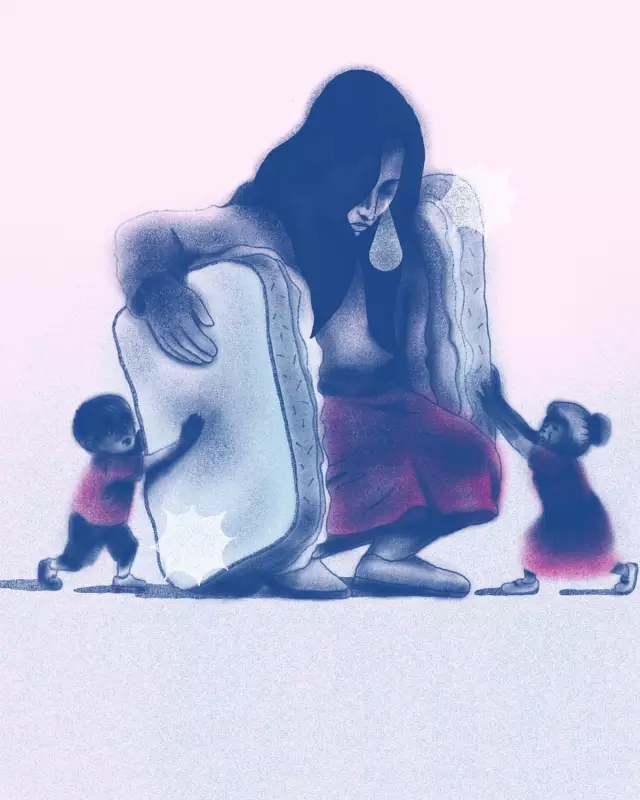
Millions of Americans are now caught in a crushing generational squeeze, caring simultaneously for their children and their ageing parents while navigating a hostile political and economic landscape. What was once termed the 'sandwich generation' has evolved into a far more intense 'triple-decker sandwich generation', with a new layer of pressure baked from ongoing crises.
The Personal Toll of a National Crisis
For writer Alissa Quart, the reality hit during a long day at a Memorial Sloan Kettering cancer centre with her mother. As she waited for an infusion to finish, calls from her daughter about a missed volleyball game underscored the impossible juggle. A glance at her phone revealed more grim news: the National Guard deployed in another city and federal plans to gut Medicaid and Medicare by a staggering $1tn over the coming decade.
"Time in hospitals moves differently," Quart observed, capturing the surreal strain of managing a parent's serious illness while maintaining a family life. This intergenerational squeeze creates a "time-space continuum" where life's most demanding stages collide. Quart is far from alone. The number of family caregivers in the US has soared to 63 million, a dramatic 45% increase in the past decade. Among those under 50, nearly half are caring for both a parent and a child.
A System Failing Under Political Pressure
The strain is exacerbated by a political climate described as 'anti-compassion'. Social worker Julie Gayer Kris, who cares for her 81-year-old mother, stepfather with Alzheimer's, and 14-year-old son, leads therapy groups for carers. She bluntly describes the situation as a "multi-layered sandwich of shit." The Trump 2.0 era, she says, "creates another layer of hopelessness and stress."
Access to care is a constant battle. Celina Su, a political science professor, struggled to secure care for her dying father while weathering cuts to academic funding. In one desperate move, she created a QR-coded medical history to force doctors to pay attention. On her father's final day, with special permission, she pressed their hands into clay as a keepsake, only to later learn two of her research grants had been revoked.
The financial architecture supporting care is crumbling. Eldercare is prohibitively expensive, and in New York City, childcare costs skyrocketed by 79% between 2019 and 2024. The supply of caregivers is also shrinking, with many being immigrants facing precarious legal status. Proposed shifts in labour rules threaten to remove overtime protections from homecare workers, effectively ensuring they are not paid for much of their work.
Facing an Uncertain Future
The consequences are dire and widespread. Julie Croghan, a professional in-home caregiver in Santa Cruz, is a mother of 12 caring for elderly parents and a severely disabled son. She is "absolutely disgusted" by how the administration is "hurting disabled children" through policies like stripping $1tn from Medicaid. "It's going to be really ugly," she warns, noting the recent evisceration of the Office of Special Education and Rehabilitative Services.
Demographic shifts explain part of the crisis: people are having children later and parents are living longer with complex health issues. However, the American framework of individualised risk, as theorised by sociologist Ulrich Beck, places the burden squarely on individuals and families. Anthropologist Danilyn Rutherford identifies a "savagery to our society now," where care is devalued and systems are dismantled.
For those in the triple-decker sandwich, the daily question is a dark one: which family member will I disappoint today? The solution, advocates argue, lies in robust policy: national paid sick leave and family leave laws. As Quart concludes, these 'sandwiches' are not experienced alone but collectively. The need for compassion is a universal one, for today's caregivers and for the future elderly they will become.