
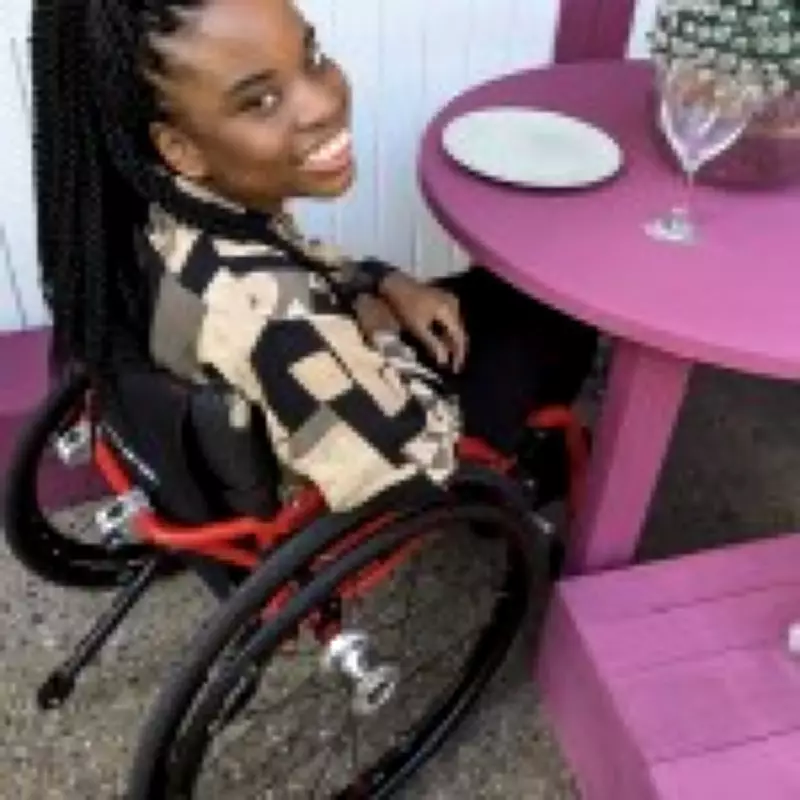
Wheelchair User's Supermarket Struggle: Inaccessible Self-Checkouts Block Food Purchases
A 26-year-old wheelchair user from south London has exposed a critical accessibility failure in modern retail, revealing that supermarket self-checkouts are often impossible for her to use, leaving her unable to pay for her weekly food shop. Toyin Fabusiwa, who lives in Croydon, posted a viral TikTok video earlier this month showing her struggles at a local Lidl store, where she couldn't reach the card machine or touch-screen monitor due to their height.
'Don't Blame Me, Blame Inaccessible Design'
Toyin told Metro that when the robotic voice says 'finish and pay,' the card machine is simply too high for her to access from her wheelchair. 'Most times when I go out, I try to pay for things with self-checkout, and it's quite hard to scan things because of the angle,' she explained. The same issue applies when trying to buy a plastic carrier bag or input items without barcodes, like loose fruit and vegetables.
Her TikTok video, which has sparked widespread discussion, features the caption: 'We need wheelchair accessible self-checkouts. Who agrees?' accompanied by the hashtags #disability and #wheelchairuser.
Manned Checkouts Present Similar Barriers
Despite Lidl's reputation for fast cashier scanning, Toyin says manned checkouts also present accessibility problems. 'When it says, "insert PIN," I can't insert the pin because the machine doesn't come down, not just in Lidl, in other shops as well,' she revealed. 'The machine won't come down, so when it says insert PIN, I can't do that, so I can't pay for my stuff.'
This frustration extends beyond supermarkets. Toyin recalled a recent visit to Greggs where the card machine was positioned too high for her to see the keypad. When she asked if a movable machine could be brought, the cashier responded: 'There's nothing I can do about it.'
Daily Shopping Challenges Beyond Payment
The accessibility issues don't stop at checkout counters. Toyin often struggles to reach stock on higher shelves or open freezer section doors. She notes that most staff members have been 'uncaring' when she flags these problems, and the difficulties have become more frequent since she started doing her own shopping three years ago instead of relying on her mother.
'I do think about the future – what if I go shopping without my mum or sister, how am I going to access this?' Toyin questioned. 'I go to the tills, the machine won't come down, so I have to go home. Sometimes, I don't want to have to ask for help. I should be able to do it myself.'
Rising Self-Checkout Numbers Contrast With Accessibility Needs
Self-checkouts have proliferated dramatically in British supermarkets over the past two decades. According to analytics platform RBR Data Services, there were 80,000 self-checkout units in UK supermarkets in 2023, up from 53,000 in 2018. A poll by The Grocer found that nearly every person in the UK has used a self-service till in the past six months, with around 54% preferring them to staffed checkouts.
However, this convenience hasn't extended to all shoppers. Alison Kerry, head of communications at disability charity Scope, told Metro: 'This shows just how much our society and environment are set up in a way which excludes disabled people. Disabled people come up against a multitude of barriers every day, from inaccessible places to discrimination and negative attitudes. We all need to work together to break down these barriers.'
Growing Backlash Against Self-Service Technology
While self-checkouts have become ubiquitous, there's growing fatigue with the technology. Some shops like Booths have scrapped them altogether, citing customer preference for human interaction. Beyond accessibility issues, complaints include machines being slow and unreliable, while low-income and elderly shoppers want more opportunities to use cash. A petition calling for a 'fair number of cash-accepting tills' launched last year garnered nearly 72,000 signatures.
A Simple Request for Independence
For Toyin, the solution is straightforward. 'We're not asking for the world, just one or two accessible self-checkouts, or tools where the machine can go down,' she said. 'Then I'd be able to shop independently and wouldn't have to ask people for help.'
Both Lidl and Greggs have been approached for comment regarding these accessibility concerns. The incident highlights how retail environments, despite technological advancements, continue to exclude disabled customers through basic design oversights that prevent independent shopping.




