
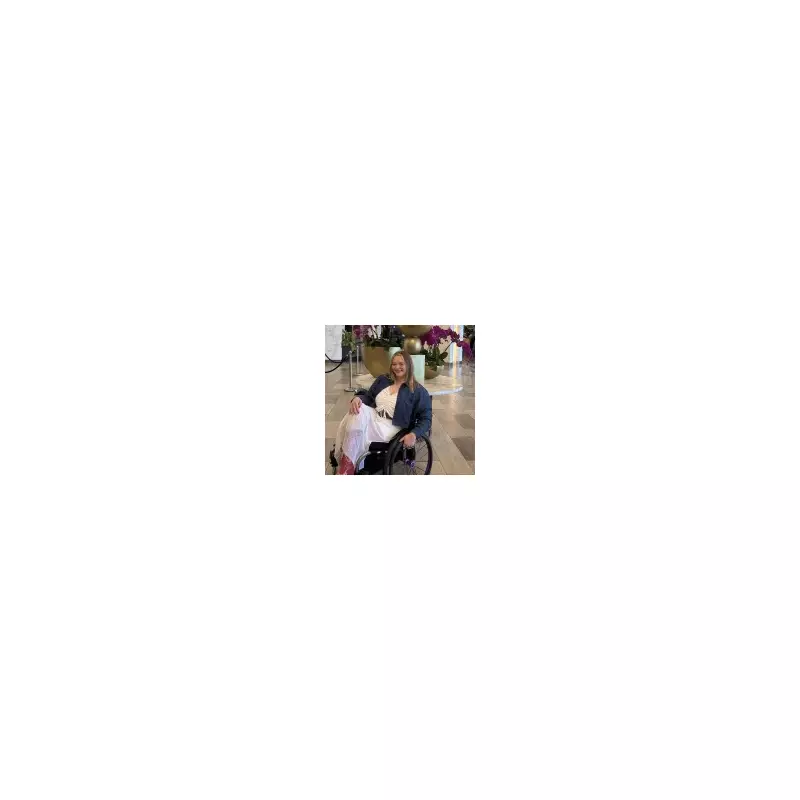
‘I can’t live like this, just take it off.’ Those raw, desperate words were screamed through tears by Amy Pohl to hospital doctors in February 2018. Her left arm, consumed by a burning, twisted agony, no longer felt part of her. She was begging for amputation, willing to do anything to stop the pain caused by Complex Regional Pain Syndrome (CRPS) – a neurological condition so severe it’s often dubbed the ‘suicide disease’.
A Life Turned Upside Down
Before her diagnosis, Amy’s life in the UK was ordinary. She lived with her parents, cherished her teaching career, and loved walking her dog, Bessler. The main concern was supporting her mother through stage 4 non-Hodgkin’s lymphoma. This stability shattered in autumn 2017.
It began with a respiratory infection. A prescribed throat medication triggered a severe anaphylactic reaction, landing Amy in intensive care. A cannula issue there led to a further infection in her hand. Despite surgeries and antibiotics, her hand never recovered. It swelled, changed colour, and radiated incredible pain. Doctors were initially baffled.
The pain became her entire world. ‘It felt like millions of angry ants were crawling up and down my arm,’ she describes. A slight breeze could provoke screams. Her teaching career stalled as she was passed between medical teams with no answers.
The Harrowing Diagnosis and Descent
In January 2018, at just 24, Amy received the CRPS diagnosis. Doctors warned of years of pain and rehabilitation ahead. Learning the condition’s grim nickname, ‘suicide disease’, sent her into a spiral. ‘I was distraught and I couldn’t imagine a future for myself,’ she admits.
The following month, her despair peaked. Despite medical warnings that amputation might worsen or spread the pain, the relentless agony in her arm made her consider taking matters into her own hands. ‘I genuinely thought about doing it myself,’ she confesses.
Her situation deteriorated further in September 2018. Waking from another hand operation, she found herself paralysed from the waist down. Whether linked to the earlier botched cannula or not, the outcome was life-altering: her once active, independent life was now defined by a wheelchair.
An Accidental Lifeline on Social Media
By 2020, Amy had hit rock bottom, with hospital wards feeling like a permanent home. A turning point arrived unexpectedly in March 2024. While in a neuro-rehab unit, she sent a lighthearted, lipsyncing TikTok video to her parents, using audio of a swimming lesson. She accidentally posted it publicly.
The response was immediate and global. Views and comments flooded in, with people showing genuine interest in her and her condition. ‘The more I shared, the more empowered I felt as my community grew,’ Amy says. She realised she wasn’t alone; many others were fighting similar battles.
While CRPS pain remained a constant, creating content became a vital refuge and a way to reclaim control. Her platforms flourished, amassing millions of followers on TikTok and Instagram. She now uses her voice to challenge stereotypes, showing that joy and hope persist even on a different life path.
This advocacy led to her winning the Sense ‘Digital Voice of the Year’ Award, a huge honour. Her life, once consumed by pleading for an amputation, is now full. She has experienced rollercoasters, horse riding, and water-skiing from her wheelchair. ‘I love my life exactly the way it is today,’ she states, a sentiment she never thought she’d express.
Amy’s message to others facing debilitating diagnoses is one of hard-won hope: ‘It’s okay to feel lost or even angry… But I promise you, this isn’t the end of your story, it’s just a different chapter.’ Through time, adaptation, and community, she has found strength to coexist with pain, not be defined by it.




