
John Knight: The Disability Campaigner Who Transformed UK Train Accessibility
John Knight, a formidable disability campaigner whose mischievous personality and strategic brilliance brought about landmark changes in UK accessibility, has died aged 67 from sepsis. His legacy is most vividly seen in the successful All Aboard campaign, which secured a 2020 deadline for making all railway carriages accessible, a battle that might have otherwise left disabled people waiting until 2035.
A Campaign That Changed Legislation
As head of policy and campaigns at the disability charity Leonard Cheshire during the passage of the Disability Discrimination Act 2005, Knight faced stiff opposition from train companies advocating for a 2035 deadline to maximise the lifespan of inaccessible rolling stock. Through determined advocacy, he persuaded the House of Lords to back an amendment setting the deadline at 2020, which was subsequently accepted by the Labour government.
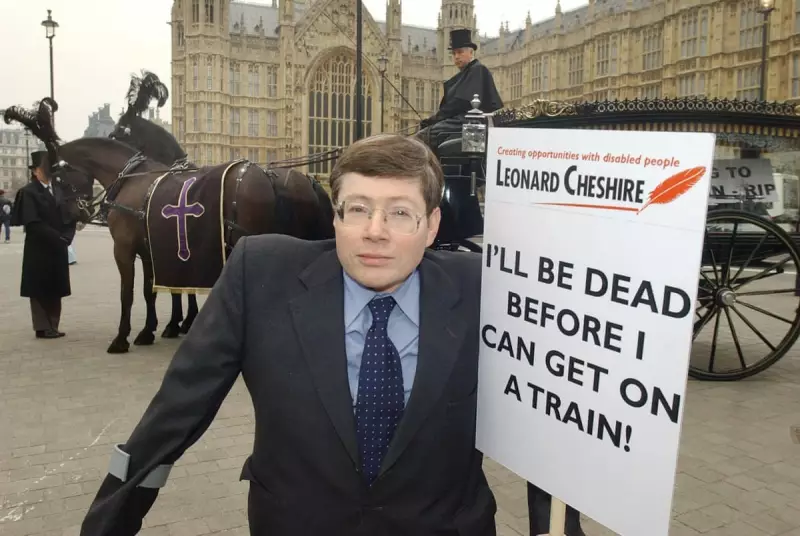
Knight's campaign tactics were as creative as they were effective. At the climax of the All Aboard campaign, he arranged for a horse-drawn hearse to deliver thousands of postcards to MPs and peers. On these cards, disabled individuals had written the age they would need to live to benefit from a 2035 deadline, under the poignant slogan: "I'll be dead before I can get on a train."
A Mischievous Personality with Profound Impact
This stunt perfectly encapsulated Knight's playful yet powerful approach to activism. Friends recall his love of fireworks and his party trick of adapting his crutches into makeshift mortar tubes. At Leonard Cheshire, where he served for 16 years and rose to board-level director, he was widely seen as a refreshing influence, helping the organisation move beyond its traditional, patrician culture and better integrate people with disabilities.
Knight robustly defended his decision to work within the establishment despite criticism from some disability activists. His other significant achievements included:
- Implementing disability equality training for London bus drivers
- Securing crucial safeguards for disabled people under Labour's 2008 benefit changes
- Later reflecting that the early 2000s were "a heady time with great progress for disabled people", though he conceded he had worked with Labour "sometimes too closely, on reflection"
Overcoming Profound Challenges from Birth
Knight's own life story was one of remarkable resilience. Born in Bristol in 1958 with profound disabilities, his parents struggled to cope, leading to his placement in care with Barnardo's children's charity at 18 months. He described this experience as "transformational", though he acknowledged it wasn't for everyone.
After initial placements in special schools, he flourished at Chailey Heritage in East Sussex, where he became head boy, and later at Hereward College in Coventry. It was at Chailey that he developed a lifelong passion for opera through free tickets to nearby Glyndebourne productions, eventually seeing Benjamin Britten's Peter Grimes 33 times.
A Barnardo's staff member, Judith Hocking, became a mother figure, frequently having him stay at her parents' house in Herefordshire - an arrangement that wouldn't be permitted today but which allowed Knight to regard the Hockings as family and Herefordshire as his home.
Education and Career Achievements
Knight's educational journey was impressive:
- Graduated in zoology from Nottingham University in 1982, researching urban seagulls despite never actually spotting one in the city due to travel difficulties
- Enjoyed a vibrant social life featuring many escapades, including appearing in a student revue having his prosthetic "legs" sawn off by a bungling magician
- Earned an Open University degree in political and social sciences in 1992
- Completed a diploma in voluntary sector management at City University Business School in 1997
- Received an honorary doctorate from Nottingham University in 2012
After a brief stint in banking, Knight joined the civil service in 1985, serving five years in the Department of Health before moving to Hammersmith and Fulham council as principal disabilities services officer in 1990. His move to Leonard Cheshire in 1994 marked the beginning of his most influential period of advocacy.
Later Years and Personal Life
In recent years, Knight again demonstrated independent thinking by openly supporting legislation for assisted dying for people with terminal illness, serving as a board member and later patron of the pressure group My Death, My Decision. He claimed to speak for a silent majority of disabled people on this issue.
His extensive public appointments included:
- Commissioner of the Commission for Social Care Inspection (2004-2009)
- Board member of the Charity Commission (2009-2013)
- Board member of the National Council for Voluntary Organisations (2003-2008)
- Board member and tenant champion at Habinteg housing association (2019-2024)
- Magistrate in north-east London for 28 years until 2020
- Appointed CBE in 2011
Knight met his wife, Ruth Hall, a social justice campaigner, through Guardian Soulmates in 1996. They married in 2021 and shared a life that included Ruth's son, Alex, and a young adult they regarded as a daughter, Shuxin Dai. Knight developed a warm grandparental relationship with Shuxin's son, Jonathan.
John Knight's life demonstrates how personal experience, professional dedication, and a touch of mischief can combine to create lasting social change. His work ensured that disabled people across the UK gained access to train travel decades sooner than might otherwise have been possible, leaving an enduring legacy of greater equality and accessibility.




