
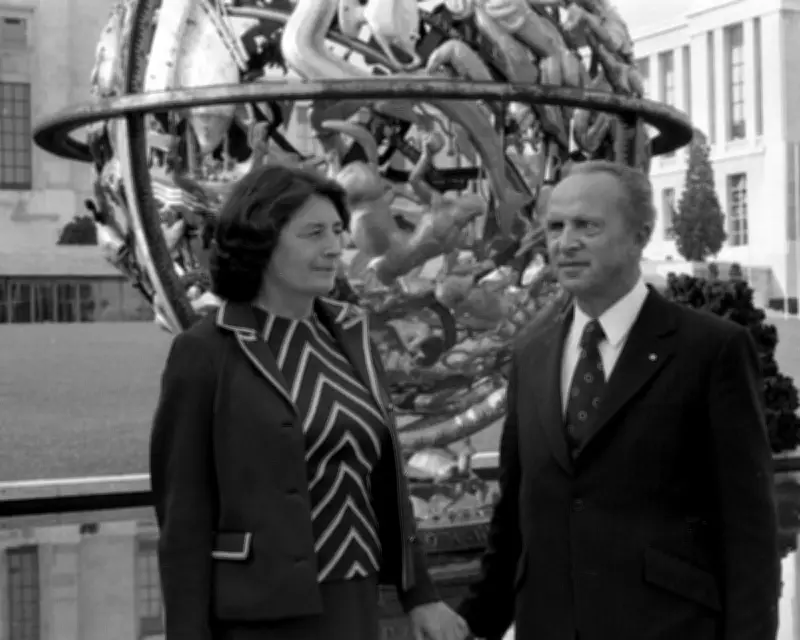
Jean Wilson, Co-Founder of Sightsavers, Passes Away at Age 103
Jean Wilson, who co-founded the renowned charity Sightsavers and tirelessly campaigned for the education of blind children, has died at the remarkable age of 103. Her legacy spans decades of transformative work in global health and disability rights.
Humble Beginnings of a Global Charity
On January 5, 1950, Jean Wilson inaugurated her charity, initially named the British Empire Society for the Blind. To conceal its modest start as a two-person operation, she would answer phone calls from journalists with the question, "Which department would you like?" Founded alongside her husband, John Wilson, the organization was later renamed Sightsavers in 1986. From these acorn beginnings, it grew into a leading force in tackling blindness across developing nations. Today, Sightsavers funds over 9 million eye examinations and half a million sight-saving operations annually in 30 countries.
A Partnership Forged in Shared Vision
Jean McDermid, as she was known before marriage, met John Wilson in 1943 when he lodged in her family home in Eastcote, west London. They married in 1944 and shared a radical vision to assist the millions globally affected by blindness. John, who became blind at age 12 due to a school chemistry explosion, worked for the National Institute for the Blind, now the RNIB. After a government tour of British colonial territories in Africa and the Middle East from 1946 to 1947, he was appalled by the widespread blindness caused by preventable issues like disease and malnutrition. Determined to make a difference, he resigned from his job, and the couple launched their charity, embarking on relentless fundraising efforts.
The Dynamic Duo's Impactful Work
The Wilsons formed a tight-knit team, with Jean serving as her husband's "eyes" during their extensive travels. A talented photographer, fundraiser, and communicator, she persuaded influential figures such as Lord Halifax, the former foreign secretary, and Helen Keller to support their cause. In 1950, one of their first trips was to the Gold Coast, now Ghana, where they visited the Nakong area on the River Sisili, a hotspot for onchocerciasis. This parasitic disease, transmitted by flies near rivers, causes permanent sight loss. Nakong was dubbed "the country of the blind," with most villagers over age 12 being blind and relying on hemp ropes or children for guidance.
Recognizing the need for effective fundraising, Jean coined the term "river blindness" for the disease, stating, "It's no good calling this thing onchocerciasis. If I can't pronounce it or spell it, I certainly can't raise funds for it." This name quickly gained traction and became widely used.
Expanding Reach and Educational Initiatives
By 1955, the society, later known as the Royal Commonwealth Society of the Blind, had established national organizations in 20 countries, including Ghana, Nigeria, Barbados, and Cyprus. These groups operated mobile eye clinics to treat conditions like river blindness and trachoma, while also funding training for blind farmers, ophthalmic surveys, and educational projects. The Wilsons emphasized a partnership approach, supporting local initiatives rather than imposing top-down solutions.
Jean, a trained teacher, was particularly passionate about educating blind children. Inspired by integrated schools in America, she helped set up a similar institution in Uganda. To challenge societal perceptions, the society organized a dramatic event in 1969: seven blind men from Uganda, Kenya, and Tanzania climbed Mount Kilimanjaro. This expedition, widely covered by African media, helped convince parents of the potential of blind children and the value of education.
Later Years and Broader Disability Advocacy
John was knighted in 1975, granting Jean the courtesy title of Lady Wilson. She received an OBE in 1981, and by 1983, both had stepped down from Sightsavers to address disability more broadly. In 1981, Jean organized the Leeds Castle international seminar on disability prevention as part of the UN's International Year of Disabled Persons. In 1985, the Wilsons and their daughter Claire Hicks founded Impact, focusing on a spectrum of disabilities, including sight and hearing loss. Impact's notable projects include the Lifeline Express, the world's first hospital train launched in collaboration with Indian Railways in 1991, benefiting nearly one million people last year alone.
Jean was a staunch advocate for preventing disability through education and immunization. As chair of the UK's National Rubella Council from 1983, she recruited figures like Diana, Princess of Wales, and Linda McCartney to promote rubella vaccination, significantly increasing uptake rates among women and girls over four years.
Personal Life and Enduring Legacy
Born in Acton, west London, Jean was the only child of Chloe and John McDermid. She attended Harrow County School for Girls and studied history at Westfield College, University of London, from 1941 to 1944, followed by a teaching diploma in 1945. After marrying John, they lived in London before moving to Rottingdean, Sussex, in 1955, where Jean remained for the rest of her life, enjoying gardening. John passed away in 1999, and Jean took over as chair of the Hearing Conservation Council. She continued her involvement with Sightsavers as vice-president and Impact as honorary president, traveling widely into her 90s. In 2002, she was made an honorary fellow of the Royal College of Ophthalmology.
Jean Wilson is survived by her daughters Claire and Jane, five grandchildren, and eight great-grandchildren. Her lifelong dedication to combating blindness and advocating for disability rights leaves an indelible mark on global health and education.




