
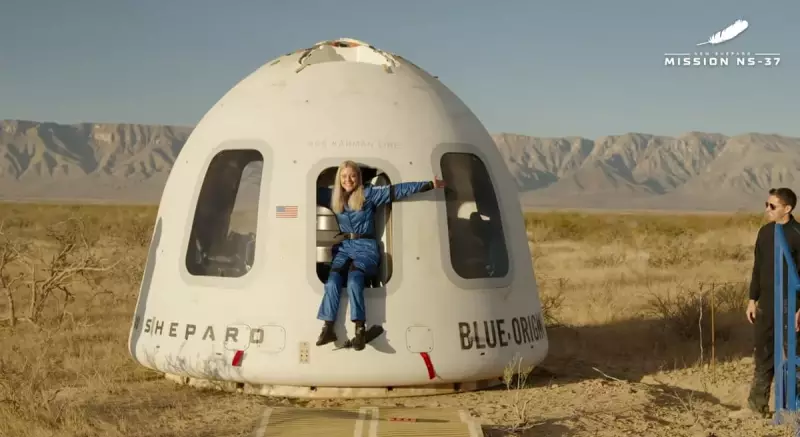
History was made in the skies above west Texas on Saturday, 20 December 2025, as a German engineer became the first wheelchair user to travel to space. Michaela Benthaus, who uses a wheelchair, soared more than 65 miles above Earth in a landmark flight with Jeff Bezos's space company, Blue Origin.
A Dream Forged From Adversity
The ten-minute journey aboard the autonomous New Shepard capsule was the culmination of a personal dream for Benthaus, whose life changed seven years ago following a severe mountain bike accident that left her paralysed. "I never really thought that going on a spaceflight would be a real option for me," she confessed to the Associated Press before the flight, citing the competitive nature of astronaut selection even for able-bodied individuals.
Her perspective shifted when retired SpaceX executive Hans Koenigsmann, also born in Germany, approached her last year. Koenigsmann helped organise and, alongside Blue Origin, sponsored her trip, offering her the chance to experience over three minutes of weightlessness. Initially thinking it was a misunderstanding, Benthaus immediately signed on for the private mission, which was not affiliated with the European Space Agency (ESA).
Engineering for Inclusion
Blue Origin stated that only minor adjustments were needed to accommodate Benthaus, a testament to the capsule's accessible design. Jake Mills, a Blue Origin engineer who trained the crew, emphasised that the New Shepard was built "making it more accessible to a wider range of people than traditional spaceflight."
The company provided a patient transfer board to help Benthaus move between the capsule's hatch and her seat, and an existing elevator at the launch pad carried her the seven stories to the capsule atop the rocket. Crucially, after touchdown, the recovery team unrolled a carpet on the desert floor, giving Benthaus immediate access to the wheelchair she had left behind at liftoff.
Benthaus, 33, is part of the ESA's graduate trainee programme in the Netherlands and had previously experienced weightlessness during a parabolic flight in 2022. She was adamant about performing as many tasks independently as possible. However, for emergency procedures, Koenigsmann was designated as her helper, and he and Mills assisted her out of the capsule after landing.
A New Chapter for Accessibility
An ecstatic Benthaus described the flight as "the coolest experience," laughing all the way up and even attempting to turn upside down in microgravity. Her mission, however, extends beyond personal triumph. "You should never give up on your dreams, right?" she urged after landing.
Her goal is to champion accessibility, not just in space but on Earth too. While celebrating the positive feedback from within the space community, she noted that wider society isn't always as inclusive. "I really hope it's opening up for people like me, like I hope I'm only the start," she said.
This flight follows the ESA's own pioneering move to clear British Paralympian and amputee John McFall, a reserve astronaut, for a future International Space Station mission. Benthaus's journey with Blue Origin, shared with Koenigsmann and other business executives and investors, raises the company's total number of space travellers to 86 and signals a tangible shift towards more inclusive space exploration.




