
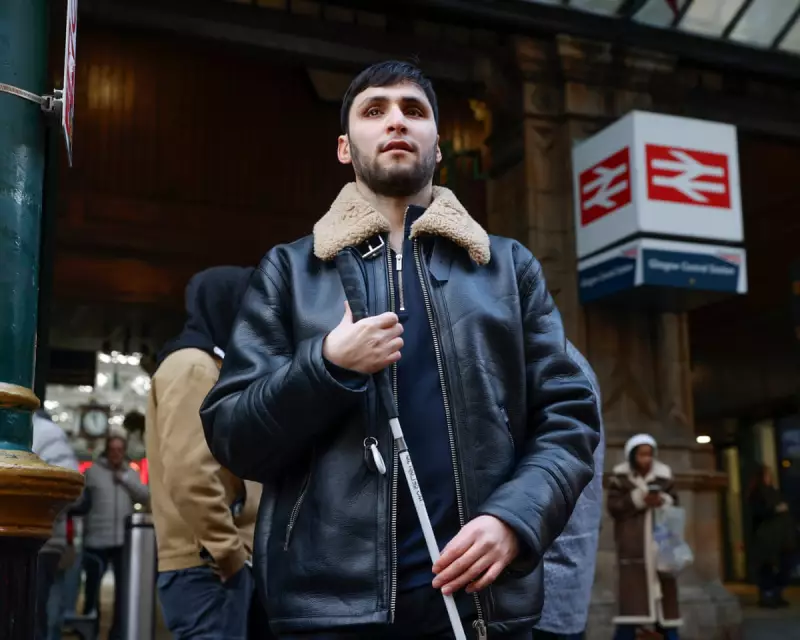
A blind man who fell onto railway tracks at Manchester Piccadilly station has been awarded £18,000 in compensation following a three-year legal battle against Network Rail.
Narrow Escape from Approaching Train
Abdul Eneser, a master's law student at the University of Strathclyde, experienced a terrifying ordeal when he slipped off platform 14 at Manchester's busiest railway station. The incident occurred after passenger assistance failed to meet him following a train delay, with staff having reportedly gone home.
"When I was down on that track I just thought, this is it," Eneser recalled. "The person dispatching from the other side of the platform told me that there was a train that was going to come past, and it wasn't going to stop."
Critical Missing Safety Feature
Eneser attributes his fall directly to the absence of tactile paving - the raised surface patterns that help visually impaired people detect platform edges. Without this crucial safety feature, he was unable to sense his proximity to the platform edge.
Miraculously, with just sixty seconds to spare before a freight train arrived, Eneser managed to haul himself back onto the platform, sustaining injuries to his knees, hands and neck in the process.
"It was a very lucky escape for me," he acknowledged, while adding that the experience has left lasting psychological effects. "Every time I go to that station, or anytime I'm near any platform, that comes up. It's really anxiety-inducing to travel now."
Legal Victory Without Admission of Liability
Law firm Leigh Day successfully argued that Network Rail breached its duties under both the 2010 Equality Act and the Occupiers' Liability Act 1957 by failing to make reasonable adjustments for disabled passengers.
Despite awarding compensation, Network Rail did not admit liability in the settlement. The case highlights ongoing accessibility concerns across Britain's railway network, particularly following the 2020 death of Cleveland Gervais, another blind man who fell from a platform lacking tactile paving.
Call for Proactive Accessibility Improvements
Eneser has become a vocal advocate for improved railway accessibility, criticising what he describes as a reactive rather than preventative culture within the rail industry.
"The rail industry have a culture of let's react to things rather than minimise risk and look ahead - that was one of my main reasons why I took on this case," he explained.
His specific recommendations for improvement include:
- A live-chat feature on passenger assist apps for easier staff communication
- Clearly marked passenger assist buttons at every station entrance
- More proactive consultation with visually impaired travellers about their experiences
Compensation as Secondary Concern
For Eneser, the financial settlement represents only part of the victory. "The money is a plus, but for me the main reason I did it was to prevent it happening again, both to myself and to other visually impaired travellers," he stated.
He emphasised the broader significance of the case: "This is about much more than compensation. Poor accessibility in rail travel is not just a one-off issue. This is something that prevents myself and others with visual impairments from travelling with confidence."
The incident has fundamentally changed Eneser's relationship with rail travel. "I'm not always sure that I'll be met with the right level of support to complete my journeys. At the best of times, it makes travel stressful, and in the worst-case scenario it can be really dangerous."
Network Rail announced in July 2025 that it had completed installation of tactile paving across its network, though Eneser's case demonstrates that accessibility challenges extend beyond physical infrastructure to encompass staff training, assistance protocols and proactive risk management.




