
Blind and partially sighted Londoners are being forced to abandon buses and rely on taxis because floating bus stops are so dangerous, campaigners have warned. They are urging the Mayor of London, Sadiq Khan, to halt all future construction of these cycle-infrastructure designs, which they say put vulnerable pedestrians at risk of collisions with cyclists.
What are floating bus stops?
Floating bus stops, introduced in 2013, feature a cycle lane running between the bus stop and the pavement. Cyclists can continue riding while passengers board or alight, but pedestrians must cross the cycle path to reach the bus. Two main types exist: Shared Use Bus Border (SUBB), where the cycle lane runs across the front of the bus stop, and bus stop bypasses (BSBs), where the bike lane runs behind the stop. Together, they account for about 1.5% of London's 19,000 bus stops.
Last year, ministers paused the rollout of SUBBs, but BSBs were allowed to continue. More than a year on, campaign groups representing blind and partially sighted people are calling for a complete halt on all floating bus stops, claiming they present a significant danger.
Campaigners demand a complete halt
Sarah Gayton of the National Federation for the Blind UK (NFBUK) told the Local Democracy Reporting Service (LDRS): "They're totally unsafe - they're inaccessible. The bikes that people are riding, the e-scooters, the e-bikes and the illegal e-bikes, they're absolutely coming down here at speed. People can't hear them, they can't see them, and they can't get out of the way. So designs like this is totally unsafe, totally inaccessible, and blind people will keep away from them."
Gayton added: "There needs a complete halt on all of the floating bus stop designs, the SUBBs, the BSBs, and that's actually what the Disabled Persons Transport Advisory Committee advised central government. They said to pause all of these floating bus stops back in August 2024 and again in October 2025. So that's a statutory body and if they're telling policymakers to pause them all until more research is done, well Sadiq Khan should actually be listening to that and say we halt all of them."
Close calls observed in Walthamstow
The LDRS joined Gayton to observe a busy floating bus stop next to Blackhorse Road Station in Walthamstow. Over two hours, several close calls with pedestrians were observed, cyclists were seen travelling down the wrong track, and multiple e-bikes and e-scooters sped by without slowing.
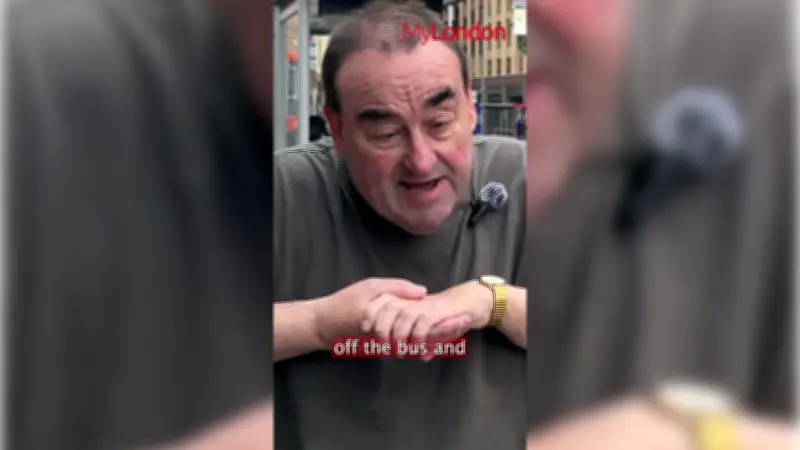
Gary Wiggins of the Waltham Forest Blind Association, who is partially sighted, said: "The bus stops are very dangerous for visually impaired people. I've got off the bus just up the road at Walthamstow and one of these cyclists has like bumped into me, knocked me over and I got abuse from the person who was riding the bike - they blamed me. Well, I can't see. So, that's not my problem, is it?"
Wiggins added: "When you get off the bus, there's a warning to passengers to be careful of the cycle lane. Well, to me, people just want to get off the bus. They want to get to where they want to get to. They just want to get out, get off the bus, and go. It's not right that we've been put in this situation. It's not right. I don't use the buses anymore, hardly ever at all now. If I go out anywhere, I use taxis. And that's more money, more cost and all the rest of it. But I'd rather be safe than sorry to be to be quite honest."
Blind Londoners forced into taxis
Hyacinth Malcolm, who is fully blind, said: "Sadiq Khan and TfL keep saying that every journey matters - but it only matters if I can take the bus. The bus is my life and it's the only way I can travel. I have to take a taxi everywhere because I'm not sure if there will be a cycle lane when I step off the bus or not."
According to TfL figures, between 2020 and 2022, there were six casualties at floating bus stops - 0.8% of the 623 pedestrian casualties involving cyclists during that three-year period. Despite these numbers, pro-cycling groups and City Hall defend the designs as essential for expanding cycling infrastructure.
Mayor's defence and cycling goals
Sir Sadiq Khan has staunchly defended floating bus stops, seeing them as a means to make London more cyclist-friendly. He wants 80% of all journeys in the city to be made on foot, bicycle, or public transport by 2041, which would require expanded cycling infrastructure.
Simon Munk of the London Cycling Campaign said: "Some campaigners claim floating bus stops are dangerous - the evidence clearly says they are no more dangerous than other stretches of road, pavement and cycle route. Some also claim floating bus stops are so difficult to deal with that a significant proportion of visually impaired people avoid using such stops. While evidence on this is limited, it appears to show the opposite. If you want more cycling and a wider range of people cycling, floating bus stops are a necessity. Floating bus stops should be delivered in as high-quality and inclusive manner as possible, but nonstop calls for their removal, them being banned, isn't coherent or safe for anyone, and would not deliver positive outcomes for inclusive mobility."
Political criticism and calls to scrap
However, City Hall Conservatives Transport spokesman Thomas Turrell told the LDRS that floating bus stops are "needlessly risky". He said: "Almost every disability group and charity I speak to raises how intimidating these floating bus stops are to passengers, especially visually impaired people. They represent a legitimate risk to disembarking passengers who are placed directly into the path of cyclists, to the extent that TfL has to actively warn passengers to be careful when getting off at a floating bus stop. What is Sadiq Khan's obsession with this failed design? The Mayor should do the right thing and scrap them - to protect passengers, especially vulnerable passengers, as well as cyclists who risk being injured too in a collision. There is no reason to retain them."
RNIB research and government response
Erik Matthies, RNIB's Policy Lead for travel and transport, who has sight loss himself, added: "Our research shows that nearly half of blind and partially sighted people avoid BSBs – even when this means, for a few, that can’t get around on our own at all any more. There’s no safe and accessible way for people with sight loss to cross the cycle lane to and from a bus stop. People with sight loss depend on buses more than any other form of transport, so it’s imperative we get this right."
A DfT spokesperson told the LDRS: "We have listened carefully to the concerns raised about floating bus stops from a wide range of groups. Following our pause on some floating bus stops in November, further research is being carried out to ensure accessibility is at the heart of these designs, and funding is available to help local authorities make changes to existing sites."
Earlier this year, ministers published updated guidance on all floating bus stops, allowing some London boroughs to push ahead with paused schemes. This included a new cycleway between Aldgate and Blackfriars, originally approved by the City of London Corporation in October 2024. After reviewing the proposed floating bus stops against the guidance, officers concluded the designs met the "recommended design process".
NFBUK wrote to Prime Minister Andy Burnham last month warning that "simply changing the designs to incorporate this new guidance will not make the floating bus stops safe or accessible for blind and partially sighted people to use independently."
City Hall and TfL responses
A City Hall spokesperson said: "The Mayor and his team are committed to enabling safe and sustainable travel across the capital for everyone. That’s why we welcome recent statutory guidance on the provision and design of floating bus stops and the ambition to help ensure future installations are as accessible as possible for everyone, while protecting cyclists from motor traffic. Bus stop bypasses provide a safer route for everyone by physically separating buses and overtaking vehicles from people on bikes. We continue to engage with Londoners to understand their experiences and explore potential transport network enhancements as we build a greener, safer, better London for all."
A TfL spokesperson added: "Bus stop bypasses are an important part of delivering more inclusive cycling infrastructure and improving road safety, however, we recognise they can present challenges, particularly for blind and partially sighted people. People cycling must follow the rules of the road and stop at zebra crossings and we are working on measures to increase awareness of bus stop bypasses among cyclists. We welcome recent statutory guidance on the provision and design of floating bus stops and the ambition to help ensure that future installations are as accessible as possible for all users, while protecting cyclists from motor traffic. We continue to work with the Department for Transport, Active Travel England, disabled people and accessibility groups to understand experiences and explore how we can further enhance design."




