Gaza's Cancer Crisis: Thousands Trapped Without Treatment Amid War and Blockade
In the heart of Gaza's humanitarian catastrophe, a particularly devastating crisis is unfolding for thousands of cancer patients who find themselves trapped without access to life-saving treatment. The ongoing conflict and stringent blockade have created impossible conditions for those battling serious illnesses, with medical evacuations becoming increasingly difficult and essential medications virtually unavailable.
A Mother's Agony: Ismail's Story
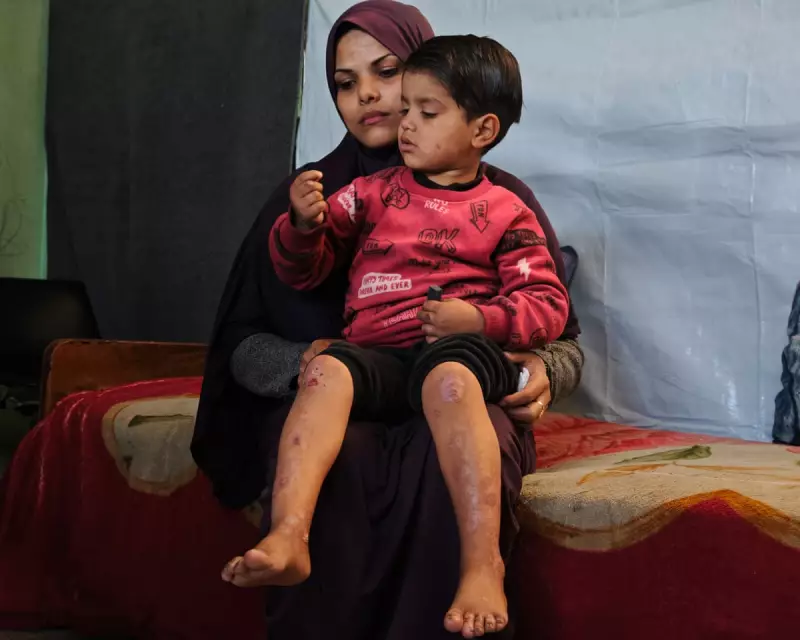
When the Gaza war began, Ismail Abu Naji was just 18 months old, his small body already ravaged by a rare blood cancer that doctors had diagnosed months earlier. His family had arranged for specialised care at Al-Makassed hospital in Jerusalem before the conflict, but the blockade imposed after Hamas's October 2023 attack meant Ismail could not leave the territory.
Now living in a tent at a school with his mother Aya Mohammed Abu Hani, Ismail's condition has deteriorated dramatically. With even basic painkillers unattainable under the blockade, his mother can only try to ease his pain by gently dabbing his swollen, bleeding lesions with a cloth soaked in salt water.
"Ismail's life before the war was already difficult, and it has become even harsher since," she told the Guardian. "He cannot sleep due to severe pain, high fever and cries constantly. We were displaced many times from one place to another, which worsened his condition. Before the war, hospitals were able to offer antibiotics and painkillers. But now, they can't even provide a single painkiller."
Healthcare System in Ruins
The Palestinian healthcare system has been reduced to ruins by Israeli airstrikes on hospitals. In March 2025, Israel destroyed Gaza's only specialised cancer treatment hospital, eliminating the territory's sole provider of oncology care. Since then, doctors have been pushed into makeshift clinics, operating with almost no resources, including the basic tools needed for diagnosis.
"As for cancer diagnosis, we have reached an extremely critical stage," said Dr Saleh Sheikh al-Eid, a specialist physician in haematology and oncology at Nasser medical complex in Khan Younis. "Basic diagnostic tools, such as biopsy needles, are unavailable. Patients come to us with obvious cancerous masses, yet we lack the means to take samples and examine them. As a result, we have lost many patients without even being able to properly diagnose or treat them."
Despite recent ceasefire agreements intended to facilitate aid entry, essential medical supplies remain severely restricted. "We receive repeated warnings from the pharmacy that essential chemotherapy drugs are close to running out," al-Eid explains. "The resources available to us do not exceed 5% of those available in hospitals in the West Bank, and in many cases they are almost nonexistent."
The Human Cost of Restricted Movement
The World Health Organization reports that about 10,700 Palestinians have been evacuated to 30 countries for specialised care since October 2023, nearly a quarter of them cancer patients. However, according to UN figures, there are more than 11,000 cancer patients in Gaza requiring treatment outside the territory.
According to health officials in Gaza, approximately 4,000 people with official referrals for treatment to third countries are unable to cross the border. The WHO states that 900 people, including children and cancer patients, have already died while waiting for evacuation.
The Israeli NGO Physicians for Human Rights Israel (PHRI) says evacuation routes to third countries have become "near impossible" to operate, especially since the closure of the Rafah crossing in May 2024. The organisation argues that Israel is failing to meet its obligation to provide medical care to populations under its control.
"Under the Israeli and international law, and according to the high court of justice, Israel is legally obligated to ensure access to medical care for populations under its effective control," PHRI states. "Current restrictions on patient movement violate this duty to protect the health and prevent avoidable death, given its full control over the movement of patients out of Gaza."
Personal Stories of Survival and Loss
Fathiya Abu Frieh, 65, diagnosed with uterine cancer last year, lives with the dual burden of her illness and the loss of her granddaughter, killed in an Israeli bombardment. Living in a tent in Deir al-Balah, she describes her current treatment as "nothing more than an anaesthetic injection – just enough to keep me alive."
Islam Al-Naour, a 40-year-old with testicular cancer displaced in Gaza City, explains how his weakened immune system makes even minor illnesses severe. "Life became difficult even for a healthy person, so imagine what it is like for a cancer patient like me, forced to carry water, set up tents, and secure them during harsh weather conditions."
The Guardian's March 2024 visit to Augusta Victoria hospital in Jerusalem revealed at least five children from Gaza receiving cancer treatment. Today, all those children are dead.
A Glimmer of Hope Amid the Crisis
On 12 January, for the first time since the war began, Dr Nour El-Din Abu Ajwa, 48, was allowed to leave Gaza to receive critical cancer treatment at a hospital in Nablus, following a prolonged legal battle by the Israeli human rights organisation Gisha.
Abu Ajwa, who learned he had colon, liver and lung cancer in the second month of the war, told the Guardian: "I fought very hard through the Israeli court to get permission to receive treatment in Jerusalem or the West Bank. I was denied the permit five times, but at the end, the Israeli judge was fair to me and he insisted that I should be allowed to travel."
He expressed hope that his case would open doors for others: "I hope I will be the first of thousands of cancer patients in Gaza who will be allowed to travel and receive proper treatment. I hope I am the one who opened the door for many to be treated as a human being."
Gisha noted that the Israeli state sought to prevent Abu Ajwa's evacuation until the last moment, submitting a request to delay implementation of the court's decision while he was already en route. The organisation stated this case "constitutes, in practice, an initial and important crack in this cruel policy, which must be abolished immediately."
The Ongoing Struggle
Back in the tent at al-Shati Martyrs school, as cold weather and storms rage outside, Ismail's mother prepares another saline compress while trying to distract her son from the pain with a notebook and coloured pencils.
"As a mother, it is unbearable to see my young child suffer without being able to help," she says. "I wish I had the power to ease his suffering, to give him the right to live without pain."
Her words echo the desperation of thousands of families across Gaza, where cancer patients face not only their illnesses but the additional trauma of war, displacement, and a healthcare system pushed beyond breaking point.