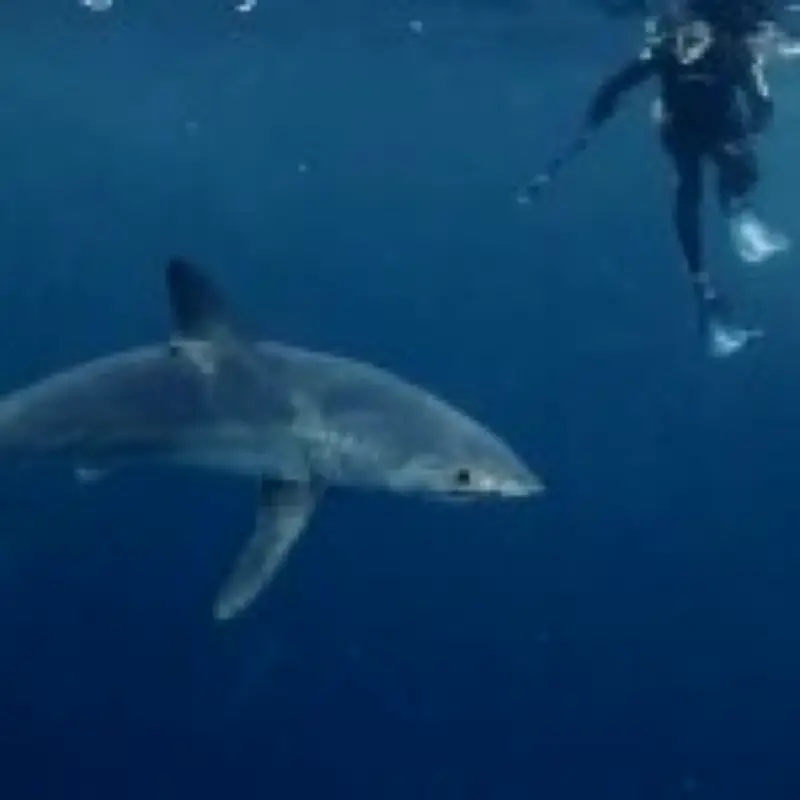
Scientists have suggested that a mutant shark could be terrorising the New York coastline following a string of attacks on other sealife, according to a new Discovery Channel show. The incidents, which occurred around Montauk at the east end of Long Island, include a humpback whale discovered with a 24-inch wound, a 400lb tuna ravaged in the ocean, and a grey seal suffering from a huge bite mark. These events have sparked theories that a 12-foot-long Mako shark, dubbed 'Sharkzilla,' could be responsible.
Nuclear Waste Dumping in Hudson Canyon
Local shark scientist Craig O’Connell, who features in the show 'Sharkzilla Takes New York,' aired over the weekend, has floated the chilling possibility that the local wildlife could have fallen victim to leaking barrels of nuclear waste stored in an underwater canyon for decades. 'In the late 1960s, they dumped 15,000 barrels of nuclear waste in the Hudson Canyon,' O’Connell said. 'Ten years later, they went out to check on these barrels, and they were all leaking.'
Radioactive Mutations and 'Sharkzilla'
O’Connell added: 'Radioactive leaks could be impacting wildlife, even top predators. If animals are subjected to nuclear waste, this could cause genetic mutations and abnormal growth. If this predator is genetically altered, it could be faster, stronger and deadlier than any predator on earth. We are calling it Sharkzilla.' The show follows O’Connell and his team as they head towards the underwater canyon in a bid to lure sharks and collect tissue samples for radioactive testing.
The Hunt for the Mutant Shark
After six hours of capturing footage using a 'baited' camera, the team attracted a number of sharks, including a great white and two female Makos, but these quickly swam away, raising fears they had been scared off by something else. The team employed other methods, including a decoy dolphin fitted with a piece of tuna and a 'blubber blaster' designed to imitate the remains of a dead whale. Ultimately, 'Sharkzilla' appeared, and the crew managed to get close enough to obtain tissue samples.
No Evidence of Radioactive Shark
However, tests on the samples revealed no evidence to prove that radioactive sharks were causing chaos in the waters around Montauk. Instead, 'Sharkzilla' turned out to be a pregnant female Mako seeking out food sources for her young pups. This does, however, indicate that sharks could be returning to Montauk, an area once famous for its large shark populations before overfishing devastated their numbers.
Return of Monster Sharks
'In the past, this is the place you came to catch monster sharks. There are so many records right here off the shores of Montauk,' O’Connell explained. 'All these monster sharks were completely fished out. They’re gone. But all the evidence we are seeing is telling me that all these big sharks might be back.' Known as the world’s fastest shark, the Mako can grow up to 13 feet long and weigh as much as 1,250lb (567kg), with speeds allowing them to hunt fish like mackerel and tuna.
Human Encounters Rare
While Mako sharks might look terrifying, the chances of humans coming into contact with them are comparatively rare, as they tend to live in deep, open water zones rather than near public beaches. According to data from the International Shark Attack File, there are just 10 recorded attacks on humans by Mako sharks between 1980 and 2024, of which three proved fatal. PETA states on its website that the chances of a human being killed by any type of shark are around 1 in 3.7 million.