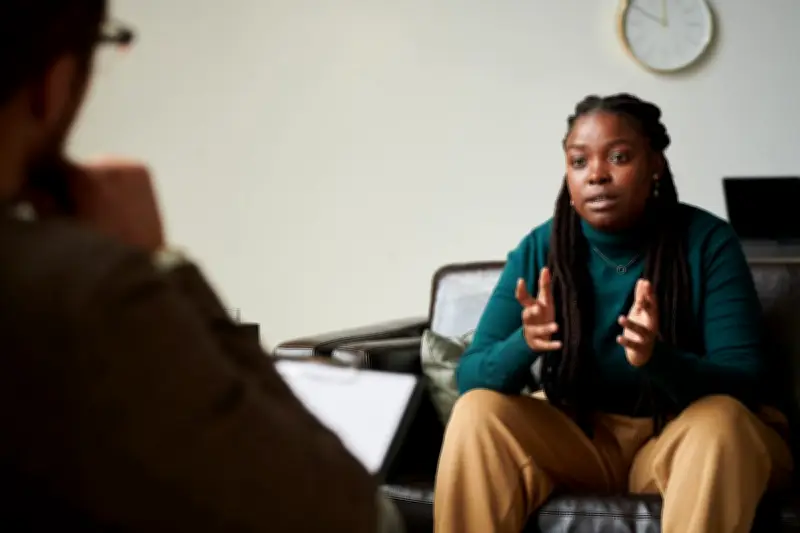
Clinical psychologist Sarah Darghouth describes how AI, particularly ChatGPT, has increasingly entered her therapy sessions, often brought in by patients seeking quick advice. One patient used AI to decide to end a relationship, while another applied AI's suggestions to repair a marital conflict. Darghouth admits feeling both impressed and threatened by AI's efficiency, noting that it sometimes offers in seconds what might take her an entire session to articulate.
Patients turn to AI for therapy
Darghouth recounts a patient who showed her how AI helped him navigate a fight with his wife. After validating his pain, the AI analyzed relational breakdowns and offered repair strategies, which the patient successfully used. She reflects: 'I would probably have offered an unpolished version of one of these ideas over an entire session.' Another patient told her, 'Chat told me I should break up with him,' and ended the relationship shortly after.
These experiences have forced Darghouth to confront the blurred line between human and AI voices in therapy. She sometimes struggles to identify whose emotion or gut feeling she is hearing. To reassert the 'IRL' world, she suggests patients write in a diary instead of talking to AI, and warns about risks: worsening anxiety, false information, increased isolation, and even delusional beliefs or suicidal thinking.
AI's appeal and dangers
Despite her warnings, Darghouth admits using AI herself. When her nine-year-old had a tantrum one Sunday morning, she turned to ChatGPT for support. 'I didn't care that it was phoney,' she writes. 'AI was there, calm and supportive, coaching me to breathe through the screams.' She questions whether the fake help matters if it works, noting that less than 7% of people with mental health and substance use conditions receive effective treatment globally.
However, she highlights serious risks: some patients become 'sucked in' by AI's sycophantic embrace, staying in bed all weekend and uploading private lives to big tech. She emphasizes that AI can be dangerous and does not recommend its use for mental health support.
What is real therapy?
Darghouth questions what distinguishes human therapy from AI. She recalls a session where a patient was intensely angry and ashamed. Her words fell flat, and she felt tongue-tied and helpless. She imagines AI stepping in with efficiently organized ideas, and wonders if human therapists will ultimately lose when it comes to technique or interpretation.
Friends reassure her that people won't feel connected to AI, but she disagrees. 'Therapy is a major reason people use AI,' she notes, and as AI improves at recognizing facial expressions, its digital empathy will accelerate its relational potency. She points to friends in Italy using AI therapists, and suggests that in a world with limited access to care, AI's availability may outweigh its flaws.
Embracing the mess
Darghouth recalls a grad school professor who compared therapy to sorting a messy closet: everything must be taken out, creating chaos, before things can be sorted. She reflects: 'What if it's the mess in therapy that is its most prized possession?' This mess includes conflict, hesitation, stalling, wrong decisions, and strong emotions that defy words. She argues that AI's clean, all-knowing stance may be a liability on the slow, unsteady path of healing.
She envisions a future where many people are swept up by AI-like therapy, but a minority will seek human therapists—those who frustrate and annoy, but also feel genuine happiness at small good things. These therapists say the wrong thing, forget parts of the past, and sit with patients in emotional tornadoes. Darghouth ends with a patient who returned after a difficult session, saying that a joke Darghouth laughed at as she left made her feel better—not the rich therapeutic dialogue Darghouth had perceived. 'I didn't even remember the joke,' she writes. 'But I went with it, not really understanding, humbled, and feeling pretty happy being a human.'