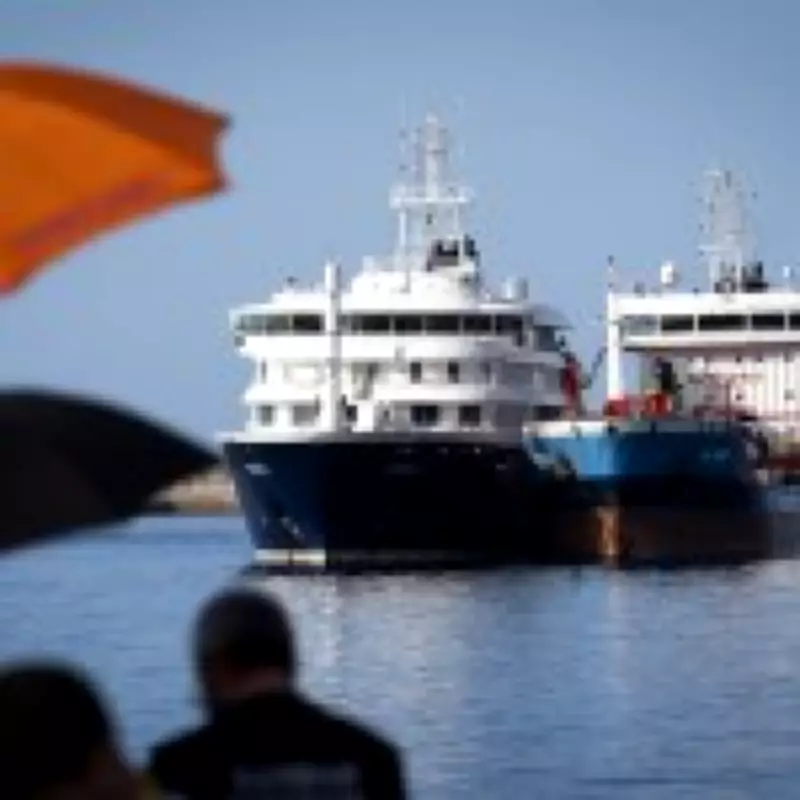
A French woman who tested positive for hantavirus after being evacuated from a cruise ship was initially told by Spanish doctors that her symptoms were 'probably just anxiety,' according to Spain's health minister. The woman, a passenger on the MV Hondius, became ill with the rare disease after the ship reached Spain's Canary Islands on Sunday.
Health Minister Javier Padilla Bernáldez told The Guardian that doctors from the Spanish foreign health service dismissed her symptoms as stress or anxiety. 'They were not thinking that these symptoms were compatible with hantavirus,' he said. 'Why? Because what she was telling them was that she had an episode of coughing some days ago that had disappeared, and what she was having at that moment was kind of like stress or anxiety or nervousness. So it was not catalogued as hantavirus.'
The World Health Organization reported that the woman is in 'very critical' condition. The European Centre for Disease Prevention and Control stated that health checks on the ship were conducted by onboard medical doctors, but an epidemiologist on board did not perform clinical examinations of passengers.

Outbreak Overview
The MV Hondius left Argentina for remote islands in the southern Atlantic Ocean nearly six weeks ago. Since then, three people have died, and at least seven others have fallen ill or tested positive for hantavirus. WHO Director-General Dr. Tedros Adhanom Ghebreyesus said there is 'no sign' of a hantavirus pandemic, but cautioned that more cases are likely because symptoms can take up to eight weeks to appear. 'While they were still on the ship, even if they were taking some preventive measures… we would expect more cases,' he added.
What is Hantavirus?
Hantavirus, sometimes called the 'rat virus,' is a rare family of pathogens carried by rodents. There is no vaccine or cure. The virus spreads through contact with feces, urine, or saliva of infected rodents. Early symptoms—fever, chills, body aches—are easily mistaken for flu but can escalate to heart or lung failure. The Andes strain involved in this outbreak is endemic to South America, including Argentina, where the ship departed on April 1.
Dr. Stathis Giotis, a life sciences lecturer at the University of Essex, told Metro that the Andes hantavirus is the only known strain that can spread from human to human, though such cases are rare. 'It is clearly a serious situation for those directly affected and it deserves careful public health follow-up, but there is no evidence at present that this represents a broader epidemic threat,' he said.
Quarantine and Response
Twelve Dutch hospital workers at Radboudumc university medical centre have been quarantined for six weeks after failing to follow strict protocols when taking blood from a hantavirus patient evacuated from the ship. They also improperly disposed of the patient's urine.
Cruise operator Oceanwide Expeditions reported that 87 guests and 35 crew have been flown home, including 20 British holidaymakers now isolating at a Merseyside hospital. Twenty-seven people remain on the ship, which is sailing to Rotterdam, Netherlands.