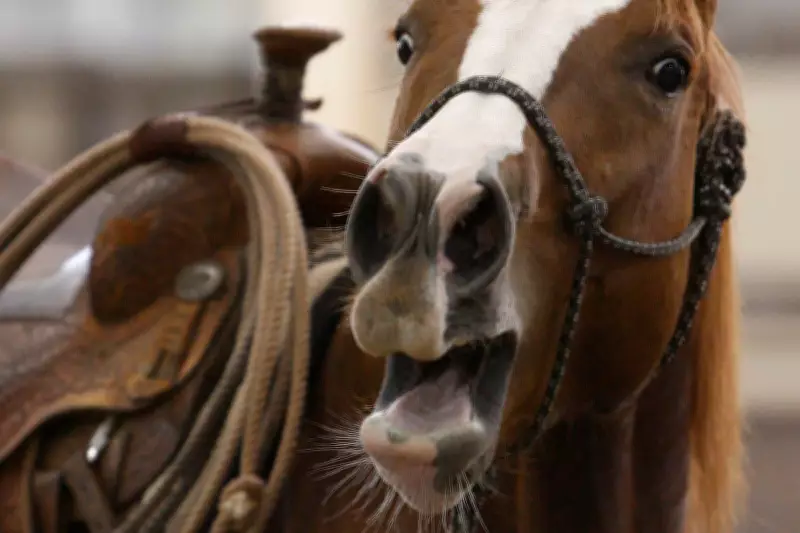
Scientists Discover Whistling Secret Behind Horses' Distinctive Whinny
Researchers have finally unraveled the mystery behind the horse's distinctive whinny, revealing that these majestic creatures produce their unique two-toned calls through a sophisticated whistling mechanism in their voice box. The groundbreaking study, published in the journal Current Biology, provides unprecedented insight into how horses communicate with their complex vocalizations.
The Dual Nature of the Equine Whinny
Horses use their whinnies for various social purposes, from finding new companions and greeting familiar friends to expressing excitement during feeding time. What has long puzzled scientists is how these large mammals produce a sound that combines both high- and low-pitched tones simultaneously, creating what researchers describe as a cross between a grunt and a squeal.
The low-frequency component of the whinny wasn't particularly mysterious. Similar to human speech and singing, this part originates from air passing over vibrating bands of tissue in the larynx. However, the high-pitched element presented a significant scientific challenge, as larger animals typically possess larger vocal systems that naturally produce lower sounds.

Innovative Research Methods Reveal Whistling Mechanism
To solve this acoustic puzzle, scientists employed innovative techniques including inserting small cameras through horses' noses to film internal vocal processes during whinnies and nickers. They complemented this with detailed anatomical scans and experiments using isolated larynxes from deceased horses.
The research team discovered that horses produce the mysterious high-pitched tones through a whistling process that begins in their voice box. As air vibrates the laryngeal tissues, a specialized area just above contracts, creating a small opening through which the whistle escapes. This mechanism differs fundamentally from human whistling, which we accomplish using our mouths.
Scientific Community Reacts to Groundbreaking Discovery
"I'd never imagined that there was a whistling component. It's really interesting, and I can hear that now," remarked Jenifer Nadeau, a horse researcher at the University of Connecticut who wasn't involved in the study. "Knowing that a 'whinny' is not just a 'whinny' but that it is actually composed of two different fundamental frequencies that are created by two different mechanisms is exciting," added Alisa Herbst from Rutgers University's Equine Science Center in an email response to the findings.
While small rodents like rats and mice employ similar whistling techniques, horses represent the first known large mammal with this vocal capability. They're also the only animals documented to whistle through their voice boxes while simultaneously producing other vocal sounds.
Evolutionary Implications and Communication Complexity
The study raises intriguing questions about how horses developed their two-toned vocalizations. Wild Przewalski's horses and elks demonstrate similar capabilities, but more distant equine relatives like donkeys and zebras cannot produce the high-pitched components.
According to study author Elodie Mandel-Briefer from the University of Copenhagen, this dual-frequency communication system likely allows horses to convey multiple messages simultaneously. "They can express emotions in these two dimensions," Mandel-Briefer explained, suggesting the differently pitched components may help horses express a more nuanced range of feelings during social interactions.
This research not only advances our understanding of equine communication but also opens new avenues for studying vocal evolution across mammalian species. The discovery that large mammals can produce high-pitched sounds through specialized whistling mechanisms challenges previous assumptions about animal vocalization and highlights the sophisticated nature of horse social communication.