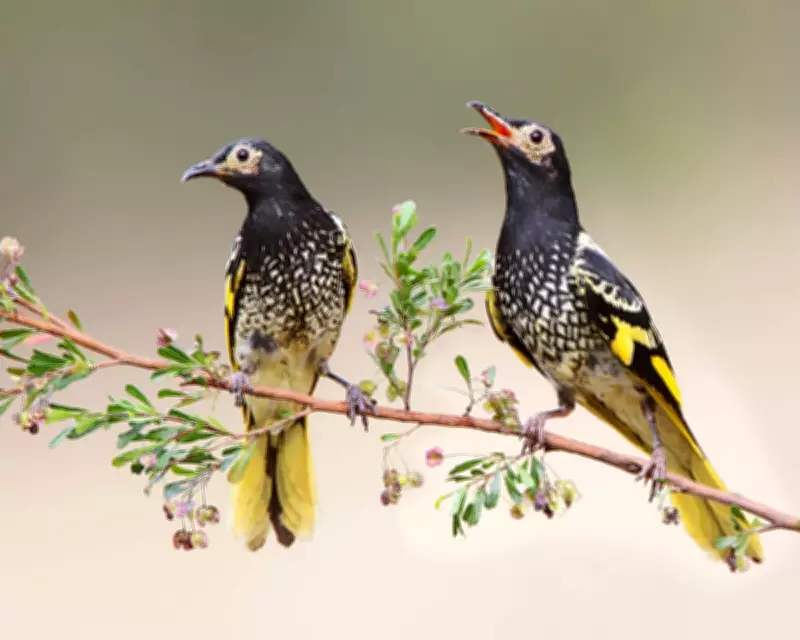
Critically Endangered Regent Honeyeater's Lost Song Rediscovered Through Wild Tutors
In a groundbreaking conservation effort, the critically endangered regent honeyeater has rediscovered its lost song, with wild-born birds successfully teaching the complete version to zoo-bred males. This discovery offers new hope for the survival of one of Australia's rarest birds, whose population has dwindled to fewer than 250 individuals in the wild.
From Vast Flocks to Near Extinction
Once seen in vast flocks across south-eastern Australia, from Queensland to Kangaroo Island in South Australia, the regent honeyeater has experienced a dramatic population decline in recent decades. Today, the songbirds are mostly confined to the Blue Mountains area. As numbers have diminished, so has the complexity of their song, with the typical tune virtually disappearing from the wild and being replaced by a simpler version containing half the number of syllables.
Rescuing the Song from the Brink
A team of researchers has now saved the song from the brink of extinction. Using recordings and direct instruction from two wild-born male "song tutors," they have taught young zoo-bred regent honeyeaters their original wild call. Dr. Daniel Appleby of the Australian National University, the study's first author, explained that initial attempts using recorded songs played daily for six months were unsuccessful.

However, in the second year, the team recruited wild-born males as singing teachers, achieving greater success. "We took fledgling birds from all different parents and creched them with a wild male who sang correctly," Appleby said. The team also found that reducing class sizes to about six juvenile males per adult tutor improved learning outcomes.
Significant Progress in Song Restoration
The study, published in the journal Nature Scientific Reports, revealed that the proportion of juveniles learning the wild song increased from zero to 42% within three years. Notably, the full version of the wild song taught to zoo-bred males disappeared from the wild during the study, making the zoo population the only remaining source of traditional song culture.
Ecologist Dr. Joy Tripovich, who studies regent honeyeaters at the Taronga Conservation Society and the University of New South Wales, described hearing the zoo-bred birds sing their restored song for the first time as "really exciting." Since 2000, Taronga and its partners have released 556 zoo-bred regent honeyeaters into New South Wales and Victoria, with more recent releases including males who have learned their original song.
Future Implications for Conservation
More research is underway to determine the impact of the song tutoring program on the success of birds released back into the wild. The researchers hope that the restored song could improve breeding success and overall fitness of zoo-bred birds once they are released. The end goal, as Appleby stated, is to "see wild and captive birds interbreeding," something that historically was rarely observed.
Tripovich emphasized the broader aim: "Our aim for the overall project is to have species become self-sustaining. We really want them to grow their numbers on their own so that we don't need to intervene any more." This innovative approach highlights the importance of cultural transmission in conservation efforts and offers a model for saving other endangered species.