
Nearly a year after thousands of dead fish washed ashore on Lake Suchitlán, El Salvador’s largest freshwater body, fishers and residents still lack official explanations for the pollution crisis that has devastated their livelihoods and raised health concerns.
Sudden die-off and invasive bloom
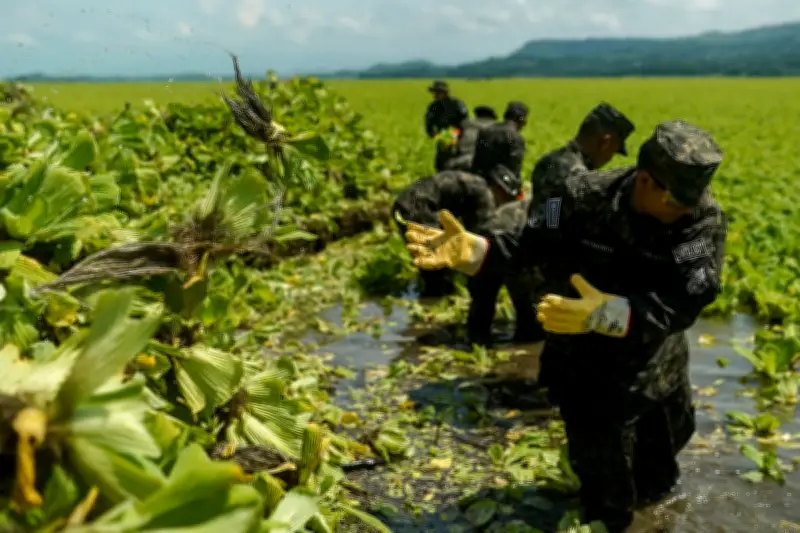
In August 2025, nearly 70% of the lake’s 135 sq km (33,000 acres) surface was carpeted with water lettuce (Pistia stratiotes), an invasive species. The bloom followed a massive fish die-off that left thousands of dead fish along the shoreline. The lake, also known as Cerrón Grande, is a Ramsar site hosting 12 of El Salvador’s 14 native fish species and endangered cougars and ocelots. It also supplies about 28% of the country’s hydroelectric power via the Cerrón Grande dam.
Fishers who earn around $15 (£11) daily were forced to join clean-up crews or rely on relatives’ income. The military was mobilized to assist. Tourism also collapsed as visitors stopped coming due to opaque, foul-smelling water. Alberto Castillo, a boat operator in Suchitoto, said: “The clean-up seemed impossible. People are starting to come back very slowly, but during these months we had to take different jobs, getting only 30% of what we were making before.”
Lack of official explanation
Despite the scale of the disaster, El Salvador’s government under President Nayib Bukele has provided no explanation. Scientists and local groups had warned for years about untreated sewage, agricultural runoff, and weak water-quality enforcement. Biologist Gabriel Cerén explained: “What facilitates the reproduction [of water lettuce] is the high amount of nutrients that the Lempa River gets from fertilisers that end up in the lake and concentrates a high amount of nitrogen and sulphates.”
Researchers from the University of El Salvador’s toxicology laboratory (Labtox) analysed water samples weeks after the die-off. They found no anomalies, but cautioned that monitoring during the bloom was impossible due to dense vegetation. Labtox does not test for pesticides like paraquat, widely used in the region. Residents reported seeing agriculture-use drones flying over the lake before the die-off, but no authority has acknowledged using chemicals.
Health and environmental impacts
Fish deaths, mosquito surges, and foul smells have become common. Many families continue to eat contaminated fish out of necessity. Noel Avalos, a fisherman from Copapayo, said: “We eat them out of necessity. Our bodies have had to adapt.” Tourists have reported skin rashes after swimming, and gastrointestinal and respiratory infections are common in lakeside communities.
El Salvador treats only a fraction of its wastewater, and municipalities upstream discharge effluent directly into rivers feeding the reservoir. Environmental regulations are rarely enforced, and monitoring agencies remain underfunded. Castillo urged: “The lake needs an urgent study. We’ve had fish die before, but nothing like this. First the water lettuce, then the plastic, now the fish – it demands attention.”
Broader regional crisis
Lake Suchitlán’s crisis mirrors similar problems across Central America. In June, a storm swept large amounts of rubbish into the reservoir. Earlier in 2025, Lake Coatepeque experienced a large cyanobacterial bloom attributed to high temperatures and excess nutrients. Lake Atitlán in Guatemala and Lake Yojoa in Honduras face similar stressors from agricultural runoff and industrial activity.
For residents like Avalos, the fear is that conditions remain ripe for recurrence. “This has become the perfect breeding ground for it to happen again and again,” he said. “It’s pure contamination.”



