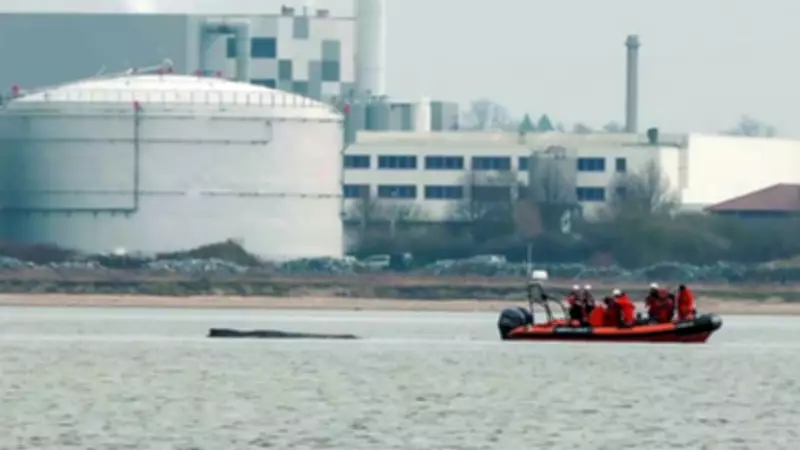
A humpback whale has been stranded once more off the coast of Germany, mere days after a successful rescue operation set it free earlier this week. The whale, measuring between 12 and 15 meters in length, became stuck again in Wismar Bay, located in northern Germany, on Saturday, according to local media reports.
Rescue Efforts and Recurring Stranding
The initial rescue mission captured global attention when the whale was found stranded on a sandbank at Timmendorfer Strand beach. Rescuers employed an excavator to dig an escape tunnel on Thursday, and by early Friday, the whale managed to swim free. It was later sighted further east near the coastal town of Wismar, in the state of Mecklenburg-Pomerania.
However, hopes for the whale's safe return to the Atlantic Ocean were dashed on Saturday when Greenpeace confirmed to the German news agency dpa that the whale had become stranded again in Wismar Bay. A spokesperson for Mecklenburg-Pomerania's environment ministry stated, "After managing to free itself from its plight, the whale was spotted again at noon today in Wismar Bay." It remains unclear whether a second rescue mission will be launched.

Challenges in the Baltic Sea Environment
The humpback whale likely migrated from the Atlantic Ocean into the Baltic Sea, but this environment poses significant threats to its survival. The salt concentration in the Baltic Sea is insufficient for humpback whales, and the area lacks the appropriate nutrition they require. Experts note that the whale has already developed a skin condition, likely due to these unsuitable conditions.
Some marine biologists speculate that the animal may have lost its way while pursuing a shoal of herring. Others suggest it is probably a male, as males are more prone to migration. For the whale to survive, it must navigate several hundred kilometers through German and Danish waters back to the Atlantic Ocean.
Global Attention and Rescue Techniques
The initial rescue operation garnered headlines worldwide, with local media providing live updates and streaming video from the scene. Authorities attempted to guide the whale toward deeper water using coastguard and fire department boats to create large waves. Rescue teams also tried to encourage the whale to swim along a dug trench by generating noise, to which the animal reportedly responded with humming sounds.
Animal rights activist Robert Marc Lehmann was photographed near the stranded whale, highlighting the widespread concern for its welfare. The recurring stranding underscores the complexities of marine rescue operations and the precarious situation for whales in the Baltic Sea.