From Logging Camps to Canopy Conservation: A Personal Transformation
Jamiluddin Jami was born in Tawau, a Malaysian city on the island of Borneo, where he grew up surrounded by logging camps due to his father's work in the industry. In the early 1990s, he witnessed extensive forest clearing for commercial purposes, initially accepting it as a normal part of life. However, his perspective shifted dramatically when he started working in conservation as a teenager at the South East Asia Rainforest Research Partnership in the nearby Danum Valley.
His role involved planting seedlings in deforested areas, which sparked a deep understanding of the critical need to protect these ecosystems. At around 19 years old, Jami observed colleagues climbing trees in the valley's forest to assist with scientific research, such as measuring tree heights and setting up wildlife cameras. Despite a fear of heights, he felt an immediate desire to join them, recognizing that while many conduct conservation work on the ground, few venture high into the canopy.
The Quest for the Tallest Tropical Tree
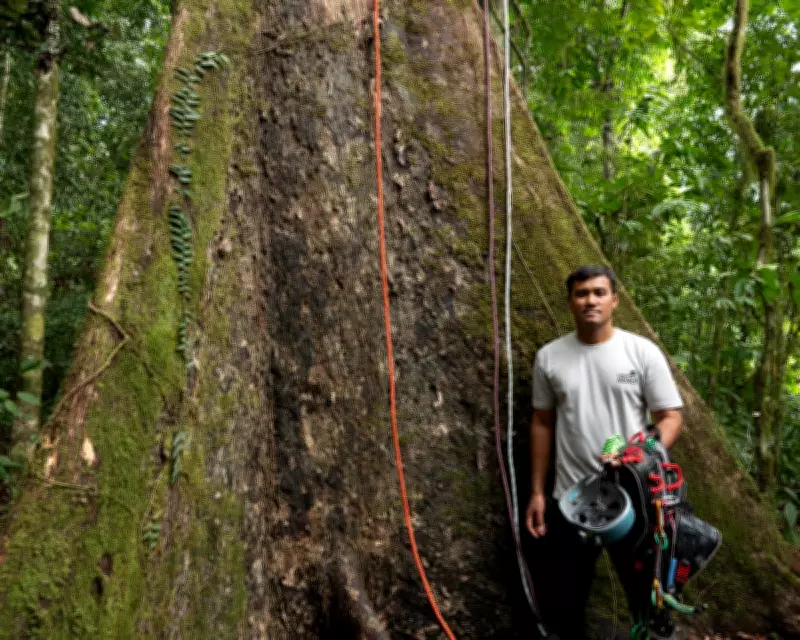
In 2018, researchers from the University of Nottingham identified a yellow meranti tree in a Borneo rainforest, estimated to be 100 meters tall, potentially making it the world's tallest tropical tree. Jami's team was assigned to verify this claim. They used a GPS location to navigate through dense forest, a journey that took three to four hours of wading through thick vegetation. Upon arrival, Jami recalls looking up in awe, but it took three months of nervous hesitation before he attempted the climb in January.

For the expedition, he assembled a team of 10 people, bringing approximately 400 meters of rope. They used a fishing line to anchor ropes to the tree, with two climbers ascending while others monitored from the ground. Equipped with climbing harnesses and a rope-walking system, Jami and his colleague moved branch by branch. Jami carried a tape measure in his harness, with one end held by a team member below to track their progress.
Perils and Precautions in the Canopy
The ascent was slow and meticulous, as Jami had to inspect each branch for strength and check for hazards like snakes, scorpions, wasps, and other insects. He once encountered bees during a climb, resulting in an attack where a few became trapped in his helmet. He suffered around 100 stings and passed out for 20 minutes after descending, leading him to avoid bright colors while climbing to prevent attracting insects.
During this particular climb, the path seemed clear initially, but his colleague expressed fear due to the tree's isolation, standing about 50 meters taller than surrounding trees. To maintain visibility, Jami instructed his ground team to wear orange helmets. At 70 meters, they appeared as tiny ants from above, and soon, the forest floor vanished from sight. Reaching this height, Jami began to see the broader landscape, and his fear dissipated.
A Breathtaking View from the Top
Jami climbed to approximately 95 meters before the branches became too thin to support him. He used a pole to measure the final height, confirming it at 100.8 meters. From this vantage point, he marveled at the layered canopy of the rainforest, comparing it to a sea with each tree resembling a tiny ripple. Clouds hovered over the forest, creating unique patterns, and the air was still, offering miles of lush green views. He felt a strong urge to stay overnight to soak in the scenery, though the descent was quick, and he eagerly anticipated future climbs.
The first ascent took over two hours, but on subsequent climbs for camera installation, he reduced the time to about 40 minutes. Jami emphasizes that every minute spent in the canopy is worthwhile, driven by a mission to showcase the importance of forest conservation. He believes each tree holds a unique story about our history and finds unparalleled calm in the heights, reinforcing his commitment to this vital work.