The Forest's Devoted Observer: Biruté Galdikas's Lifelong Quest
Following orangutans through dense rainforests presents extraordinary challenges. These arboreal masters swing effortlessly through towering canopies, while human researchers must navigate treacherous swamps, dense underbrush, and dangerous encounters with insects, snakes, and crocodiles just to maintain observation. This demanding existence became the chosen life of pioneering primatologist Biruté Galdikas, who has died at age 79 after dedicating over five decades to understanding and protecting these critically endangered great apes.
Transforming Scientific Understanding
Beginning her groundbreaking fieldwork in 1971, Galdikas fundamentally expanded scientific knowledge about orangutans, creatures whose Malay name translates to "people of the forest." Through patient, persistent observation, she documented that orangutans possess the longest birth interval of any land mammal, with females producing offspring only every seven or eight years while investing intensely in their rearing. Her research revealed that while omnivorous, fruit constitutes the majority of their diet, and they serve as essential "gardeners of the forest"—the only animals large enough to distribute seeds of larger plants through digestion.
Galdikas challenged the long-held assumption that orangutans were strictly solitary creatures. She demonstrated that while males typically live alone, females form loose matrilineal groups, a social pattern consistent across great ape species. Her work inspired subsequent researchers who documented tool use among orangutan populations, with variations in tool selection and application suggesting cultural differences between groups—evidence previously considered exclusively human.

The Conservation Imperative
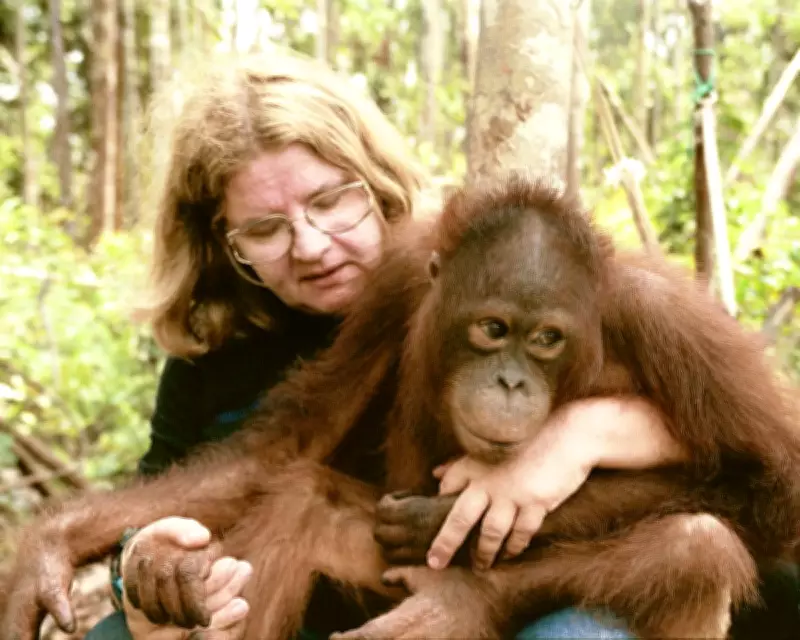
Galdikas naturally evolved from researcher to conservationist, joining her friends Jane Goodall (chimpanzee expert) and Dian Fossey (mountain gorilla specialist) as part of the celebrated "trimates" who revolutionized primate studies. Photographs of these women cuddling orphaned apes graced magazine covers worldwide, though Galdikas faced particular criticism for serving as surrogate mother to hundreds of orphaned orangutans. Critics argued her close relationships compromised scientific objectivity and increased disease transmission risks between species.
Gillian Forrester, who researches ape cognition at the University of Sussex, defended the trimates' approach, noting that disease risks were less understood during their pioneering era. "Those women worked in an age of discovery," Forrester explained. "Now we're moving into an age of responsibility." She emphasized that human surrogate mothers often remain the only viable option for orphaned orangutans who would normally spend their first seven years inseparable from biological mothers.
A Life Shaped by the Forest
Born in Wiesbaden, Germany to Lithuanian immigrant parents, Galdikas moved with her family to Toronto, Canada, where she developed a fascination with human evolution. This interest crystallized around orangutans—the only great apes native to Asia—partly because their eyes feature whites around the iris similar to humans. As a student at UCLA, she encountered paleoanthropologist Louis Leakey, who encouraged her fieldwork alongside Goodall and Fossey, earning them the alternative nickname "Leakey's angels."
In 1971, Galdikas established her first research camp in central Borneo with her then-husband, photographer Rod Brindamour. They named the site Camp Leakey, enduring waist-deep swamps, relentless leeches, and primitive conditions to embed themselves in orangutan habitat. The work demanded constant presence from before dawn until dusk, requiring years of observation before the animals accepted human proximity enough to reveal behavioral patterns. This commitment contributed to her 1979 divorce agreement granting Brindamour custody of their young son, Binti.

Enduring Legacy and Challenges
Galdikas understood that conservation required both public outreach and local community involvement. The organization she founded in 1986, Orangutan Foundation International, will continue under Indonesian leadership headed by Frederick, her son with second husband Pak Bohap, a native Bornean. The foundation has facilitated the release of over 1,000 rehabilitated captive orangutans and rescued approximately 200 wild individuals.
Her conservation work involved significant personal risk. Galdikas faced death threats from logging and palm oil interests, endured kidnapping, and nearly died from malaria. She attributed her eventual lung cancer and pulmonary fibrosis diagnoses to prolonged exposure to wildfire smoke while fighting Borneo's forest fires. "I was struggling against an industry making billions of dollars," she acknowledged in a recent interview. "It did sometimes come to physical violence."
Biruté Galdikas's pioneering research transformed orangutans from scientific curiosities into recognized complex beings with culture, social bonds, and individual personalities. Her work narrowed the perceived gap between humans and other great apes while establishing foundational knowledge for ongoing conservation efforts. She is survived by her children Binti, Frederick, and Jane; seven grandchildren; and her sister Aldona.