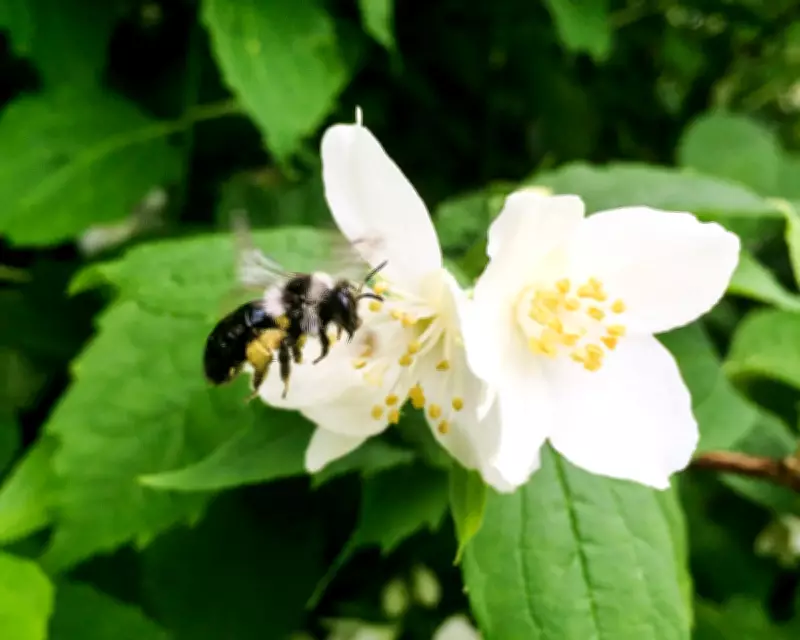
On a sun-warmed day in Langstone, Hampshire, the narrow strip of turf in front of a neighbor's garage comes alive with a remarkable spectacle. Hundreds of ashy mining bees, classified as solitary insects, hover low to the ground in a dense aggregation, transforming this modest patch into a bustling settlement. Despite each female maintaining her own burrow—a neat, pencil-eraser-sized hole excavated in the bare, sun-warmed soil—they gather here in large numbers, creating a shimmering movement that defies their solitary nature.
Striking Appearance and Mating Rituals
The females of this species are striking with their glossy, hairless black abdomens and fuzzy black-and-ash-grey humbug-striped thoraxes. However, it is the smaller, hairier, white-moustachioed males that capture attention. They spend their short lives patrolling the airspace just a few inches above the grass, holding position as they await the emergence of females. Their flight has a peculiar rhythm, resembling insects tethered by an elastic thread, with bodies oscillating steadily up and down.
When a female appears, the calm breaks abruptly. Several males converge at once, grappling for the chance to mate. One male grabs her midair, and the pair tumbles to the ground in a brief coupling before separating. This intense activity peaks during the day, with bees hoping to mate before nightfall.

Foraging and Pollination Importance
Ashy mining bees are polylectic, meaning they forage widely and collect pollen and nectar from a diverse range of spring-flowering plants and trees. This makes them crucial pollinators in the ecosystem. Notably, they play a significant role in pollinating oilseed rape, with their activity synchronizing with the blooming of this bright yellow brassica crop. It is perhaps no coincidence that their presence often coincides with the onset of hay fever for some observers, as they thrive during peak spring pollination periods.
Females returning from foraging flights navigate back to their nests using landmarks such as blades of grass, stones, and the tiny, volcano-like cones of loose earth that mark each entrance. However, they sometimes enter the wrong hole, leading to brief tussles at the threshold as the rightful occupant defends her tunnel before slipping inside.
Daily Cycle and Shelter
By dusk, the bustling site falls still. The females retreat below ground, temporarily sealing their tunnel entrances against intruders and evening rain. Meanwhile, the males disperse to seek shelter in nearby flowers, ending another day of intense activity. This daily cycle highlights the bees' adaptation to their environment, balancing social aggregation with solitary nesting habits.
As one of the 68 UK-recorded species in the genus Andrena, the ashy mining bee exemplifies the complexity of solitary bee behavior. Their presence in Hampshire underscores the importance of preserving natural habitats for these vital pollinators, which contribute significantly to both wild flora and agricultural crops.