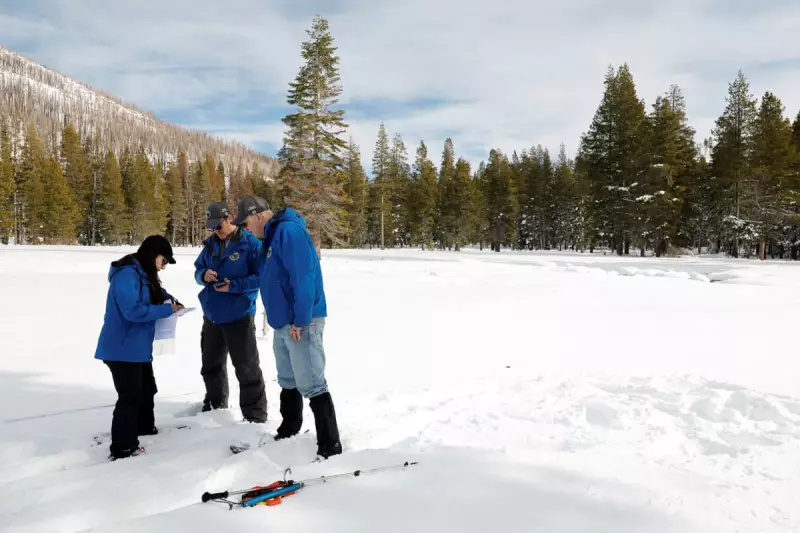
A series of powerful December storms has delivered a much-needed boost to California's crucial mountain snowpack, state water scientists announced this week. The seasonal snow, which acts as a natural reservoir, is a vital component of the state's water supply for millions of residents and its vast agricultural sector.
First Survey Shows Promising Start
The first manual survey of the season was conducted on 30 December 2025 at the Phillips Station in El Dorado County, within the Sierra Nevada range. State hydrometeorologist Angelique Fabbiani-Leon reported a snow depth of 24 inches (61cm).
The statewide snowpack, measured by a network of electronic sensors, currently stands at 71% of the average for this date. This marks a significant improvement after a warm, dry start to December delayed the accumulation of snow.
A Critical 'Frozen Reservoir'
The Sierra snowpack is California's most important frozen savings account. As it melts in the spring and summer, it feeds rivers and streams, replenishes groundwater, and provides roughly one-third of the state's annual water supply for cities and farms.
The recent surge is attributed to a potent atmospheric river that broke the dry spell, dumping record rain in areas like Los Angeles and heavy snow in the mountains. However, officials were quick to temper optimism with caution.
"The return of storm activity, especially in the last week, helped to build a solid base for this year's snowpack," said Fabbiani-Leon. "While California is in a better position now, it is still early in the season."
Long Road to April Peak
The data reveals a more nuanced picture. At the Phillips Station, the water content within the snowpack is only at 50% of the average for late December and a mere 21% of the typical 1 April peak. David Rizzardo, the department's hydrology section manager, noted that current levels are about half of what was seen at the same time last year.
"The trend we're looking at right now is more rain than snow," Rizzardo told reporters. "We'd like to see the snow accumulation pick up by April 1 so that we're closer to average."
In a positive parallel development, the state's network of reservoirs, which store water from rain and snowmelt, are currently at 123% of their average level for this time of year, thanks to previous wet winters.
California's water managers and the 39 million people who depend on this resource will be watching the skies closely in the coming months. The state's recent history has been marked by extreme swings between drought and deluge, making the health of the April snowpack a critical determinant for summer water allocations.