
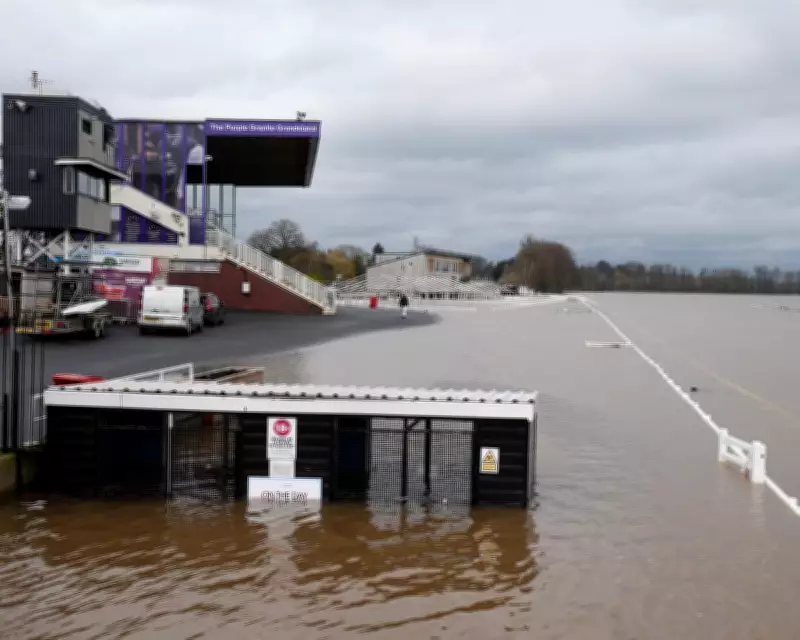
UK Flood Crisis: Record Rainfall and Climate Change Impacts
Flood waters have engulfed Worcester racecourse this week, highlighting the severe weather conditions sweeping across the United Kingdom. In a startling meteorological pattern, Astwood Bank in Worcester has recorded rainfall on every single day of the year so far, underscoring the persistent and unyielding nature of the current wet spell.
Unprecedented Rainfall Statistics
The United Kingdom has experienced what experts describe as a "miserable and relentlessly wet" start to the year, with precipitation falling in various regions daily for weeks on end. According to the UK Met Office, Northern Ireland endured its wettest January in 149 years, while southern England recorded its sixth wettest January since records began in 1836. The south-west of England saw 56% more rain than the long-term average, with the south-east and central south regions experiencing an astonishing 88% increase above normal levels.
Specific locations such as North Wyke in Devon, Cardinham in Cornwall, and Astwood Bank in Worcester have all documented rainfall on each day of the year to date. Jess Neumann, a hydrologist at the University of Reading, commented on the situation, noting the difficulty in recalling the drought conditions and hosepipe bans that affected large parts of the UK merely a few months ago.
Meteorological Causes Behind the Deluge
The continuous rainfall is attributed to a rapid succession of separate weather events. January witnessed storms Goretti, Ingrid, and Chandra battering the UK with back-to-back rounds of precipitation, leading to saturated soils across numerous areas. Neil Armstrong, a chief forecaster for the Met Office, explained that repeated bands of rain sweeping in from the Atlantic have created increasingly waterlogged ground.
A key factor is a southward shift of the jet stream, a fast-flowing air current that has steered low-pressure systems towards the UK. Armstrong detailed that cold air plunges across North America have strengthened the temperature gradient over the north-west Atlantic, energising the jet stream. Additionally, a blocking high-pressure system over northern Europe has prevented weather fronts from clearing, causing them to stall over the UK and prolong the rainfall.
Broader European Impacts
This shift in the jet stream has also had devastating consequences in Spain and Portugal, where severe floods have resulted in fatalities and forced thousands to evacuate their homes. Storm Leonardo, which merged with an atmospheric river carrying tropical moisture from the Caribbean, was followed by Storm Marta over the weekend, claiming two lives. While the low-pressure systems in the UK have not intensified as rapidly, they have been sufficiently strong to break daily rainfall records in several locations.
Climate Crisis and Future Projections
Scientists are increasingly linking these extreme weather patterns to the climate crisis. Fossil fuel pollution is believed to be making the jet stream wavier, allowing extreme weather systems—from heavy rainfall to heat domes—to become stuck in one place, causing significantly more damage than if they moved freely. Such blocking systems are projected to increase under medium- and worst-case emissions scenarios.
Global heating exacerbates the situation by enabling the atmosphere to hold more moisture—approximately 7% for every 1°C increase—contributing to wetter winters in the UK that are occurring two decades earlier than regional climate models predicted. Although January saw slightly cooler temperatures due to Arctic air, the high monthly rainfall totals resulted more from persistence and duration rather than intensity.
Looking ahead, climate breakdown is expected to lead to wetter winters and drier summers in the UK. Despite the challenges, there is a silver lining: the recent rainfall has helped move UK water resources to recovery status. Neumann highlighted that England is now free from drought for the first time since May, with reservoirs and aquifers gradually restocking to healthy levels.



