
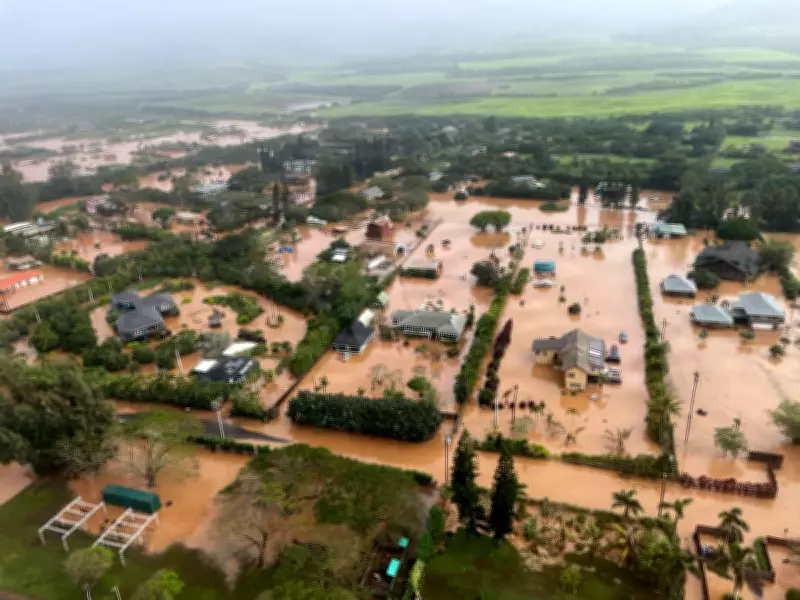
Hawaii's Worst Flooding in Decades Forces Mass Evacuations as Dam Threat Looms
Hawaii is grappling with its most severe flooding event in more than two decades, prompting urgent evacuation orders for thousands of residents as relentless rains continue to batter the islands. Officials have issued stark warnings for people in hard-hit areas of Oahu and Maui to "LEAVE NOW" amid rising waters that have already caused extensive damage and put critical infrastructure at risk.
Immediate Threats and Evacuation Orders
The emergency intensified early Saturday as heavy rainfall fell on soil already saturated from a winter storm the previous week. Muddy floodwaters have engulfed vast stretches of Oahu's North Shore, a region famous for its big-wave surfing culture. Raging waters have lifted homes and cars, leading to evacuation orders for approximately 5,500 people north of Honolulu.
Authorities have expressed grave concerns about the potential failure of the 120-year-old Wahiawa dam, located about 17 miles northwest of Honolulu on Oahu. An emergency alert stated, "The remaining access road out of Waialua is at high risk of failure if rainfall continues." Water levels in the dam, which has been vulnerable for decades, receded briefly on Friday only to rise again with overnight rain, keeping the threat alive.
Maui's Additional Vulnerabilities
On the island of Maui, the situation is particularly dire in Lahaina, a community still recovering from a deadly 2023 wildfire. Authorities upgraded an evacuation advisory to a warning for some parts of the area because retention basins are nearing capacity. This compounding disaster highlights the ongoing challenges facing Hawaii's most vulnerable communities.
Governor Josh Green emphasized the severity of the crisis, stating that the cost of the storm could exceed $1 billion, including damage to airports, schools, roads, homes, and a hospital in Kula, Maui. "This is going to have a very serious consequence for us as a state," Green said at a news conference, adding that his chief of staff has received assurances of federal support from the White House.
Human Stories Amid the Chaos
Personal accounts from residents paint a vivid picture of the flooding's impact. Racquel Achiu, a Waialua farmer who stayed to care for her livestock, described finding her goats in knee-high water on Thursday night. An hour later, her family's seven dogs were in danger of drowning in an elevated kennel, prompting her nephew and son-in-law to brave chest-high water for a rescue.
"My dogs' heads were literally just sticking out of the water," Achiu recalled. "There was so much water, I cannot even express." Despite moments of receding waters and blue sky that heartened some North Shore residents who didn't evacuate, meteorologists warned that more rain was imminent.
Meteorological Context and Climate Connections
The flooding has been driven by winter storm systems known as "Kona lows," characterized by southerly or south-westerly winds that bring moisture-laden air. These systems have been responsible for deluges over the past two weeks. Parts of Oahu have received 8 to 12 inches (20 to 30 centimeters) of rain, falling on already saturated land that cannot absorb more water.
Experts note that the intensity and frequency of heavy rains in Hawaii have increased amid human-caused global heating, suggesting that such extreme weather events may become more common. The current flooding represents the state's most serious since 2004, when homes and a University of Hawaii library were swamped.
Response and Recovery Efforts
Emergency crews have conducted extensive search and rescue operations, saving more than 200 people from rising waters. Fortunately, no deaths have been reported, and all individuals are accounted for. However, dozens and potentially hundreds of homes have been damaged, with officials yet to complete a full assessment of the destruction.
Molly Pierce, a spokesperson for Oahu's department of emergency management, noted that while the dam threat had somewhat diminished by Saturday morning, the "breadth of hazardous conditions" across the island remained concerning. She observed substantial flooding even in residential parts of Honolulu and cautioned residents against complacency.
"We're seeing the waters receding in a lot of places, but again with that saturation, just the smallest amount of water can bring those raging back up," Pierce explained. "So even if it's blue skies where you are, I think we all know in Hawaii that if rain is falling on the mountain, it's coming to you soon enough."
Tina Stall, a meteorologist with the National Weather Service in Honolulu, echoed this warning: "Don't let your guard down just yet. There's still potential for more flooding impacts." As Hawaii faces this unprecedented weather crisis, the state braces for continued challenges while beginning to assess the long-term implications of what may become one of its costliest natural disasters in recent memory.



