
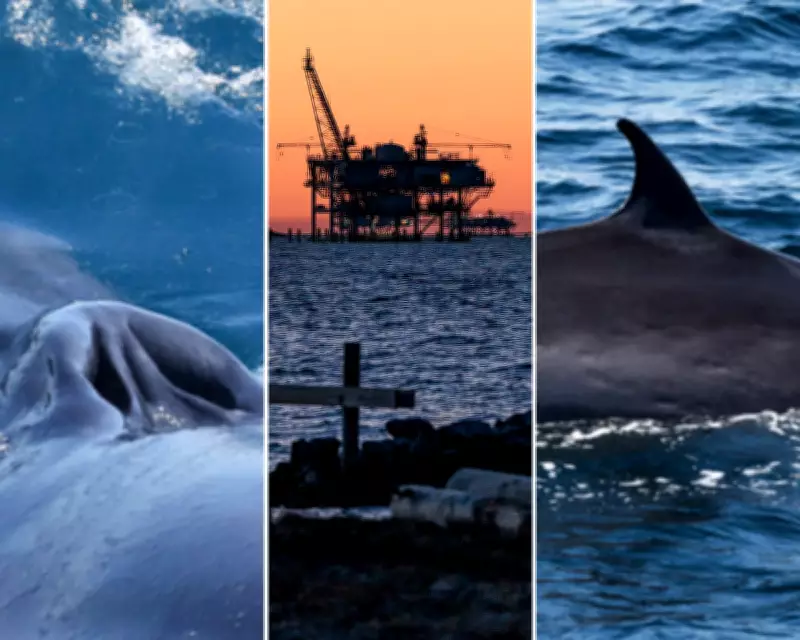
Trump Administration's 'God Squad' Endangers Rice's Whale with Drilling Exemption
For millennia, long before the dawn of modern humanity, Rice's whales have thrived in the depths of the ocean, growing to the size of a bus and weighing as much as six elephants. These majestic baleen whales have navigated the Gulf of Mexico, feasting on fat-rich fish in their secluded habitat. However, their ancient existence now faces an unprecedented threat from human activity, as the Trump administration has taken drastic steps that could lead to their extinction.
A Dire Population and Industrial Encroachment
Today, only about 50 Rice's whales remain on Earth, confined to a small, heavily industrialized patch of the Gulf of Mexico. This area has become a hotspot for the oil and gas industry, with clanging aquatic highways of boats and shifting drilling infrastructure encroaching on their habitat. The whales, which rest at the sea surface at night, are particularly vulnerable to deadly vessel strikes and noise pollution from seismic surveys, pipelines, and drilling operations.
In a closed-door meeting that lasted barely 15 minutes, six Trump administration officials convened the Endangered Species Committee, informally known as the "God Squad," to exempt the oil and gas industry from complying with endangered species laws in the Gulf. This panel, which holds the power to decide the fate of species, has only been convened three times since its inception, not since 1992.
National Security Rationale and Industry Response
Pete Hegseth, the Secretary of Defense, invoked "national security" as the rationale for this exemption, marking the first time such a justification has been used since the passage of the Endangered Species Act in 1973. Hegseth argued that restricting energy production in the Gulf could undermine domestic oil output, citing recent hostile actions by Iran as a security imperative. Doug Burgum, the Interior Secretary, echoed this sentiment, emphasizing that energy streams must not be disrupted by litigation.
As a result, the Rice's whale, listed as endangered in the U.S. and critically endangered internationally, will lose modest safeguards such as speed limits for boats in whale habitat and monitoring requirements during exploratory work. The oil and gas industry, while not having requested the exemption, has welcomed the move. Andrea Woods, spokesperson for the American Petroleum Institute, stated that the industry has a long track record of protecting wildlife while meeting energy demand.
Historical Context and Conservation Concerns
The Rice's whale was only recognized as a separate species in 2021, distinct from the Bryde's whale due to genetic and skull shape differences. Its precarious situation became immediately apparent, with a tiny population restricted to a busy industrial zone. Jeremy Kiszka, a marine mammal expert at Florida International University, describes the species as a "bougie eater," preferring fatty fish found at great depths, making it highly vulnerable to environmental changes.
If the Rice's whale goes extinct, it would mark the first loss of a whale species in North American waters in 300 years, since the gray whales were wiped out in the 1700s. Pat Parenteau, an environmental law expert at Vermont Law School, expressed shock at the decision, calling it "beyond belief" and a potential black mark on the nation's legacy. He warned that if upheld, this could set a precedent for using national security to justify various environmental harms.
Legal Challenges and Future Implications
Environmental groups have filed lawsuits to reverse the God Squad's ruling, arguing it is illegal and lacks due process. Parenteau emphasized that courts are unlikely to accept the national security justification without proper review. If the decision stands, it could pave the way for similar exemptions in other industries, from timber sales to AI datacenters, further endangering wildlife.
Dan Snyder, director of the Environmental Enforcement Project, lamented the potential outcome, stating that the government has "voted to knowingly eradicate every member of an entire whale species from our planet" for minimal benefit, such as allowing oil tankers to travel slightly faster. As the legal battle unfolds, the fate of the Rice's whale hangs in the balance, with conservationists urging immediate action to prevent a tragic loss of biodiversity.



