
Record Antarctic Krill Haul Threatens Fragile Ecosystem
About 620,000 tonnes of krill were trawled in the Antarctic last year, representing a record haul that has environmental experts deeply concerned about the long-term consequences for this delicate marine ecosystem. While the fishery operates under regulatory oversight, marine biologists and conservationists argue that the industrial-scale operations are systematically wrecking the foundational food chain that supports Antarctica's unique wildlife.
Frigid Waters, High Stakes Mission
On the deck of the Allankay, Sea Shepherd's research vessel, the bitter cold presents immediate dangers. Bosun Luca Massari, a heavily tattooed veteran of the environmental organization, carefully checks that none of the crew members are wearing contact lenses before they descend into Antarctic waters. "There is a risk," he warns, "that lenses will freeze solid over the eyes." Massari himself wears thick goggles that give him the appearance of an Olympic ski jumper, prepared for the extreme conditions.
Eight crew members bundle into bright red dry suits, helmets, and lifejackets as they prepare to launch the ship's small boat. In these wind-whipped waters, the average survival time for hypothermia is just five minutes, making every precaution essential. The team is positioned in the waters off Coronation Island in the South Orkney Islands, a glaciated 25-mile finger of jagged mountain slopes located a day's sail from the Antarctic peninsula.
The Krill Conundrum: Commercial Value Versus Ecological Cost
Sea Shepherd contends that this remote location hosts one of the most inaccessible and environmentally ruinous industrial workplaces on Earth. The focus is on fishing for krill – the small, shrimp-like marine crustaceans (Euphausia superba) that feed on plankton and serve as the primary food source for larger marine animals throughout the Antarctic region.
These tiny creatures hold enormous commercial value, processed into ruby-red fish oil capsules sold in health food stores worldwide and used as fishmeal to give farm-fed salmon its characteristic pink hue. The global krill trade is valued at more than $450 million annually, creating powerful economic incentives for continued exploitation.
While the fishery is legal and regulated by the Commission for the Conservation of Antarctic Marine Living Resources (CCAMLR), which sets an annual quota of 620,000 tonnes, environmental organizations argue that the current regulatory framework fails to adequately protect the ecosystem. Ships from multiple nations compete aggressively to secure the largest and most lucrative share of this quota before the cap is reached.
Scientific Evidence Points to Ecological Damage
The Antarctic ecosystem relies fundamentally on krill as a foundational food source for the region's birds, penguins, seals, and whales. A peer-reviewed scientific study from a coalition of US and German universities suggests that the current number of krill in the ocean is insufficient to sustain both the existing whale population and commercial fishing operations simultaneously.
Additional research indicates troubling trends:
- Humpback whales are breeding less frequently
- Several penguin species show declining reproduction rates
- Krill populations serve as "carbon-storage powerhouses" according to WWF research, meaning fewer krill translates to more carbon dioxide released into the atmosphere
Documenting the Industrial Fleet
The Allankay, which sailed 34 days from New Zealand by way of Argentina to reach Coronation Island, has undertaken the mission to document krill fishing operations firsthand. Once Massari's small boat receives permission from the Allankay's captain to set down on Antarctic waters, the team begins their slow descent. Even with an experienced operator controlling the winch, the boat shudders violently as it hits the waves.
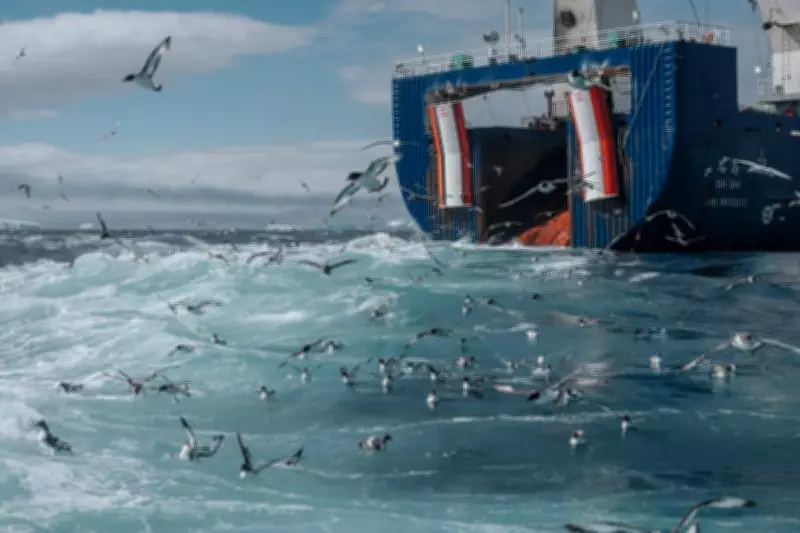
Immediately, the small vessel is dwarfed by twelve giant ships comprising the krill fleet, flying flags from China, Chile, Norway, South Korea, and a Ukrainian vessel registered in Namibia. The scene presents a surreal fusion of nature and industrial humanity: vessels load throbbing green nets resembling 20-meter sausages crammed with krill into their holds, while albatrosses and hundreds of petrels with distinctive black and white wings swoop in their wake. Whales' flukes peek above the water, and baby penguins leap alongside like butterfly swimmers.
"The smell of these krill trawlers is like a rancid fish and chip shop," says Luci Connelly, an Australian deckhand navigating Massari's small boat. As the team barrels closer, showered by spray, Connelly's description becomes increasingly apt.
Sea Shepherd's Two-Pronged Campaign
The Sea Shepherd campaign operates on two distinct stages. The current mission represents the first: a fight for attention in an era where social media visibility is crucial. Massari pilots the small boat with practiced ease so photographers and videographers can capture compelling footage of the industrial operations.
The small boat crests past icebergs with bluish tinges to edge close to three Chinese-flagged vessels operating in close proximity. The main vessel is the Fu Yuan Yu 9199, a new 139-meter Chinese factory ship that trawls for krill, processes them into various products, and packs them for shipment via adjacent vessels. As the Sea Shepherd team bobbed in its wake, a crane ferried packaged crates of krill meal between ships, while a third vessel provided fuel bunkering services.
While orange-clad workers on the Chinese ships ignore the observers, crew on other vessels wage their own information campaigns. Two Norwegian supertrawlers, Antarctic Sea and Antarctic Endurance, unfurl banners with messages including "Congratulations on the High Seas Treaty" and "Science First," along with the website address for Aker Biomarine, a company that supplies krill as an ingredient in health products.
Regulatory Challenges and Conservation Concerns
The ultimate goal of Sea Shepherd's latest campaign is to stop all krill fishing in the Antarctic, an epic challenge considering CCAMLR operates on a consensus-based model. Its membership includes the very countries trawling around Coronation Island, creating inherent conflicts of interest that have prevented consensus on meaningful conservation measures.
In a statement, CCAMLR maintains: "While most members voiced an urgent need to distribute the catch to avoid over-concentration at the commission's last session in October 2025, to date there has been no scientific evidence to suggest any specific threat to krill as a keystone species or to Antarctic marine ecosystems more broadly." At that same meeting, Norway proposed almost doubling the catch trigger limit.
For Sea Shepherd and environmental scientists, the industry's expansion is outpacing the time needed to gather comprehensive data to assess the full consequences of the trade. "Without robust evidence to assess ecological impacts, the push to raise catch trigger limits risks irreversible damage to one of our planet's last true wildernesses," warns Baptiste Brebel, the Allankay's chief officer.
As Massari zips the boat back to the relative shelter of the Allankay and Connelly attaches the winch for their ascent, the team reflects on their mission. The Allankay feels like firm ground after hours bobbing on the small boat in treacherous waters. Massari expresses excitement about the footage captured by the camera crew, noting: "Every small boat journey helps our wider mission." Their twin efforts harnessing media attention and scientific research in these frigid waters aim to head off what they believe represents a tipping point for the region's krill populations and the entire Antarctic ecosystem that depends on them.



