
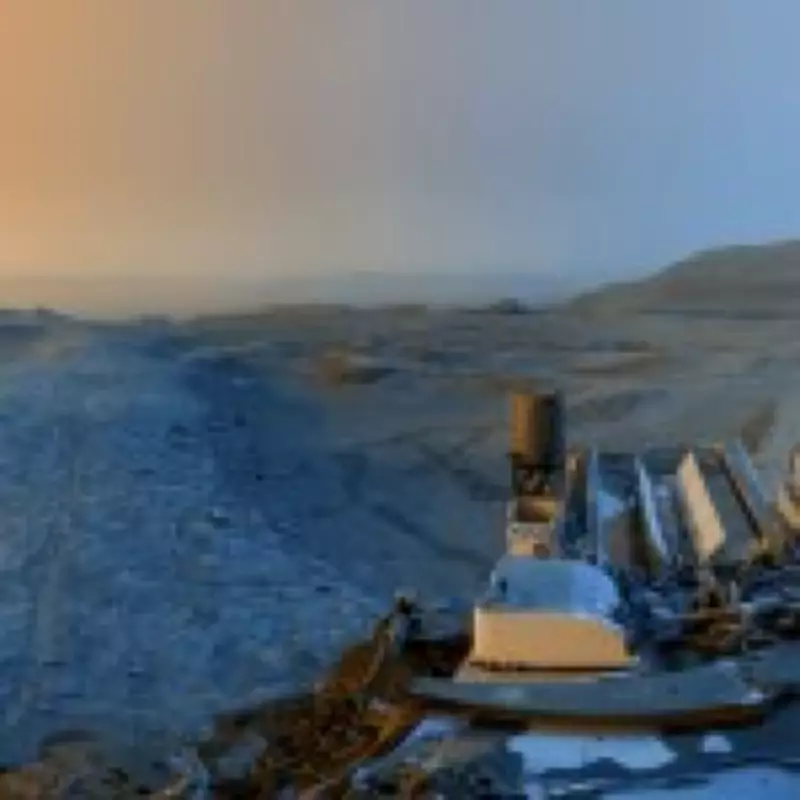
NASA's Curiosity Rover Uncovers Mysterious Egg-Like Structures on Mars
In a groundbreaking discovery, NASA's Curiosity rover has identified mysterious never-before-seen egg-like structures on the Martian surface, shedding new light on the planet's geological history and potential for past life. The rover has been meticulously investigating spider-web-like rock formations, known as 'boxwork', on the slopes of Mount Sharp within Gale Crater, capturing images that reveal small, rounded spheroids scattered across these intricate ridges.
Unprecedented Geological Features
Over the past eight months, Curiosity has closely examined these interconnected rocky ridges, which span an area up to 12 miles (20 kilometers) wide. Scientists believe these structures formed billions of years ago when groundwater flowed beneath the Martian surface, depositing minerals that later hardened into ridges as surrounding rock was eroded by wind. From orbit, the formations resemble enormous spiderwebs etched into the landscape, first identified by spacecraft in 2006 but largely unexplored until Curiosity's arrival.
For about six months, the rover has traversed the low ridges, standing roughly three to six feet (one to two meters) tall, with sandy hollows in between. The patterns suggest groundwater was present in this region later in Mars' history than previously thought, raising fresh questions about how long microbial life might have survived on the planet. Researchers theorize that water once flowed through fractures in the bedrock, leaving minerals behind that strengthened certain areas to form ridges, while surrounding rock without reinforcement gradually wore away.
Surprising Discoveries and Scientific Analysis
As Curiosity climbed higher up Mount Sharp, rising about 3 miles (5 kilometers) above the crater floor, rock layers revealed evidence of Mars' changing climate, with higher layers indicating increasingly dry conditions interrupted by occasional wet periods. Tina Seeger of Rice University, leading the investigation, noted, 'Seeing boxwork this far up the mountain suggests the groundwater table had to be pretty high. And that means the water needed for sustaining life could have lasted much longer than we thought looking from orbit.'
Curiosity's close-up investigations confirmed that dark lines in the spiderweb-like patterns are indeed fractures where groundwater once flowed. Additionally, the rover identified small, bumpy egg-like features known as nodules, clear signs of past groundwater activity. Surprisingly, these nodules were found along the sides of ridges and in hollows, rather than near central fractures. Seeger explained, 'We can't quite explain yet why the nodules appear where they do. Maybe the ridges were cemented by minerals first, and later episodes of groundwater left nodules around them.'
Advanced Techniques and Future Explorations
Curiosity has drilled several rock samples from the region, analyzing powdered material using X-rays and high-temperature ovens. Results revealed clay minerals in the ridges and carbonate minerals in the hollows, offering further clues to the formations' development. A more recent sample was analyzed with a specialized wet-chemistry technique designed to detect organic compounds, carbon-based molecules crucial to the origins of life.
The rover is expected to leave the boxwork region in March and continue exploring a wider sulfate-rich layer of Mount Sharp. Scientists hope this ongoing mission will provide deeper insights into how Mars' climate evolved billions of years ago, transforming from a planet with flowing water into the cold, dry world observed today. This discovery not only enhances our understanding of Martian geology but also fuels the search for signs of ancient life beyond Earth.



