
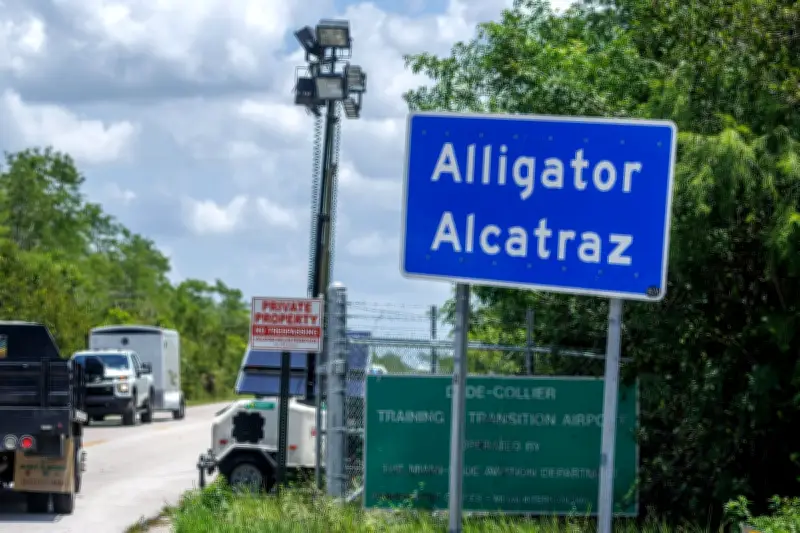
Environmental groups and immigrant-rights advocates are demanding an independent investigation into the environmental damage inflicted by the now-closed Alligator Alcatraz migrant detention center in Florida's Everglades. The facility, which operated for 12 months, was shut down on Thursday, but concerns about its lasting impact on the surrounding wilderness persist.
Press conference at the detention center
At a news conference on Friday outside the entrance to the shuttered facility, Eve Samples, executive director of Friends of the Everglades (FOE), condemned the camp as a “failure, an obscene waste of taxpayer dollars and an abuse of the Everglades.” Her nonprofit filed a lawsuit in June 2025 seeking to halt construction at the site, with the Miccosukee Tribe joining the suit to defend tribal rights. The $608 million facility was built to detain undocumented immigrants during the second Trump administration's immigration crackdown.
Trump administration officials had repeatedly denied requests by environmental organizations to access the premises. However, during four days of hearings in a federal courthouse in Miami in August, FOE presented evidence of significant environmental harm, including the paving of 20 acres (8 hectares) without permits and the installation of new fencing and high-intensity lighting. The bright lights were shown to impact an estimated 2,000 acres (800 hectares) of Florida panther habitat, as the big cats are displaced by unnatural lighting during their nocturnal movements.
Ongoing environmental concerns
Speakers at Friday's news conference noted that despite the closure, hazardous materials continue to be trucked into the former premises, while vehicles containing human waste are still leaving the site. Florida Governor Ron DeSantis, who announced the formal shutdown on Thursday, rejected criticism of the decision to hire sanitation vendors to haul away waste. He maintained that the high construction cost was partly due to the facility's design as a “self-contained” unit, stating, “They did a really good job of keeping this contained so that it didn’t have that impact on the surrounding environment.”
Alligator Alcatraz was built in the middle of the Everglades ecosystem, opposite an airstrip about 45 miles (70 km) west of downtown Miami. The site, which deported 21,000 people, is surrounded by the Big Cypress National Preserve, a 720,000-acre swamp run by the US National Park Service. The preserve is home to alligators, crocodiles, eastern diamondback rattlesnakes, bobcats, coyotes, and Florida panthers, whose population is believed to be about 200.
Human toll highlighted
The human toll of the detention center was also highlighted by Ana María Hernández, civic engagement director for the Florida Immigrant Coalition. Hernández, a native of Medellín, Colombia, who immigrated to the US at age 10, described witnessing the cruel nature of the Trump administration's immigration campaign. Her cousin's Cuban husband, referred to only as Wilson, entered the US at the beginning of the century and was granted a work permit under the Cuban Adjustment Act. He had been renewing his legal status annually for 25 years.
In January, Wilson's routine visit to ICE offices in Miramar resulted in his arrest and transfer to Alligator Alcatraz. The reasons for his detention were never explained. During his stay, he was allowed to shower only every three or four days, and on one occasion was issued men's underwear with feces staining the garment. After his initial 20-day internment, Wilson spent more than five months being shunted between Alligator Alcatraz and lockups in Texas and Louisiana before being released in June.
Hernández said the experience shattered her trust in her adopted homeland. “In Florida people are being detained because of the color of their skin or because they speak English with an accent,” she said. “This is how people who have legal status or are US citizens end up in custody.”



