
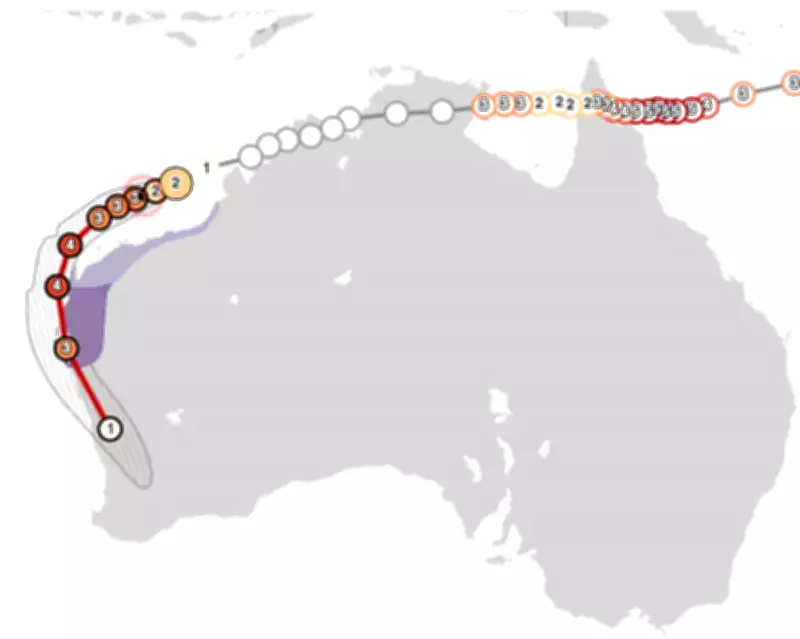
Tropical Cyclone Narelle's Unprecedented Journey Across Australia
In a remarkable meteorological event, Tropical Cyclone Narelle carved a historic path across Australia, becoming the first storm system in more than two decades to make landfall in three separate states and territories. This rare occurrence has captured the attention of climate scientists and historians alike, highlighting the evolving nature of extreme weather patterns in the region.
A Storm of Unusual Proportions
Narelle's journey began in far north Queensland, where it struck as a powerful category 4 cyclone, unleashing severe winds and heavy rainfall on local communities. From there, it moved westward, impacting the Northern Territory as a category 3 storm before continuing its trajectory across the continent. By the time it approached Perth, likely passing east of the city, Narelle had traveled an astonishing distance of over 5,500 kilometers, equivalent to approximately 3,400 miles.
This looping path is highly atypical for cyclones in Australia. According to Dr. Milton Speer, a fellow at the University of Technology Sydney and former Bureau of Meteorology forecaster, such storms are historically rare. "Instead of following the typical tropical easterly trade winds, they get captured by mid-latitude westerly winds," he explained. "This causes them to curl around and move southward, often at a faster pace once captured." The exact trajectory depends on complex upper-level wind patterns in the Earth's troposphere, where weather phenomena occur.
Historical Context and Rarity
Narelle joins an exclusive list of cyclones that have made multiple landfalls in Australia, with the last similar events being Cyclone Ingrid in 2005 and Cyclone Steve in 2000. Dr. Joseph Christensen, a historian at the University of Western Australia who studies cyclones, noted the uniqueness of Narelle's path. "It's very unusual, and we only know of one or two precursors with any certainty," he said. He also pointed out that reliable meteorological data for cyclones in Australia only dates back to the 1970s, making it difficult to assess how often such events occurred historically.
Typically, West Australian cyclones form in the Timor Sea off the Kimberley coast and move in a south-easterly direction. Narelle, however, took almost the opposite route, traveling from east to west, which further underscores its exceptional nature.
The Role of Global Heating
Climate scientists have raised concerns about the potential influence of global heating on Narelle's formation and trajectory. Record ocean temperatures in the Coral Sea, where the cyclone initially developed, likely played a significant role. Andrew Watkins, an adjunct professor at Monash University and a councillor with the Climate Council, highlighted that the Coral Sea has experienced unprecedented warmth in recent months, including its hottest December, February, summer, and calendar year on record.
Cyclones require ocean temperatures above 26.5 degrees Celsius to form, along with favourable atmospheric conditions. The elevated sea temperatures provided an ideal environment for Narelle to intensify rapidly. Dr. Speer added that global heating is making cyclones more likely to travel long distances from east to west, as there are fewer westerly winds near the equator. Additionally, a warmer atmosphere can hold more moisture, potentially leading to increased rainfall from such storms.
This event serves as a stark reminder of the interconnectedness of climate change and extreme weather, urging continued research and monitoring to better understand and mitigate future risks.



