
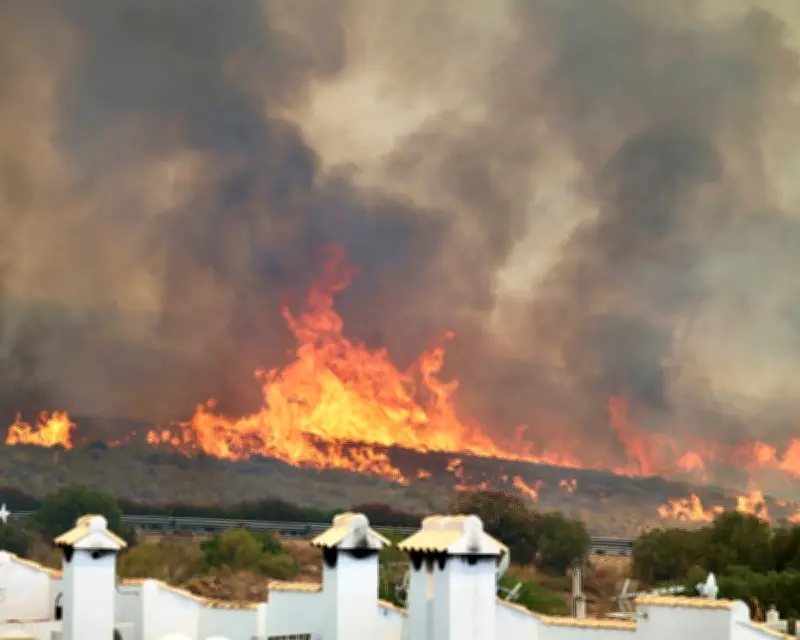
At least 12 people died in a fast-spreading wildfire in Almería, southern Spain, on Thursday, as a heatwave and strong winds fueled the blaze. The fire scorched 3,800 hectares (9,390 acres), trapped many in their cars, and left eight injured and 23 unaccounted for, according to authorities.
Deadly smoke a greater threat than flames
While the confirmed deaths in Andalucía are tragic, far more fatalities are caused by the thick black smoke from wildfires. A 2024 study found that lung-scarring pollution from wildfires kills 1.53 million people annually. Separate research indicates that a severe fire season in one country, such as Canada in 2023, can lead to tens of thousands of deaths worldwide as toxic particles are carried across oceans.
Last year's record-breaking wildfires in the Iberian peninsula, which killed eight in Spain and six in Portugal, produced enough smoke to cause 2,000 premature deaths, according to a preprint study released last month.
Conditions that fueled the blaze
Reports suggest the fire may have been sparked by a fallen power line. A hot summer turned vegetation into dangerous fuel, following a wet winter and spring that boosted plant growth. Guillermo Rein, a fire scientist at Imperial College London, said: "The Los Gallardos wildfire in Almería appears to have faced the worst possible combination: a point of ignition in a vast landscape of extremely dry vegetation, strong winds, and a nearby community that was unprepared."
Western Europe is enduring its third heatwave in two months, and this year's fires are among the deadliest in Spanish history. Data from the European Forest Fire Information System shows that the burned area is double the usual for this time of year, with triple the number of fires and above-average emissions.
Rural depopulation exacerbates fire risk
The steep terrain of the Sierra de Bédar, with its ravines, facilitates rapid fire spread. Temperatures reached nearly 42°C after several days above 35°C. Gustavo Saiz, a senior scientist at the National Institute for Agricultural and Food Research and Technology, noted: "In this area, just a few weeks without rain during the summer are enough for fine fuels to reach very high levels of flammability."
The hollowing out of rural Spain, with aging populations and young people moving to cities, has alarmed fire experts. Vegetation overgrowth, combined with a political tendency to suppress fires rather than prevent them, encourages large fuel build-ups that make mega-fires more likely.
Juan Picos, a forest fire scientist at the University of Vigo, commented: "The inertia of the two major processes that have brought us to the current situation – land abandonment and climate change – is enormous. Even if we begin implementing ambitious measures immediately, conditions are likely to continue worsening for some time before any significant improvement becomes apparent." He compared the shock at increasingly "unprecedented" wildfires to someone climbing a mountain and being surprised each day at a new height: "If they continue climbing, they will almost certainly say exactly the same thing again tomorrow."



